

Original article ISPreview UK:Read More
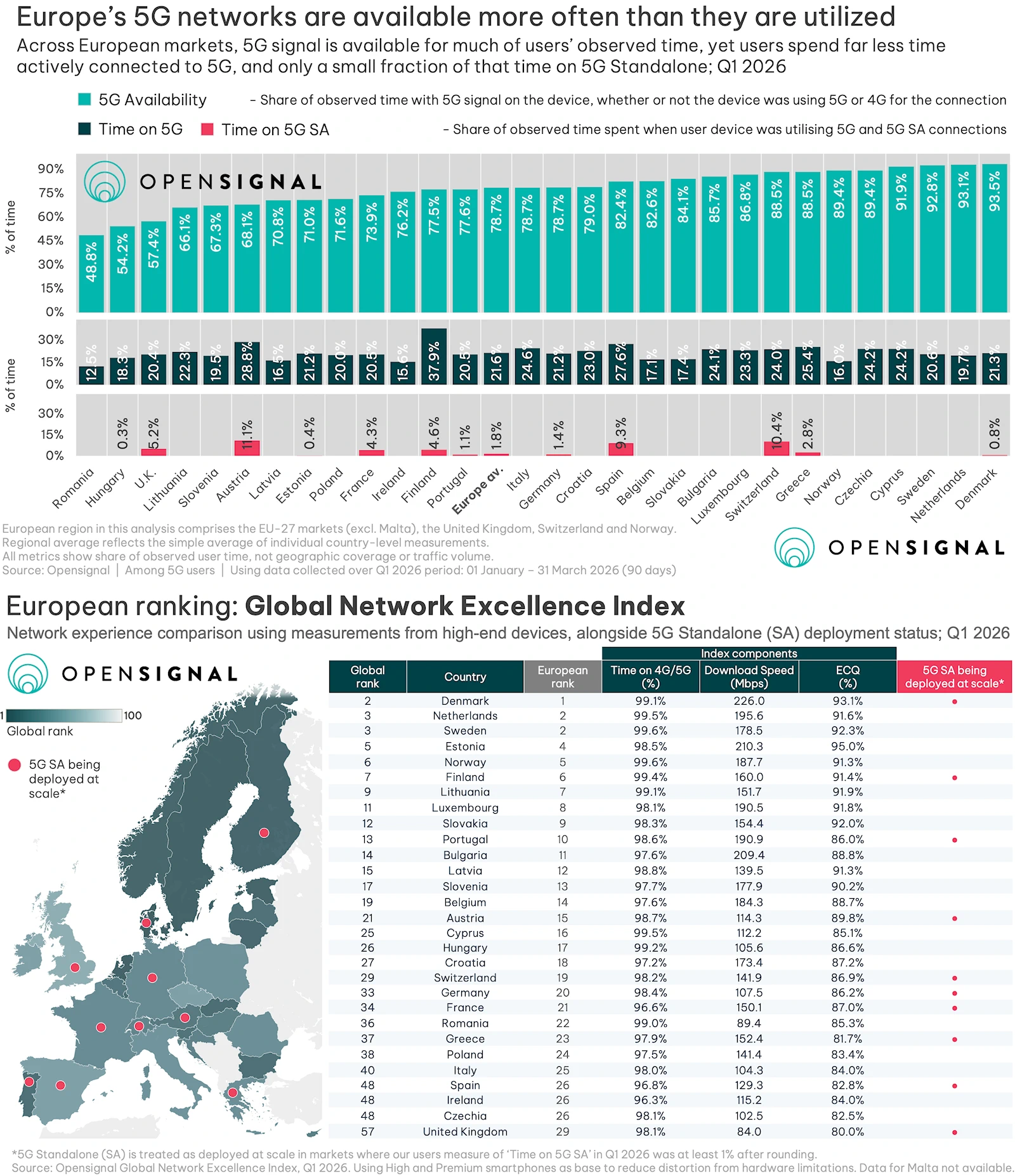
Network benchmarking firm Opensignal has this morning published their latest analysis of 5G non-standalone mobile (mobile broadband) and 5G Standalone (5G+) availability and performance across Europe. The results rank the UK last in Europe with average download speeds one-third of Denmark’s and the lowest Excellent Consistent Quality score in the region.
As usual the data in this report is based off crowdsourced testing, which has been gathered by users of Opensignal’s app on millions of devices (Smartphones etc.). The analysis draws on data collected during Q1 2026 – covering 29 European markets, encompassing the EU-27 (excluding Malta), plus the United Kingdom, Norway and Switzerland – collectively referred to as the European region in this study.
Overall, the study found that the “vast majority of connectivity time” in Europe is still over 4G, while wide-scale 5G+ deployment in Europe are localised to just 11 networks and its “most tangible impact” is on network responsiveness. As for the UK, we rank just 29th out of 29 European markets in Opensignal’s Global Network Excellence Index.
The UK ranks last in Europe with average download speeds (84Mbps), coming in at just one-third of front-runner Denmark’s speed (226Mbps), and we also have the lowest Excellent Consistent Quality (ECQ) score in the region (80% in the UK vs 93.1% in Denmark). In addition, 5G Availability in the UK is also low at 57.4%, although people in this country do spend more time connected to 5G+ networks (5.2%) than most of the other countries, except Spain on 9.3% and Switzerland on 10.4%.
In short, 5G+ is only just beginning to take hold, and only among a select group of operators. Across the region, 5G users spent just 1.8% of their connection time on 5G+ in Q1 2026, a figure that masks a wide gap between a handful of leaders and everyone else. Looking at individual mobile operators in the UK, the ‘Time on 5G+‘ score for EE’s (BT) customers was 8.3%, then 5.3% for O2 (Virgin Media) and 4% for Vodafone (Vodafone and Three UK).
The study also examines what kind of mobile broadband performance improvement 5G+ delivers when compared with 4G and regular 5G (NSA). Overall, 5G+ users recorded average download speeds of 180.2Mbps against 153.2Mbps on 5G NSA, an 18% download uplift; with latency being 17% faster (39.5ms vs 32.6ms); and Consistent Quality (CQ) improving by up 1.6 percentage points (87.8% vs 89.4%).
Sadly Opensignal did not examine upload speeds, which is an usual thing to leave out when considering 5G+. Otherwise, the study noted that the scale of the 5G+ rollout is driven by commercial strategy, not technical capability, and the availability of radio spectrum is no longer considered the limiting factor (most operators now have plenty of it).
Opensignal’s analysis suggests that operators making the strongest moves on 5G+ are disproportionately the ones with the most ground to make up on overall network quality, which certainly seems true for the UK.