Original article ISPreview UK:Read More
Broadband and mobile operator Virgin Media and O2 (VMO2) have this morning set out their new Green Transition Plan, which claims to reveal how it will achieve Net Zero carbon emissions across its full value chain, while reducing its environmental impact, by their current target for the end of 2040.
Admittedly keeping tabs on all these “green” initiatives has become a bit of a choir, particularly when you have operators like VMO2 attaching several different labels for helping to achieve the same thing every few years and months. For example, we had the “Better Connections Plan“ between 2022 and 2025, then we recently had the “Responsible Business Plan” to 2030 (ESG strategy) and now the “Green Transition Plan“.
Suffice to say it can be a real pain to wade through all the waffle, but the focus this time seems to be on “sharing a long-term approach to becoming a low-carbon business“, which admittedly is what we thought the original plan was also attempting to do.
As before, the “new” plan includes a range of measures to decarbonise, support nature recovery, strengthen the resilience of its network infrastructure to climate risks, and drive device reuse and recycling. Once again this mostly seems to consist of summarising the expected impacts of their existing initiatives.
Climate – reducing the impact of our network:
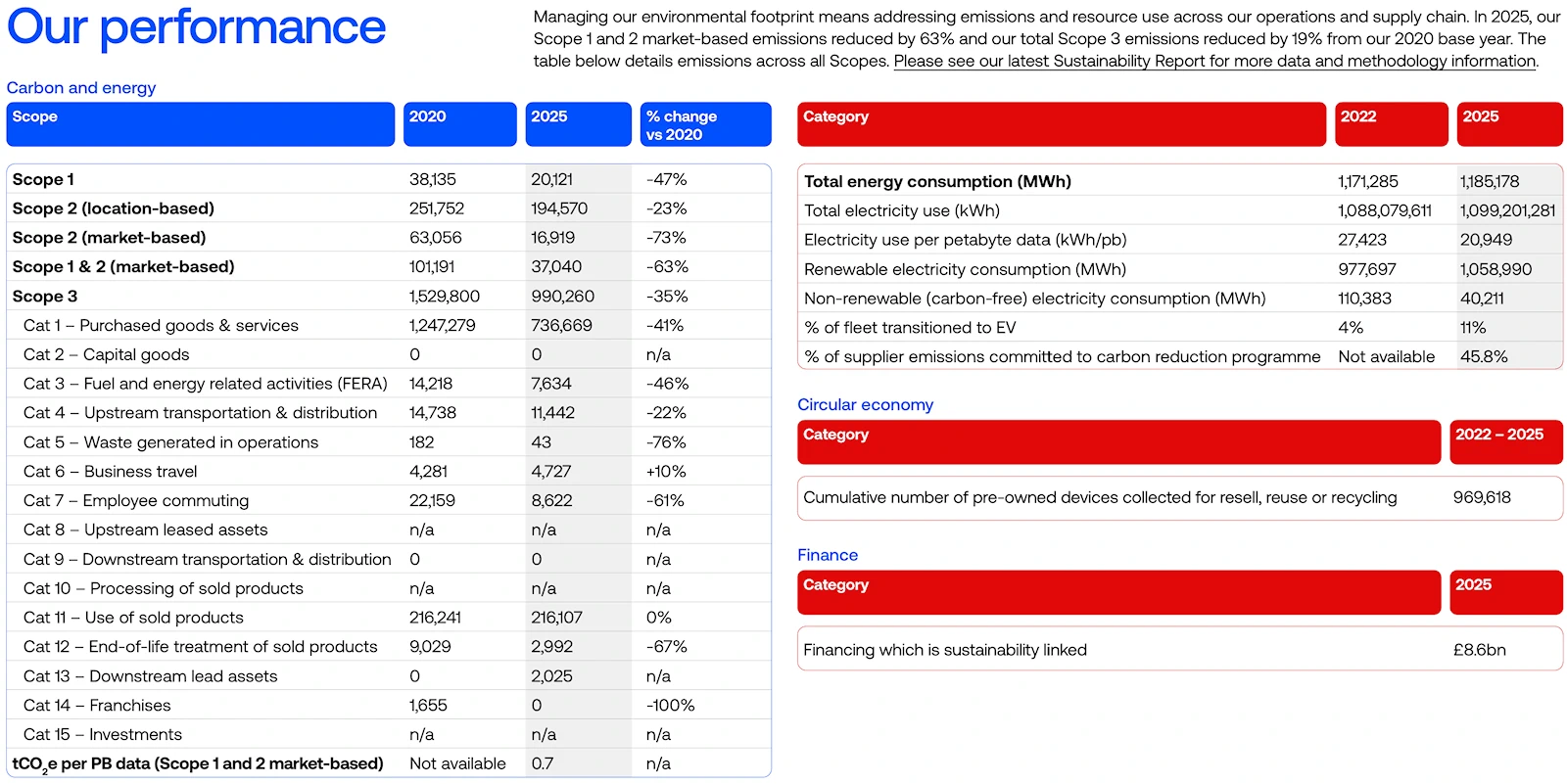
➤ Near-term decarbonisation: By 2030, Virgin Media O2 will reduce Scope 1 and 2 emissions by 90% and Scope 3 emissions by 50%. It has already reduced Scope 1 and 2 emissions by 63% against its 2020 baseline.
➤ Long-term net zero: Achieve net zero carbon emissions across its full value chain by the end of 2040.
➤ Carbon-free power: Support the UK’s energy transition by sourcing 100% carbon-free energy from UK sources and driving energy efficiency across its operations.
➤ Climate resilience: Building and operating more climate-resilient broadband and mobile networks.
Circularity – Extending the life of technology:
➤ Supporting every device to ‘live twice’: Virgin Media O2 will continue to drive the UK’s circular economy so technology, such as smartphones, tablets or consoles, can be given a second life and repaired, recycled or refurbished and sold as ‘like new’ products. This reduces demand for critical materials, supports business resilience and increases customer choice.
➤ Refurbished growth: Aim to double the number of people buying refurbished devices from Virgin Media O2 by 2030.
➤ Recycling: Aim to double the number of people recycling unwanted devices via O2 Recycle by 2030.
➤ Reuse culture: The company will build on its partnership with Coventry City Council by championing a device reuse culture in 30 cities by 2030, supporting programmes and initiatives to keep tech in use for longer and support digital inclusion. This means devices will be reused locally and passed to people who need them, creating social value and preventing electronic waste.
The plan is said to be underpinned by 14 ‘transition levers’ that will help the company reach its goals as quickly and efficiently as possible. These include working with its supply chain to cut carbon and waste from network and customer equipment, sourcing carbon-free energy, improving the energy efficiency of customer devices, and continued investment in its networks which will support the UK’s Net Zero transition.
Dana Haidan, Chief Sustainability Officer at Virgin Media O2, said:
“Our Green Transition Plan is a milestone in Virgin Media O2’s journey to become a more resilient, lower carbon business.
It’s a long-term commitment backed with action across many interconnected areas where we’re working to reach net zero, give technology a second life, and build and operate climate-resilient networks.
Embedding responsible business into every decision Virgin Media O2 makes is key, as we reduce our environmental impact, help protect the planet, and keep our customers connected.”
The new plan does also contain a useful update on the progress that VMO2 has been making toward their target, which we’ve pasted below to save you needing to read through the document.