

Original article ISPreview UK:Read More
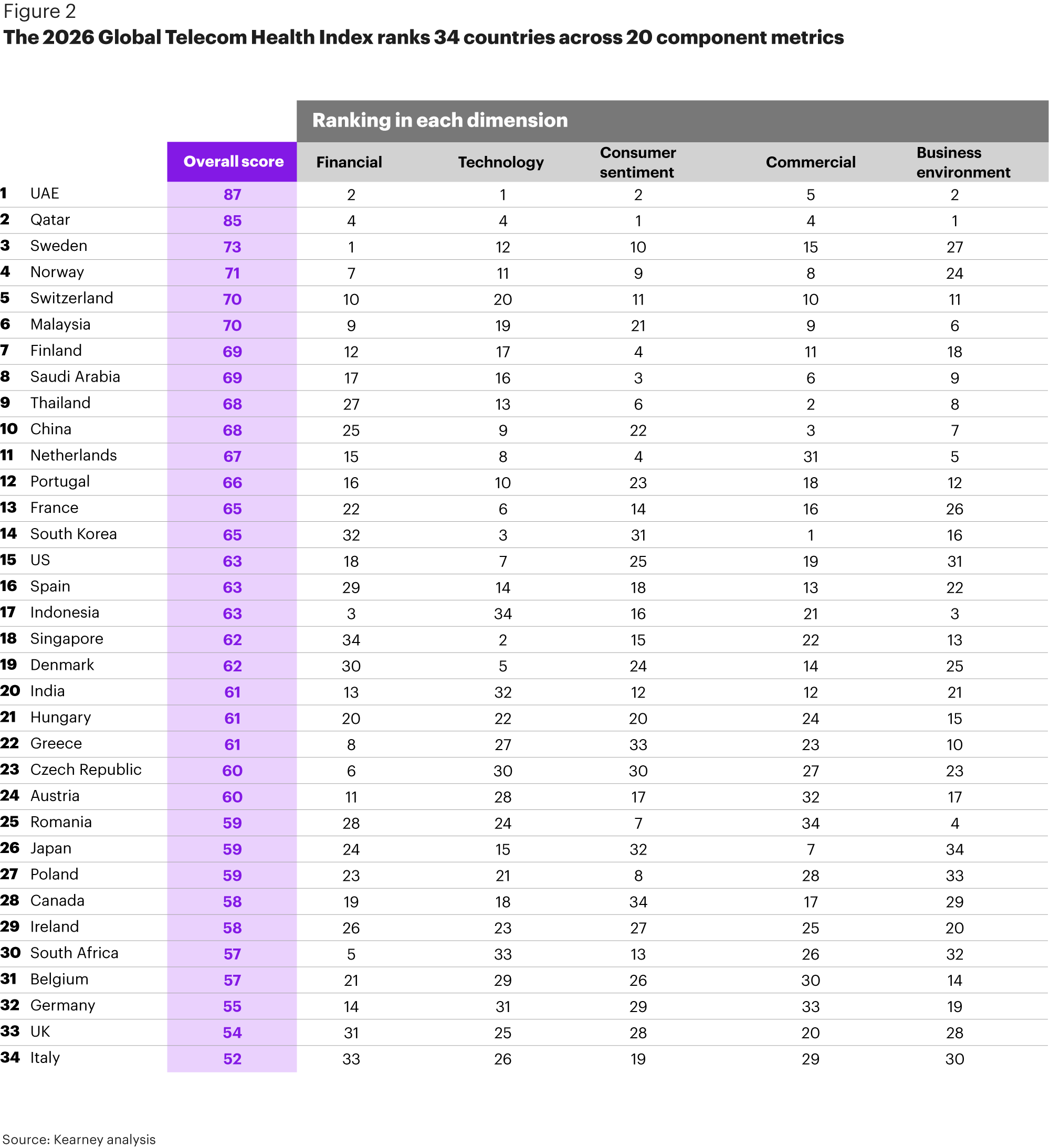
Management consulting firm Kearney has today published their latest annual Global Telecom Health Index, which ranks 34 countries across various metrics in order to measure and compare the health of the telecoms (broadband, mobile etc.) sector on a country-by-country basis. Overall the United Kingdom placed near the bottom on a rank of 33rd.
The index broadly considers five core dimensions (or categories, if you prefer) and 20 individual metrics on a country-by-country basis, including technology (network coverage, speed etc.); customer satisfaction with fixed and mobile services; financial returns (capacity for investment, EBITDA etc.); commercial (spend relative to income, convergence, pricing etc.) and the business environment (level of competition, talent pool etc.).
Unfortunately, the UK ended up ranking in the bottom 10 markets, where low financial scores were common, which typically lead to poor technology deployment and, in turn, lower customer satisfaction. Canada and the UK were thus found to be examples of markets that “rank particularly low on customer sentiment and also rank in the bottom half on technology deployment and commercial dimensions“.
The above is perhaps a nod to the UK’s long delay in deploying full fibre broadband at scale and the many challenges mobile operators have faced in expanding 5G coverage. In the UK, the index also highlights that “mid-contract price rises have become the norm, leading to customer discontent and a value perception gap when paying more for a service that is not seen as having improved” – few of our readers would disagree.
The report goes on to add that government and regulatory intervention, coupled with negative press coverage, has made these price increases particularly visible. “There is an opportunity for operators to revisit their pricing and bundling models to drive higher value perception, especially in markets with the potential for higher service convergence,” said the report. But we’ve seen no sign of mid-contract pricing policies being reversed.
Kearney’s report then goes on to indicate that some markets would benefit from more market concentration, which it suggests would support larger consolidated operators to “invest more effectively in a single network infrastructure (or work more closely with a wholesale partner in the case of retail Internet service providers)“.
The above is certainly something that could be said to reflect the UK’s fixed line broadband market, which is still chocked full of many financially struggling alternative full fibre networks – those that have been hit hard by rising build costs, high interest rates and competition that often spreads customers too thinly across multiple networks.
“In both mobile and fixed, financial and commercial health scores are higher in markets with fewer than four operators,” adds the report, while admitting that the difference is still smaller than might be expected. We’ve seen a fair bit of consolidation in the UK already (ISPreview’s Consolidation Tracker), although that does seem to have slowed a bit in 2026 and there are strong differences of opinion on which is the right consolidation partner for whom (e.g. VMO2/nexfibre’s £2bn move to acquire Netomnia vs CityFibre’s attempt to acquire Netomnia). Speaking of which..
Rajiv Datta, CEO of nexfibre, told ISPreview:
“The results of Kearney’s inaugural Global Telecom Health Index offer clear counsel; the research finds that more concentrated markets achieve higher fibre coverage and take-up, as well as more positive customer outcomes.
The UK’s telecoms market is fragmented and fragile. To deliver greater choice and quality for consumers and businesses alike, it requires a scaled financially-secure, wholesale challenger. Consolidation will be crucial as the route to sustainable competition and a healthier sector.
The UK now has an opportunity to move beyond fragmentation and build a competitive, resilient fibre market that can support the country’s digital and economic ambitions for generations to come.”
The full report is worth a read, although it does seem to generalise a lot of its points and doesn’t include a detailed breakdown of each country and its scores, which would have been useful to get the proper context for how they arrived at some of the scores.