

Original article Total Telecom:Read More
Contributed Article
by Ayswarya Ashok, Founder and CEO of Halleyx
The UK fibre story has been told in terms of homes reached.
Full fibre now reaches 24.9 million premises (82% of UK homes), with 47% taking a full-fibre service. By 2028, Ofcom expects 73% of UK homes to have access to at least two gigabit-capable networks.
The industry has spent years answering:
“Can we connect the home?”
But in an MDU, that question is only the beginning.
An apartment building may be one premise on a coverage map, but it can represent hundreds of customers, propositions and decisions.
That distinction is becoming increasingly important.
A building is not a customer
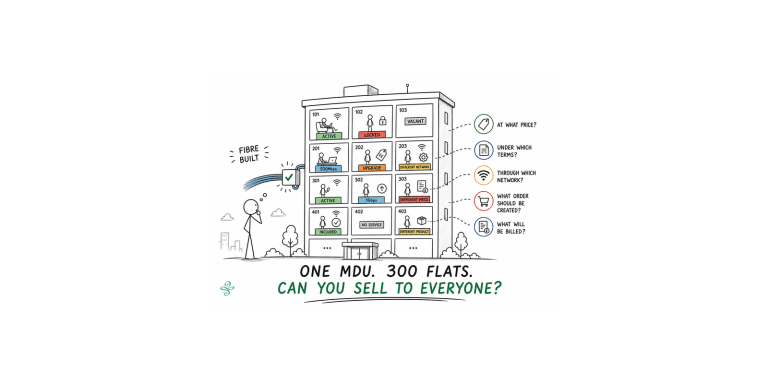
Consider a 300-unit apartment building.
The building has one location, but 300 realities.
One unit has a customer. Another is vacant. Another has a network. Another may be covered by a building agreement. One customer wants an upgrade while another moves out.
The network infrastructure may remain the same.
The commercial context doesn’t.
Customer. Product. Price. Eligibility. Service. Billing.
All can change from one unit to the next.
Take Flat 217, for example. The resident wants to move from 500Mbps to 1Gbps.
The question isn’t whether fibre reaches Flat 217.
The operator needs to establish whether the service is eligible under the building agreement, whether 1Gbps is included or an additional purchase, what price applies, which network should fulfil it, whether the change requires a new order or modification, and what billing should charge.
And this is where I think the MDU conversation needs to change.
The problem isn’t that operators don’t have the data. It’s that the commercial context isn’t travelling with the unit.
The unit is the missing context
Most telecom journeys follow:
Customer → Product → Order → Service → Bill
MDUs add something that doesn’t fit into that model:
Building → Unit → Customer
The customer is temporary.
The unit is persistent.
When one resident leaves Flat 217, the next resident shouldn’t inherit a blank record. The operator should already know the unit’s network availability, applicable building agreement, eligible propositions and commercial rules.
The same applies when something changes at building level.
A new agreement, network, product or pricing rule shouldn’t require teams to manually work through hundreds of units to understand the impact.
The building should establish the context. The unit should carry that context into every transaction.
That’s the missing link.
What should “MDU Ready” actually mean?
For me, MDU readiness shouldn’t stop at serviceable.
It should mean that an operator can take a unit and answer, without manual reconciliation:
Can I sell this product to this unit? At what price? Under which commercial terms? Through which network? What order should be created? What should ultimately be billed?
And the answer should remain consistent from:
Qualification → Proposition → Order → Activation → Billing
Operators should look beyond coverage and take-up and start measuring how many MDU transactions require human intervention.
How many need commercial overrides? How many orders are corrected? How long does qualification take to reach activation? How many billing issues can be traced back to an earlier commercial decision?
These questions tell us how efficiently a network converts availability into revenue.
The next MDU advantage
Fibre availability is becoming less of a differentiator. What happens after availability will matter more.
When every unit can have a different customer, product, price, network and commercial agreement, the ability to manage that complexity without manual intervention becomes a competitive advantage.
The building is connected.
Now make every unit count.
Are you maximising the value of your networks? Join HalleyX and the UK fibre industry at Connected Britain 2026, the UK’s largest digital economy event

The post The fibre is built. Now what? appeared first on Total Telecom.