Getting VAT right on bundles: What the KFC tribunal ruling changes

For businesses that bundle products or services, a KFC dip pot dispute has thrown VAT treatment into sharp focus. Irena Scullion explains what the Upper Tribunal ruling means and what you should do now.

Although the case arose in a fast-food context, the principles apply across any sector where bundled offerings are common. The ruling makes the initial classification of a transaction more critical and reduces the scope to influence VAT outcomes through how products are structured.

From dip pots to dispute: How the case unfolded

The dispute centres on how Queenscourt, which operates KFC outlets, treated the VAT on takeaway meal deals.

Historically, Queenscourt treated its meal deals as a single standard-rated supply, meaning VAT was charged at 20% on the full price. In 2019, it reassessed its position and concluded that meal deals should instead be treated as a multiple supply,  in other words, a collection of separate items rather than one combined product. This would allow certain components, such as dip pots, to be analysed separately and potentially treated as zero-rated (meaning no VAT applies).

To correct earlier VAT overpayments, Queenscourt submitted claims to HMRC covering past periods. HMRC initially accepted this approach and repaid the VAT claimed in respect of dip pots.

However, a later review led HMRC to change its position. While accepting that some items (such as cookies or yoghurts) could be treated as separate supplies, HMRC argued that dip pots were ancillary, essentially a minor add-on, to the hot food and therefore formed part of a single standard-rated supply. HMRC subsequently rejected a further repayment claim and sought to recover VAT it had already repaid.

Queenscourt appealed. The First-tier Tribunal sided with HMRC. The case then progressed to the Upper Tribunal, where the key question became: how should multi-element transactions be analysed for VAT purposes?


 

Read full article

The Last Waltz and moving beyond TCP/IP

Moving beyond TCP/IP1 Fred Goldstein and John Day for the Pouzin Society – June 2011. The triumph of the Transmission Control Protocol/Internet Protocol (TCP/IP) protocol suite in today’s market is nearly complete. A monoculture of networking has emerged, based on protocols originally developed in the 1970s. With a near-universal use of IP for purposes well beyond the original designers’ intent, conventional wisdom holds that all future solutions must slowly evolve from it. This belief, however popular, is not necessarily correct. The Internet itself has been a popular success in large part because of its low-price business model. IP has absorbed the glow from the Internet’s halo. People confuse the Internet with its protocols. But they are not the same thing. TCP/IP has been a 30-year distraction from real internetworking. In a real sense, it is the networking equivalent of Microsoft DOS (Disk Operating System). For the Internet to prosper in the long term, it needs to move beyond TCP/IP. TcP/IP WAs designed for allmited set of tasks TCP/IP was designed for the Advanced Research Projects Agency Network (ARPANET), a Department
of Defense resource-sharing network. When the ARPANET began in 1969, it demonstrated the then-radical notion of packet switching. The original ARPANET protocol, Network Control Program (NCP), was designed to ensure reliability of transmission on a hop-by-hop basis.


Read full article

Just deliver the bits, stupid

In 1997 Isenberg wrote: “A powerful leading indicator of the stupid network will arrive when entrepreneurs, who have no vested interest in maintaining telephone company assumptions, begin to offer profitable, affordable widely available data services.”

I can’t remember if Isenberg’s paper had the same effect on me as when I first heard Up From the Skies [1] way back in 1967, but it too made me sit up and take notice. Isenberg’s paper is considered seminal in that, at the time, he was promoting an alternative approach to the existing orthodoxy in telecoms thinking and more recently, it was considered to be the eighth most important Internet paper ever published [2]. The paper is reproduced below with a view to encouraging discussion amongst ITP members. I will follow it with my own observations.
An historic note may be in order in that, like Isenberg, I too am a child of the all encompassing Telco as I started my working life in August 1971 in what was then Post Office Telecommunications, London City Telephone Area (and subsequently joined the predecessor of the ITP, the IPOEE very soon after). It should be noted that Isenberg’s paper was first written in May 1997 and many of the ‘Intelligent Network’ concepts Isenberg describes are familiar to me. Whilst the paper did not have AT&T’s endorsement, it was widely available on the Internet and was ‘formally’ published in
Computer Telephony in August 1997. If I recall correctly, I was consulting to Enertel in the Netherlands at that time launching an indirect access product, but wasn’t aware of the paper until
early 2000. So here it is.

Read full article

Those That Fail – The Internet Fibre Access Market

fibre-access-network

Those That Fail to Learn From History Are Doomed to Repeat It

by John Francis Nolan, first mile networks

Introduction

At the risk of understatement, the author has been “monitoring” the Internet3 fibre access4 market for a good few years i.e. from circa 2003 onwards with his definition of fibre access being “the replacement of the copper (and coax) infrastructure for connectivity, primarily to the home/business.”

This paper is by way of an update on the author’s current thought process and will offer opinion, etc., where appropriate. In the development of this paper, the author has drawn on his experiences within the telecoms industry and a number of references – these references are expanded upon in Section 8.

At the outset, the author wishes to draw readers attention to the early work of First Mile Networks (FMN)5,6 with FTTH7 in the UK, and in particular, discussions held with a number of UK “developers” namely Land Securities, Meridian Delta (MDL), and Quintain Estates.

Figure in the attached document illustrates an extract from the early FMN thought process and, whilst Land Securities and MDL did not engage with our approach, we were successful with Quintain in developing a comprehensive business plan for their Wembley Park Estate.

The FMN business model was predicated on the provision of ducts and fibre at the early stage of such developments with the premise being that every potential end point on the estate would be serviced by fibre. It could be argued that the FMN model was a precursor to today’s many alternative network providers and hence the author would argue that he is not some “Johnny come lately.”

Click to Download the Full Article

Investment in Connectivity: Driving Sustainable Business Growth

Investment in Connectivity: Driving Sustainable Business Growth


Book a Place


Investment in Connectivity: Driving Sustainable Business Growth

Join us at the House of Lords for a high-level discussion on the critical role of connectivity in driving sustainable business growth across the UK.

The UK Future Connectivity Forum (UKFCF) is proud to host this exclusive parliamentary event, bringing together business leaders, investors, fibre connectivity experts, MPs, and policymakers to explore how strategic investment in digital infrastructure can unlock opportunity, fuel innovation, and strengthen long-term economic growth.

This invitation-only gathering will provide a platform for informed discussion, knowledge-sharing, and meaningful engagement between industry and policy leaders shaping the future of UK connectivity.

Why Attend?
– Gain exclusive insight from leading voices in business, investment, and connectivity
-Network with influential decision-makers and key stakeholders
-Contribute to shaping the future of UK connectivity and sustainable growth

Secure your spot today 

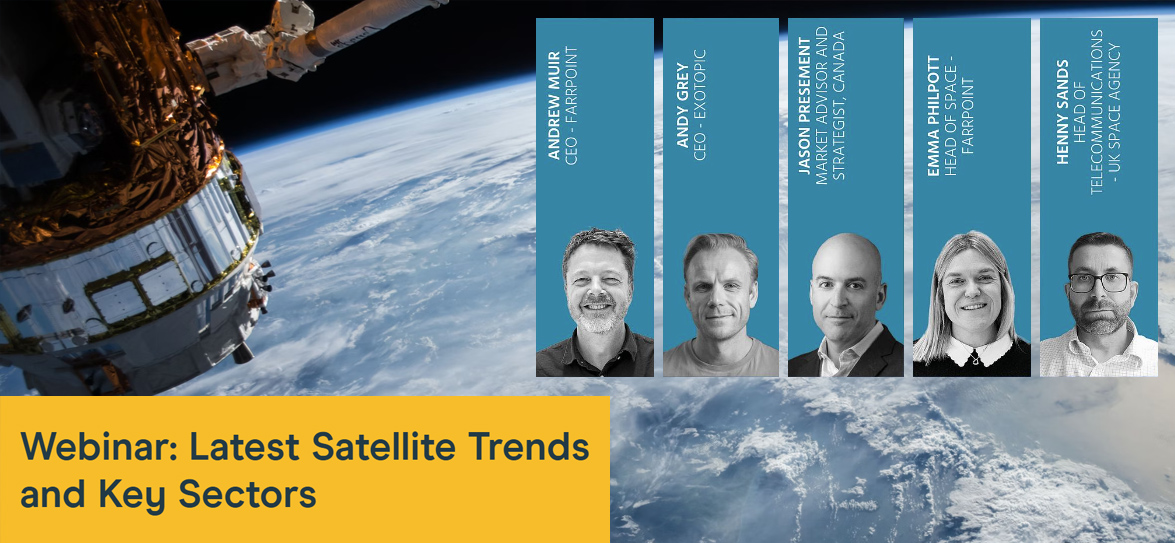
Webinar: Latest Satellite Trends and Key Sectors

satellite webinar2

satellite webinar


Book a Place


The satellite industry continues to evolve, unlocking new opportunities and transforming global connectivity. Join this FarrPoint webinar for an insightful discussion on the latest satellite developments, key trends, and what the future holds for this rapidly expanding sector.

Webinar details

When: 2nd April 2025, 15:00 – 16:00 UK BST Time

Meet Our Expert Panel

Webinar Speakers

What to Expect

This one-hour webinar will bring together industry leaders to share their expertise on:

  • The most exciting developments in the satellite industry and their implications.
  • The top three end-user markets for Low Earth Orbit (LEO) and why they matter.
  • The future of Direct-to-Cell connectivity – will it complement or replace terrestrial networks?
  • How organisations should consider satellite as part of their connectivity strategy and identify the best use cases.

Secure your spot today


Future Investment at Parliament 2023 Image Gallery

Future-Investment-at-Parliament-2023-Event

A huge thank you to everyone that attended our event discussing the future of Investment in the UK’s digital infrastructure. Many exciting ideas and points of view shared by all of the speakers who generously gave their time; the UK’s digital future is looking bright.

Future-Investment-at-Parliament-2023-Image-Gallery

The future of Investment in the UK’s digital infrastructure to fuel growth and accelerate the path to net zero

The Future of Investment in the UKs Digital Infrastructure

Book a Place


When – 23rd October 2023
Time – 18.30 – 22.00
Where – Terrace Pavilion, House of Commons, UK Parliament London SW1A 0AA

A landmark debate focusing on the future of Investment in the UK’s Digital Economy.

Tickets are going fast so please register to attend as soon as possible. Admission charges, where applicable, are purely to cover the costs of the event. Attendees from the public sector should contact christine@ukfcf.org.uk to obtain a free ticket.

The event is kindly hosted by the Rt. Hon. Mark Tami MP.

The debate will be opened by Sir Chris Bryant-Shadow Minister for Culture and Digital.

Panel members confirmed are;

  • Rob Kenny-Co- founder of Communication chambers
  • Schellion Horn-Grant Thornton- Partner, Co-head of Economic Consulting, Grant Thornton.
  • Richard Flint-Chief Strategy Officer at AllPoints Fibre
  • Paul Morris- Head of Government Affairs and Sustainable Business-Vodafone
  • Matt Hammond -Partner at Foresight Group.
  • Charles Cameron -Partner at Cameron Barney LLP.

The debate will focus on:

  • The Investor’s approach to opportunities in the current economic climate
  • The UK Government’s policy in tackling rural digital infrastructure
  • The Shadow Government’s digital infrastructure policy
  • Mergers, acquisitions, and consolidation within the Altnets

The evening will start with arrivals at 6.30pm. From 7.00 pm to 7.30 pm there will be a series of short speeches by keynote speakers from the Parliament. This will be followed by a panel discussion and a Q&A session util 9.30 pm. There will then be food and drinks and a networking opportunity for our guests. The event will conclude by 10.30 pm.

Formal invitations will be sent out to confirmed attendees just prior to the event. Entrance is strictly by invitation only.

The ticket price is purely to cover the costs of the event. The room capacity is limited , so please register to attend as early as possible.

Admission is free to Public Sector attendees. Please contact christine@ukfcf.org.uk to obtain a promo code to reveal these hidden tickets.

About UKFCF

The UK Fibre Connectivity Forum (“the Forum”) is an association of membership striving for digital connectivity across the whole of the UK. It is a not-for-profit organisation run by volunteers and relying on sponsorship to fund its activities.

The Forum is committed to working to support and advise policy makers to deliver policies that can create a fertile environment for the rapid growth of the UK’s digital economy.

Its mission is to be a vocal group, lobbying, influencing, and educating policy makers as to the most fair and efficient way to put an end to the digital divide.

UKFCF Event: An appetite for investing in the UK’s digital infrastructure?

An-appetite-for-investing-in-the-UKs-digital-infrastructure

An-appetite-for-investing-in-the-UKs-digital-infrastructure


Book a Place


When – 7th November 2022
Time – 1.00 – 5.00pm
Where – Grant Thornton, 30 Finsbury Square, London, EC2A 1AG
Subject – “An appetite for investing in the UK’s digital infrastructure?”

How can Altnets unlock their investment potential? An interactive networking event with major investment firms and consultants.

We have invited investors, business consultants, and M&A advisers to give their view of the economic forecast for the industry and to look at how Altnets can break down barriers to access funding. This will be a very interactive session which will provide thought provoking debate and an overview of the process and parameters applied in the valuation of assets.

Speakers include:

Robert Kenny -“Prospects for alt-net consolidation”.

Rob Kenny is a founding member of Communications Chambers, a UK-based strategy and policy consultancy working in telecoms and media. His clients for telecoms projects have included Ofcom, the Australian Government, BT, Vodafone, Virgin Media, Sky, O2, KCOM, Gigaclear, Telstra, Google, Amazon, Netflix, the Broadband Stakeholder Group and many others. Rob acted as an advisor on broadband policy to Malcolm Turnbull, subsequently prime minister of Australia.

He previously headed strategy and/or M&A for Level 3, Reach and Hongkong Telecom. In those roles he conducted numerous multi-million- and billion-dollar negotiations with commercial entities and regulators. He has a degree in mathematics and management from Cambridge University.

Jonathan Dann-“Consolidation, if not, what next”?

Jonathan has spent four years at Greenhill & Co focussed on digital infrastructure globally. Before that he spent 20+ years in equity research at RBC, Barclays, JP Morgan-Bear Stearns and HSBC. He started his career in fund management at USS.

Hector Lloyd-“Present and expected trends in M&A and consolidation”.

Hector Lloyd, Director, is a member of the BlackRock Private Equity Partners (PEP) group within BlackRock Alternative Investors. Based in London, he is responsible for performing due diligence and monitoring private equity investments in Europe. Mr. Lloyd earned a BA degree from Trinity College Dublin.

Mark Smallwood-“The Top 5 questions you must answer before seeking Private Equity Investment”.

Over the last two decades, Mark has helped many companies achieve high growth and has coached more than 800 leaders to fulfil their full potential. This has also included developing ‘go to market’ strategies, growing customer numbers and helping his clients become more attractive to external investors. He will be sharing his insights with us.

Community Fibre Adopt Simple £2 Policy on Out of Contract Price Rises

UK-Fibre-Connectivity-Forum london community

London focused UK broadband ISP CommunityFibre, which has so far covered 500,000 premises in the city with their new Fibre-to-the-Premises (FTTP) network, has today adopted a new policy that will “implement a £2 out of contract price increase on all its broadband packages for new customers“. The move, which has already been implemented for existing […]