nPerf Name EE and Three UK as Fastest Mobile Broadband Networks for 2026 | ISPreview UK

Original article ISPreview UK:Read More

French internet connection benchmarking firm nPerf has this morning published the results from their annual 2026 crowdsourced study into UK mobile broadband (4G, 5G) performance. The results see both EE and Three UK being named as delivering the country’s “best Mobile Internet performances“.

The latest nPerf study (PDF) is based on masses of tests carried out – between January and December 2025 – exclusively by customers of the various mobile network operators, using tools on both nPerf’s website and via their dedicated mobile testing apps for Android and iOS. The results are said to reflect “users in real conditions” from across the United Kingdom, although they only include the major national operators with a test share above 5%.

However, there are caveats to this sort of data, such as the fact that it could be impacted by any limitations of the devices being used, which hampers the ability to adopt a common type of hardware in order to establish a solid baseline of performance. But those caveats are shared by all operators in the study.

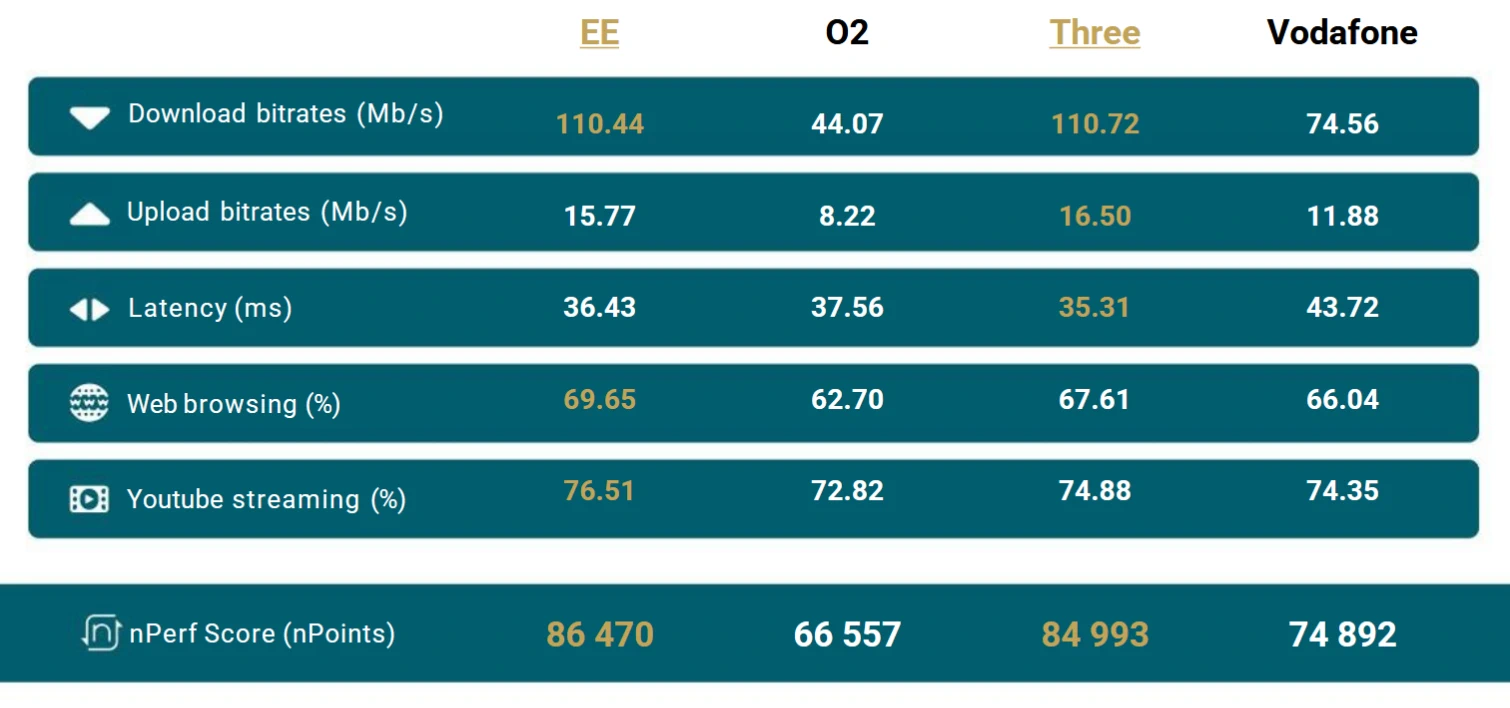
Overall, EE and Three UK were both top of the pack and virtually neck and neck for performance. The United Kingdom’s mobile internet sector displays an average score of 78,222 nPoints. EE and Three UK share the leadership positions with 86,470 and 84,993 nPoints respectively, dominating across download speed (both exceeded 110Mbps in download speeds), upload speed, and latency.

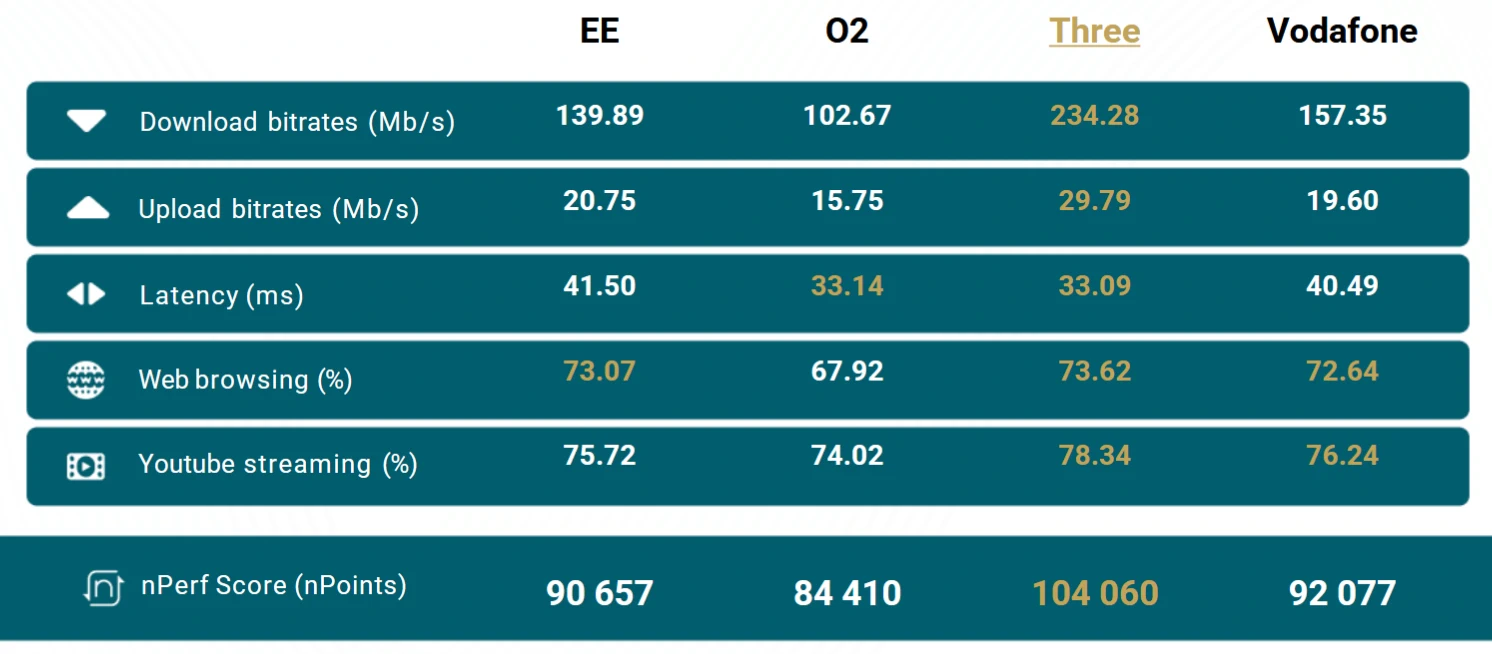
By comparison, Vodafone scored 74,892 points, while O2 once again found itself at the bottom of yet another mobile performance study with a score of just 66,557 points. The full results can be found below, which includes a second set of results for 5G-only connections (Three UK pulls out in front on that one).

2026 nPerf UK Mobile Benchmark (All Connections)

nPerf-UK-Mobile-Broadband-benchmarks-2026

2026 nPerf UK Mobile Benchmark (5G-only Connections)

nPerf-UK-5G-Mobile-Broadband-benchmarks-2026

One other thing to consider above is that Vodafone and Three UK began to merge their networks during the latter half of 2025. This is a slow multi-year process, but it may well start to impact the results for next year’s study.

“The UK mobile market demonstrates strong competition at the top, with both leaders delivering comprehensive performance and user experiences that benefit from high-speed connectivity across all key indicators“, states Sébastien de Rosbo, CEO of nPerf.

Broadband ISP Voneus See UK Turnover Rise to £6.33m as Losses Hit £38m | ISPreview UK

Original article ISPreview UK:Read More

Alternative rural network provider Voneus, which has built a mix of full fibre (FTTP) and wireless (FWA) broadband networks across some remote parts of Wales and England, have published their annual accounts to the end of March 2025. The figures show that turnover increased 43% to £6.33m due to customer growth, but they suffered a loss before tax of £38m.

Just to recap. Voneus was last year hit by some redundancies and a slowdown in their network build (here), due to many of the same pressures as other altnets have been facing (rising build costs, competition and high interest rates etc.). Back in 2024 they also withdrew (here) from the publicly funded Project Gigabit broadband build contract for Mid West Shropshire (Lot 25.01), which has since been picked up by Openreach (here).

NOTE: Voneus has received investments from Macquarie Asset Holdings, the Israel Infrastructure Fund (IIF) and Tiger Infrastructure Partners (principal shareholder of Rural Broadband Solutions) etc. The operator originally aspired to cover 370,000 homes with their gigabit networks, but they’ve so far done 100,000 (Feb 2025) and are home to 26,000 customers (Nov 2025).

However, at the end of last year they did manage to strengthen their position for “long-term growth” with a business reorganisation, which was said to have secured their funding through to 2030. This involved the renegotiation of an existing £70m loan facility with banking partners, which is intended to support future network commercialisation.

The company’s latest annual accounts help to show why they needed to strike the aforementioned agreement and Voneus’ directors say they now have a “reasonable expectation that the company has adequate resources to continue to operate in the foreseeable future“.

Summary of Key Figures – Voneus Accounts (March 2025)

➤ Turnover increased 43% to £6.33m due to customer growth (2024: £4.41m).

➤ Gross profit increased to £800k (2024: £768k), although gross profit margin declined to 13% (2024: 17%).

➤ Employees grew to 275 (2024: 238).

➤ Losses before tax increased to £38m (2024: £36.6m).

➤ Government grant receipts (gigabit vouchers etc.) increased to £2.25m (2024: £1.12m).

➤ Net assets worth £136.18m

Voneus are currently in the process of conducting a “business reorganisation to ensure operational efficiency and future scalability“, which is already known to include the “outsourcing of some business functions” and may result in a “limited number of redundancies“ (here).

The Curious Case of Openreach’s Vanishing UK FTTP Broadband Coverage | ISPreview UK

Original article ISPreview UK:Read More

Independent data analysis has recently revealed a curious trend where patches of Openreach’s full fibre (FTTP) broadband network, often within urban areas and usually but not always associated to installs that require a more complex stage 2 process, suddenly vanish after somebody places an order. The issue is estimated to be impacting 0.3% of UK premises.

Regular readers will know that there are already various reasons why areas that have already gone live with FTTP may suddenly, albeit temporarily, cease to be available. For example, availability can be impacted if the local distribution nodes (e.g. Connectorised Block Terminals / CBT) run out of spare ports or nearby telecoms poles have no space for new cables. This often causes a delay in availability until engineers can deploy a solution, albeit usually only for a very small area (e.g. one side of a street or a handful of homes).

NOTE: Openreach’s Fibre-to-the-Premises network, which is costing £15bn to build, currently covers 21 million premises and aims to cover 25m by December 2026 (there are c.32.5m across the UK), before possibly rising “up to” 30 million by the end of 2030 (regulatory conditions allowing).

However, the cases we’re looking at today concern a different issue or set of issues, which can often impact a wider area (e.g. several streets or postcodes). The problem, which was picked up by Andrew Ferguson over at Thinkbroadband (here, here, here and here), concerns areas where Openreach have deployed FTTP, but then latter identify additional complexities after somebody places an order.

Often these will be areas that have already been designated as falling under a stage 2 (KCI2) installation process. Just for context, a stage 1 process tends to reflect a normal property that is expected to be installed within a single engineering visit, while stage 2 usually reflects those that are expected to be more complex (i.e. may require additional external engineering work before a connection can be made to the inside of the property).

During stage 2 installs, engineers may also come across various often unexpected issues, such as cable ducts that are blocked or don’t exist (e.g. the cable may be directly buried in the ground). Properties marked as stage 2 are usually considered to be covered if Openreach have built their FTTP network to the area, but that last little hop into homes can still throw up problems. In some cases this has been causing Openreach to remove some sizeable patches of coverage from areas where the service was previously marked as “available” (RFS).

A Spokesperson for Openreach told ISPreview:

“We’ve temporarily paused new Full Fibre orders at a small number of previously enabled premises as we don’t want customers there to face long delays when they order. These particular locations have proved more complex to connect than a typical order, so we’re taking a closer look at the reasons for that to make sure we can give people the right service experience from day one. Existing customers and inflight orders aren’t affected, and we’ve already made some paused locations available again. We plan to the remainder as quickly as possible.”

Openreach are certainly not the only network operator to run into this sort of problem, although until recently it wasn’t really possible to get a feel for how much of an impact it was having. However, Andrew’s recent mapping efforts have changed that, which has increasingly identified areas across the UK where the operator’s FTTP coverage figures have been going backwards. Andrew said: “We’ve had plenty of networks where everything says yes and they’ll actually take peoples money to then find out a street has been removed from footprint.”

For example, over in Plymouth (Devon) it was identified that this issue had recently resulted in full fibre coverage dropping from a peak of 80.21% to 79.15% (a reduction of c.1,300 premises), which has created islands of vanishing availability within the city. But nationally, Thinkbroadband estimates that it may only impact around 0.3% of UK premises, although it’s not clear how long it usually takes for operators to resolve such issues and Andrew is still working to fully map the impacted areas.

Suffice to say, full fibre coverage is turning out to be a bit more dynamic than we originally expected, although the above challenges should perhaps be considered par for the course on any network that’s still in the process of building.

Broadband Satellite ISP Starlink Prep Free Stargaze Data to Avoid Space Collisions | ISPreview UK

Original article ISPreview UK:Read More

The Starlink service from SpaceX, which operates a mega constellation using thousands of ultrafast broadband internet satellites in Low Earth Orbit (LEO) for the UK and globally, has revealed that they’re about to start making data from their Space Situational Awareness (SSA) system, called Stargaze, available for free to other satellite operators.

Starlink currently has around 9,600 satellites in Low Earth Orbit (c.6,150 are v2 / GEN2 variants) – mostly at altitudes of between c.340-525km. Residential customers in the UK usually pay from £35 a month for the ‘Residential 100Mbps’ unlimited data plan (kit price may vary due to different offers), which also promises uploads of c.15-35Mbps and low latency connectivity. Faster packages exist at greater cost, while more restrictive (data capped) options also exist for roaming users (e.g. £50 per month for 100 GigaBytes of data).

NOTE: By the end of 2025 Starlink’s global network had 9 million customers (up from 6m in July 2025). The service had 110,000 customers in the UK as of July 2025 (up from 87,000 in 2024) – mostly in rural areas.

However, one of the growing concerns with such large constellations is that they may increase the risk of a Kessler Syndrome style event, which is a theoretical situation in which a runaway chain reaction of collisions in low Earth orbit (LEO) creates a cloud of space debris density. This then damages many other satellites and potentially renders Earth’s orbit unusable for satellites and future space missions / rockets.

SpaceX thus operates a novel Space Situational Awareness (SSA) system, called Stargaze, which they say enhances the safety and sustainability of satellite operations in LEO. The system uses data collected from nearly 30,000 star trackers, each of which makes continuous observations of nearby objects, resulting in approximately 30 million transits detected daily across the fleet.

The system autonomously detects observations of orbiting objects and are then aggregated to generate accurate orbit estimates and predictions of position and velocity for all detected objects in near real-time. These predictions integrate into a space-traffic management platform that identifies potential close approaches between objects in space and generates Conjunction Data Messages (CDMs). The system can provide conjunction screening results within minutes, compared to the current industry standard of several hours.

Such systems are necessary because there are all sorts of hazards for Earth’s increasingly crowded satellite space to consider. Practices — such as leaving rocket bodies in LEO, operators manoeuvring their satellites without sharing trajectory predictions or coordinating with other active satellites, and countries conducting anti-satellite tests — have all heightened the risk of collision, necessitating improvements in space-traffic coordination.

The problem is that conventional methods typically observe objects only a limited number of times per day, causing large uncertainties in orbital predictions, further compounded by volatile space weather. So in order to address this, Starlink has gone a step further by announcing that its screening data will be made available to the broader satellite operator community “free of charge in the coming weeks.”

Starlink Statement

To maximize safety for all satellites in space, SpaceX will be making Stargaze conjunction data available to all operators, free of charge, via its space-traffic management platform. This platform has been in a “closed beta” with over a dozen participating satellite operators, allowing low-latency ephemeris sharing and conjunction screening.

Starting this spring, operators that submit ephemeris (trajectory predictions) to the platform will also receive CDMs against Stargaze data, in addition to ephemeris from other participating operators. This ensures that operators have low-latency access to the best available data for conjunction assessment.

Stargaze already has a proven track record in its utility for space safety. In late 2025, a Starlink satellite encountered a conjunction with a third-party satellite that was performing maneuvers, but whose operator was not sharing ephemeris. Until five hours before the conjunction, the close approach was anticipated to be ~9,000 meters—considered a safe miss-distance with zero probability of collision.

With just five hours to go, the third-party satellite performed a manoeuvre which changed its trajectory and collapsed the anticipated miss distance to just ~60 meters. Stargaze quickly detected this manoeuvre and published an updated trajectory to the screening platform, generating new CDMs which were immediately distributed to relevant satellites. Ultimately, the Starlink satellite was able to react within an hour of the manoeuvre being detected, planning an avoidance maneuver to reduce collision risk back down to zero.

With so little time to react, this would not have been possible by relying on legacy radar systems or high-latency conjunction screening processes. If observations of the third-party satellite were less frequent, conjunction screening took longer, or the reaction required human approval, such an event might not have been successfully mitigated.

Despite the development and improvements of their system, SpaceX have recently become keen to encourage other satellite operators to start sharing their data on satellite trajectories and now appear to be trying to lead by example (partly because their huge network also makes them among the most vulnerable to such dangerous events).

“Starlink ephemeris is updated and shared publicly every hour, and all other operators should do the same,” said the company. “By providing this ephemeris sharing and conjunction screening service free of charge, we hope to motivate operators to take similar steps towards ephemeris sharing and safe flight.”

Is a BEAD conflict brewing between NTIA and Starlink? | Total Telecom

Original article Total Telecom:Read More

ray of light near body of water

News

Starlink, a subsidiary of SpaceX, is trying to change the government’s broadband playbook, a new leaked document reportedly reveals.

By Brad Randall, Broadband Communities

States are being sent riders from Starlink that list caveats to the service the company will eventually give to broadband serviceable locations (BSLs) under government’s massive broadband push, known as the BEAD program.

The revelation comes after several “concerned states” reached out to broadband.io, according to Doug Adams, an admin for the website.

Adams said the riders, which he posted a copy of online, were marked as confidential.

His post describes the brewing conflict the riders signal, which also demand that Starlink be paid 50% upfront.

“Even though the rider insists that Starlink is paid 50% upfront, Starlink isn’t required to increase capacity before it is requested by BSLs,” Adams wrote. “This flies in the face of the NTIA’s June 6 guidance”

In his post, Adams also said multiple contacts at state broadband offices told him NTIA was urging states not to sign the riders.

His analysis of the rider continued.

“Starlink is asking to be paid (in arrears) for BSLs already subscribed and if at any point in time, a BSL tried service but cancelled, Starlink still wants these locations to be considered ‘served’.”

SpaceX, which operates Starlink as a wholly owned subsidiary, has thus far been granted more than any satellite provider in the program, according to Connected Nation’s BEAD tracker.

As has been previously reported, revised guidance to BEAD last year ordered bureaucrats to find more cost-efficient means of delivering broadband. As a result, the attractiveness of low-Earth orbit satellite connectivity has boosted for states seeking cheaper alternatives to fiber.

Of proposals analyzed by Connected Nation so far, Starlink has thus far been awarded over $733 million.

Get news like this in your inbox. Subscribe to the Broadband Communities newsletter!

The post Is a BEAD conflict brewing between NTIA and Starlink? appeared first on Total Telecom.

Sparkle and Valencia Digital Port Connect: Agreement to Land Barracuda Subsea Cable at Genoa Landing Platform | Total Telecom

Original article Total Telecom:Read More

Rome/Valencia, 30 January 2026

Sparkle, the first international service provider in Italy and among the top global operators, and Valencia Digital Port Connect (VDPC), the Spanish telecommunications infrastructure company developing the Barracuda submarine cable project in collaboration with private equity firm Teset Capital, announce a strategic agreement to land the Barracuda submarine cable at Sparkle’s Genoa Landing Platform.

The Barracuda project will establish the first direct high-capacity, low-latency submarine route between Spain and Italy, creating a 1,070 km digital bridge between Valencia and Genoa. Designed with an “open cable system” architecture, Barracuda will feature 12 fibre pairs, each with a capacity of 32 Tbps (Terabits per second). The project has an estimated total investment of €100 million and is scheduled to be completed in three years, with operations expected to begin in 2028.

Under the agreement, Barracuda will land at Sparkle’s Genoa Landing Platform, a scalable infrastructure designed to offer a turnkey, highly resilient and secure submarine cable landing on the Western European coastline. Through this infrastructure, the cable will reach Sparkle’s Genoa Digital Hub in Lagaccio, an open and neutral colocation facility and interconnection point with other submarine cables and European terrestrial networks as well as Internet Exchange Points already present in the facility. By landing in Genoa, VDPC will gain immediate access to major European hubs, avoiding the cost, time and administrative complexity of deploying a proprietary landing infrastructure.

As part of the broader agreement, Sparkle will also acquire infrastructure assets on the Barracuda submarine cable system between Valencia and Genoa and colocation in Valencia Cable Landing Station, a fully neutral, scalable infrastructure designed for Barracuda and up to three additional submarine cable systems. This additional capability will strengthen Sparkle’s connectivity in the Iberian Peninsula, serving the local as well as the growing West African market, thus further reinforcing its strategic footprint in the Mediterranean region.

“This agreement represents an important step in our strategy to position Genoa as a key gateway to Europe,” said Enrico Bagnasco, CEO of Sparkle. “The landing of Barracuda will strengthen and expand the city’s digital ecosystem, while the additional capacity on the system allows us to further expand our resilient, high-performance Mediterranean network and better serve international connectivity demand”.

Enrique Martín, CEO at Valencia Digital Port Connect said “This agreement with Sparkle marks a key milestone in the Barracuda project and confirms that we are advancing in line with our strategic roadmap. Securing Genoa as our landing point and welcoming Sparkle as a long-term customer reinforces Barracuda and Valencia Cable Landing Station as strategic assets for international partners confirming the credibility of. our ambition to have the system fully operational by 2028”.


About Sparkle

Sparkle is TIM Group’s Global Operator, first international service provider in Italy and among the top worldwide, offering a full range of infrastructure and global connectivity services – capacity, IP, SD-WAN, colocation, IoT connectivity, roaming and voice – to national and international Carriers, OTTs, ISPs, Media/Content Providers, and multinational enterprises. A major player in the submarine cable industry, Sparkle owns and manages a network of more than 600,000 km of fiber spanning from Europe to Africa and the Middle East, the Americas and Asia. Its sales force is active worldwide and distributed over 32 countries.

Find out more about Sparkle following its X and LinkedIn profiles or visiting the website tisparkle.com


About Valencia Digital Port Connect, S.L.

VDPC is a Spanish telecommunications infrastructure company headquartered in Alicante. Its mission is to establish a next-generation, neutral, and sustainable international connectivity hub in the Valencian Community through the deployment of advanced colocation infrastructure, terrestrial interconnection networks, and submarine connectivity solutions. VDPC is leading the development of the Barracuda submarine cable connecting Valencia with Genoa, including a data center and neutral cable landing station on the Valencian coast. The team is composed of seasoned professionals with executive backgrounds in telecom multinationals, the industrial sector, and academia.

Find out more about VDPC following LinkedIn profiles or visiting the website valenciadigitalport.com 

Sparkle Media Contacts

sp*******************@*******le.com

X: @TISparkle

Valencia Digital Port Connect Media Contacts

Pablo de Santiago

  1. +34.679.607.604
  2. pa***@********go.com


The post Sparkle and Valencia Digital Port Connect: Agreement to Land Barracuda Subsea Cable at Genoa Landing Platform appeared first on Total Telecom.

Gigaclear Makes Progress on Cotswolds Project Gigabit Broadband Build | ISPreview UK

Original article ISPreview UK:Read More

Rural broadband ISP Gigaclear, which has so far deployed their full fibre (FTTP) network to cover 612,000 UK premises (inc. 160,000 customers), has just put their new network live in the Cotswolds village of Kemble. The deployment forms part of Project Gigabit’s £10.81m East Gloucestershire (Lot 18) contract to upgrade 3,547 premises in hard-to-reach areas.

The original contract was first awarded all the way back in February 2024 (here) and was initially valued at £16.6m (state aid), with a goal of extending gigabit-capable broadband to an additional 4,400 premises in remote rural areas. But this shrank in size during August 2025 “due to [the] removal of 899 premises” from its scope (here) and the construction phase then didn’t start until October 2025 (here).

NOTE: Gigaclear is principally owned by Infracapital, together with Equitix and Railpen. The company previously had investment commitments estimated to be worth up to around £1.1bn (here) and in late 2023 secured a £1.5bn debt facility (here). The provider holds several Project Gigabit build contracts in Oxfordshire (here) and East Gloucestershire (here).

However, today’s announcement seems to slightly contradict the October 2025 news, by stating that work began “earlier this year” across the 18 rural areas in the county, including Kemble, with the first homes and businesses now able to benefit from Gigaclear’s ultrafast service. Residents and businesses can now access speeds of up to 900Mbps.

The other locations set to benefit include Alderton, Andoversford, Aston Somerville, Brockhampton, Cold Aston, Coln St Aldwyns, Great Rissington, Hawling, Lower Slaughter, Miserden, North Cerney, Quenington, Stanton, Tarlton, Teddington, Upper Slaughter and Woodmancote.

Telecoms Minister, Liz Lloyd, said:

“Connecting the first customer in Kemble to lightning fast broadband is a fantastic milestone for Project Gigabit’s rollout in Gloucestershire.

Reliable, fast broadband transforms lives, supporting local businesses to grow, and opening up new opportunities in our rural communities. I look forward to seeing many more homes and businesses across Gloucestershire benefit from this investment.”

Nathan Rundle, Chief Executive Officer at Gigaclear, said:

“Connecting the first customer in Kemble is a great achievement and one that will help close the gap further for the digital divide in rural Gloucestershire. Kemble is one of many villages that has historically been overlooked when it comes to broadband investment, leaving residents with services that simply haven’t kept pace with modern life.

Our Project Gigabit build is changing that. By delivering reliable, ultrafast full fibre where it has previously been absent, we’re enabling people to work from home, commute less and spend more time with family and friends. This in turn means they are more present in their communities which positively supports local businesses. We’re delighted to see the first premises go live and look forward to connecting many more as the rollout continues.”

The original contract indicated that Gigaclear’s roll-out is expected to reach completion by Spring 2027, although it’s unclear if this target still stands.

Residential customers of the service currently pay from £17 a month (£43.50 after 18-months) for a symmetric 200Mbps broadband package and speeds go up to 900Mbps.

Virgin Media and O2 Set to Merge UK Customer Communities Together | ISPreview UK

Original article ISPreview UK:Read More

Broadband ISP Virgin Media and mobile operator O2 are about to begin an impactful change as part of their previous merger, which will bring their once entirely separate community discussion forums together for the first time. The operators also plan to move to a “new platform” during the process as their “agreement with the current provider is ending“.

Most of the major broadband and mobile operators run customer communities, which are often a useful place to find help and advice. In fact, we tend to view it as a big plus when telecoms providers are able to provide their customers with such a venue, although some prefer not to give their customers a place to engage and raise problems (e.g. Vodafone had an excellent forum until they unceremoniously nuked it last spring).

Similarly, both Virgin Media (here) and O2 (here) have long run their own community forums. O2 doesn’t appear to have changed their forum for a long time, while the last time Virgin Media upgraded their own forum occurred a year ago (here), when they switched from using the older Khoros ‘Classic’ platform over to the modern ‘Aurora’ one (call us old-fashioned, but we much preferred the look and feel of the old one).

However, the network operators are both now starting the process of changing platform again, but this time it’s more than a mere upgrade. The platform itself is being changed (no details have been provided on the new one) and, more significantly, they intend to merge both of their communities together at the same time (posts, stats, member accounts etc.).

VMO2’s Joint Community Statement

Just a heads‑up that the community will have some downtime at the end of the month. We’re moving to a new platform as our agreement with the current provider is ending. This migration will take a little while as we move everything over. The community will switch to read‑only next week before going offline for a bit.

We’re also taking this opportunity to bring the Virgin Media and O2 communities together. Our aim is to merge as much as we can – posts, stats, member accounts, the lot.

Thanks so much for everything you’ve contributed so far. From me and the whole community team, we really appreciate it – and we’ll see you on the other side!

Anybody who has any experience of trying to do what O2 and Virgin Media are about to attempt with such a large database of historic customer content will know that it can be a nightmare to pull off smoothly. Complex database migrations and mergers of this type rarely go without problems, to say the least. This perhaps explains why neither operator has specified how long the downtime will last, because they can’t be sure themselves.

At present, it’s not known precisely what the new platform will look like or if everything will be placed under a new website, but we should have those answers soon.

North Africa’s 5G wave continues with Libya launch | Total Telecom

Original article Total Telecom:Read More

News

The launch means all African nations on the Mediterranean have now launched 5G

This week, Libya’s second largest state-owned telco, Almadar Aljadid, has announced the launch of 5G in parts of the capital, Tripoli.

For now, the launch is limited to just central parts of the city, but citywide coverage – and, indeed, nationwide coverage – will take place in stages, according to the company.

The company said the launch represents a significant boost in service quality for customers, as well as noting the technology’s potential to support key industries like healthcare and education.

2025 was a remarkable year for North Africa’s mobile markets, with Tunisia launching 5G in February, Egypt in June, Morocco in November, and Algeria in December. Now, with Libya’s launch, the entire region has formally entered the 5G era.

Keep up to date with all the latest telecoms news with the Total Telecom newsletter

Also in the news
World Communication Award Winners 2025
Ofcom clears the way for satellite-to-smartphone services
LG Uplus’s AI voice call app glitch leaks user data

The post North Africa’s 5G wave continues with Libya launch appeared first on Total Telecom.

South Korean memory-makers warn of AI supply chain crunch | Total Telecom

Original article Total Telecom:Read More

a close up of a pattern of small squares

News

Despite efforts to expand capacity, semiconductor players are struggling to keep pace with demand

As the AI boom continues to gain momentum, two of the world’s leading chipmakers, SK Hynix and Samsung Electronics, are warning that their expansion plans will not move fast enough to ease supply chain bottlenecks.

The companies, both which reported their latest financial results this week, said that the memory chip supply crisis would be unlikely to alleviate for the next two years despite their best efforts.

“We are planning a substantial increase in our capital expenditure in 2026 as AI-driven demand is likely to continue,” said Kim Jae-june, executive vice-president of Samsung’s memory business, as reported by the Financial Times. “But supply shortages are likely to worsen as capacity expansion is expected to be limited this year and next.”

SK Hynix has plans to invest 19 trillion won ($12.9bn) in the construction of a semiconductor packaging facility in Cheongju, while Samsung is investing 60 trillion won ($41.5 billion) in its P5 factory in Pyeongtaek, South Korea, which broke ground in November last year.

Both investments are driven by the surge in demand for High Bandwidth Memory (HBM), a crucial part of AI accelerators and data centre GPUs, as well as other memory chip technology; SK Hynix says it expects the HBM market to continue to grow significantly between 2025 and 2030, with projections indicating a compound annual growth rate of 33% until 2030.

However, the additional capacity being generated from these new facilities will take time to realise.

“Demand is growing sharply, but it takes time to expand capacity, so the mismatch in demand and supply is worsening, pushing chip prices higher,” added Song Hyun-jong, president of SK Hynix, in the same FT report.

The extent of the memory bottleneck is already being felt acutely across the world. The cost of dynamic random access memory (DRAM), for example, has skyrocketed since 2024, and is set to double again this year.

At the same time, the industry is also in the midst of a significant shift, moving from the current HBM3E technology to the more advanced HBM4. These next generation memory chips will offer higher data transfer speeds (exceeding 1 TBps per stack) and more than double the bandwidth of HBM3E, making them ideal for AI data centres.

SK Hynix is currently the global leader in this latest memory design, accounting for roughly 60% of the overall market, according to Macquarie Equity Research. Samsung, however, is expected to soon challenge this position, beginning production of its own HBM4 chips next month.

Needless to say, this memory bottleneck is making both SK Hynix and Samsung very rich.

SK Hynix reported a net profit of 97.15 trillion won ($67.9 billion), up 46.8% year-on-year, while Samsung saw profits rise to 45.21 trillion won ($31.6 billion, up 31.2% year-on-year.

Keep up to date with all the latest telecoms news with the Total Telecom newsletter

Also in the news
World Communication Award Winners 2025
Ofcom clears the way for satellite-to-smartphone services
LG Uplus’s AI voice call app glitch leaks user data

The post South Korean memory-makers warn of AI supply chain crunch appeared first on Total Telecom.