UK Government Warns Promoting the Use of VPNs Could Attract Fines | ISPreview UK

Original article ISPreview UK:Read More

The UK government has warned that online platforms which “deliberately target UK children and promote [Virtual Private Network] use” could now “face enforcement action, including significant financial penalties“. The statement comes after many people – ironically mostly adults – rushed to adopt VPNs to avoid the wide adoption of age verification.

As regular readers will already know, the UK’s new Online Safety Act (OSA) – a product of both the past and present governments – includes a requirement for age verification. The government and Ofcom would of course have you believe that this is all about restricting access to the naughty bits of the human anatomy (porn), but as we’ve previously warned, the rules go much.. further.

NOTE: The Act and its codes are far-reaching and will touch many websites and online services (big and small alike – major social networks and small personal blogs). But it’s also true to say that Ofcom lacks the resources to monitor everything, thus their focus is likely to be fixed on the worst offenders and major firms.

Ofcom recently began enforcing the requirement for age verification and, unsurprisingly, this meant that people suddenly woke up to a heap of online services all wanting to scan their faces and collect credit card details (among other methods) – often via unfamiliar third parties – before allowing them access.

Want to retain access to your music streaming account at Spotify, or risk having it deleted? You must age verify. Want to access all your existing private messages and contacts on the Bluesky social network? You must age verify. The same quickly became true on TikTok, a favourite of the younger crowd, and YouTube, among many.. many other services.

The OSA’s rules are so broad that they apply to all sorts of internet sites/services and content, which go well beyond the core remit of porn and occurs at a time when most of us have long been conditioned to share as little personal and financial data as possible with online platforms (especially social networks where real names aren’t always used) – due partly to the sadly all too common risk of data breaches.

Suffice to say, many adults do NOT want to have to share personal or financial details with unknown third-parties just to be able to chat with family members/business contacts or listen to the latest music. But the government’s sledgehammer approach leaves no alternative, potentially fuelling the risk from cybercrime and making it harder for people to control their data.

In response to this many younger people, and seemingly many more adults, have been flocking to adopt VPN services in order to get around age verification.

What is a VPN?

VPNs allow you to create a secure connection to another network over the internet. Many people use them (you can even setup your own proxy/VPN) as an additional means of helping to secure their connection against hackers or prying eyes, which is particularly vital when accessing a network that you don’t trust or haven’t used before (e.g. public / hotel wifi). Businesses also use them to help employees access their work remotely. Yours truly does both of those via a VPN, a vital service for a journo.

However, it’s also true that VPNs – as well as various other services – can be used for circumventing website blocks by ISPs, age verification systems (i.e. many AV systems only apply to IPs originating in the UK) and tackling geo-blocking; such as by adopting an IP address from another country.

Sadly, hackers and spammers also use them to conceal the true source of their attacks, which is a notable downside. We should also point out that third-party VPNs, despite their claims, may not all be 100% trustworthy and secure from prying eyes.

What’s all this about punishment?

The government clearly aren’t happy with age verification being so easily defeated (not only by VPNs but also via various other methods – fake pictures etc.), which is far from being either a new or surprising development – the weakness of age verification has long been somewhat of an Achilles heel in the whole approach.

Meanwhile, the government, which probably aren’t doing themselves many favours by branding opponents of age verification as supporting porn and worse, are now warning people not to even promote the use of VPNs.. or else (there are exceptions for editorial news articles like this).

A government spokesperson said:

“Platforms have a clear responsibility to prevent children from bypassing safety protections. This includes blocking content that promotes VPNs or other workarounds specifically aimed at young users.

Where platforms deliberately target UK children and promote VPN use, they could face enforcement action, including significant financial penalties.”

None of this is to say that we disagree with the principles of the OSA. We don’t. But while placing stricter controls over things like porn and illegal content is perfectly understandable, extending AV to everything from Spotify to private messaging services and general discussion forums is, in many cases, going too far. A form of censorship by the backdoor, since many adults do not want to age verify via unknown third-party companies.

All of this also ignores the fact that treating under 18’s, particularly teenagers in the 15 to 18 range, like they’re all five years old is going to be hugely insulting for many of them. The government might yet regret giving many in this group the power to vote.

Meanwhile, a handful of MPs have previously gone so far as to suggest that VPNs should be banned to stop circumvention of the rules, which would be an incredibly dangerous precedent for a democracy to set. Mercifully, the government has confirmed that they are not currently planning to do this, although plans can and often do change with time.

Both the Conservative and Labour parties currently remain supportive of the OSA, while Reform UK has called for it to be completely repealed (unnecessary as it can be amended to deliver on the bits that work – the act also does have a lot of public support).

Finally, the Liberal Democrats will put forward an emergency motion to their Conference asking for a “pause and rethink of the OSA given what we have seen“. The party highlights threats to wiki and free exchange of information, LGBT+ websites being blocked and “heavy-handed implementation” by Ofcom. In fairness, the regulator is only following what the law tells them to do.

Please note that comments on this news article have been closed, as we’re currently unsure about the liability if anonymous posters start using it to promote VPNs.

VMO2 taps Age UK to help elderly customers manage 3G switch-off | Total Telecom

Original article Total Telecom:Read More

Press Release

Virgin Media O2 and Age UK are working together to provide additional support to the small number of older mobile phone users who will need to upgrade their handsets to continue using mobile data once 3G is switched off.

Virgin Media O2 will support Age UK’s work to develop and distribute new informative content designed for older people and their families to help them better understand the 3G switch-off. The charity will provide key information on its website and social media channels and, via its Advice Line, support older people and their families who are seeking advice in relation to the 3G switch off.

Virgin Media O2’s contribution will also help to fund Age UK’s Digital Champions programme, which supports disadvantaged older people through local awareness sessions, practical hands-on digital skills tuition and tailored guidance so they can stay connected and confidently use new devices.

This activity will complement the work Virgin Media O2 is already doing to raise awareness of the switch-off and encourage the small number of customers who will be impacted to take action. The operator is already writing directly to all customers currently without a 4G or 5G handset, offering free compatible devices for known vulnerable customers and discounts on new handsets for all others.

Virgin Media O2’s 3G network first launched more than 20 years ago and today carries less than 2% of all network data – a figure that continues to fall. Switching off this older technology – as agreed by the Government and all mobile network operators in 2021 – allows providers like Virgin Media O2 to reallocate mobile spectrum to more efficient 4G and 5G services and improve customers’ overall experience with faster data speeds, more reliable streaming and higher quality voice calls.

Customers who don’t upgrade to a 4G or 5G device before 3G is switched off will still be able to use voice calls and send text messages as they currently do for now, but they will not be able to use mobile data.

Virgin Media O2 and Age UK County Durham collaborated in a similar way earlier this year when the city of Durham became the first area to have the company’s 3G network switched off. Further local switch-offs have since been completed in other parts of the UK – Norwich, Telford and Guildford on 16 July, and Torquay will follow in August – ahead of a wider programme that will see the 3G network withdrawn across the country by the end of 2025.

O2 customers continue to be encouraged to visit their local store or call to access more information and support, while Tesco Mobile, giffgaff and Sky Mobile are supporting their own customers through this migration. Anybody with an old, unwanted handset is able to recycle their device through O2 Recycle where they could receive cash in exchange for their old phone and play their part in disposing of old equipment responsibly to protect the environment.

Jeanie York, Virgin Media O2’s Chief Technology Officer, said: “We’re continuing to push ahead with our plans to switch off 3G across the UK by the end of this year, allowing us to reallocate mobile spectrum to more efficient 4G and 5G services and give our customers a better overall experience.

“While we know that the vast majority of our customers already have a 4G or 5G handset and do not need to take any action, our priority has always been to support the minority who may be impacted.

“Given that many of these customers are likely to be older and potentially less tech-savvy, it makes perfect sense to partner with Age UK as we carry out this migration. We’ll draw on their expertise and significant reach to raise awareness among customers who will need to upgrade their device to continue using mobile data once 3G is withdrawn.”

Caroline Abrahams, Charity Director at Age UK, said: “The 3G switch-off may feel daunting for many older people so it’s important that we do all we can to support those affected.

“We’re very grateful for this funding from Virgin Media O2 as this will enhance our services, including our Advice Line, so that older customers can get the help needed when 3G is switched off.

“It’s important to note that for those using a 3G network who don’t wish to change their handset, for now they will still be able to make phone calls and send texts as they do today – it’s just their mobile data this change will affect.

“Anyone who is feeling worried and would like some support can get in touch with their provider to find out more about their options and make sure they are ready for the change, or they can call Age UK’s Advice Line for free on 0800 169 65 65.”

O2 customers can find out more about the 3G switch off on its website. Tesco Mobile customers can find out more here, Sky Mobile customers should visit here for further information, while giffgaff customers can access further support here.

How is the UK connectivity ecosystem changing in 2025? Join the discussion at Connected Britain, the UK’s largest digital economy event

Also in the news:
US judge rules Huawei must face charges of fraud and racketeering
Optus ditches football rights to focus on telecoms
Nokia launches digital twin platform Enscryb to digitalise energy sector

CityFibre UK Finish Primary £50m Wolverhampton FTTP Broadband Rollout | ISPreview UK

Original article ISPreview UK:Read More

Network operator CityFibre, which has so far built their 5.5Gbps speed Fibre-to-the-Premises (FTTP) broadband ISP network to cover 4.5 million UK premises, has today confirmed the completion of their “primary” £50 million build across the West Midland’s city of Wolverhampton.

CityFibre originally started this deployment during July 2020 (here) and they’ve since made their network “ready for service” (RFS) at over 100,000 premises (up from 90k in April 2024), which reflects more than 90% of Wolverhampton’s homes and most businesses.

NOTE: CityFibre is owned by Antin Infrastructure Partners, Goldman Sachs, Mubadala Investment Company, Interogo Holding etc. The network is supported by UK ISPs such as Vodafone, TalkTalk, Zen Internet, Sky Broadband and more, but they aren’t all live or available in every location yet.

The FTTP deployment is on top of their existing Dark Fibre build in Wolverhampton, which initially connected approximately 170 public sector sites to its full fibre network, including schools, libraries, leisure centres and council offices. CityFibre has since completed a further 119 connections including the City of Wolverhampton Council offices, educational buildings and Wolverhampton Homes apartment blocks.

While the primary-build is now complete, the operator said they would continue to explore opportunities to connect more homes and businesses, including flats, new-build homes, business parks and homes on private roads.

Charlie Kitchin, Partnership Manager at CityFibre, said:

“We’re delighted to announce the completion of the latest primary-build of our full-fibre network in Wolverhampton. This rollout marks an exciting step for the city’s connectivity, which will now benefit from faster and more reliable broadband. The upgrading of this digital infrastructure will bring significant productivity and innovation benefits for the local economy.”

When considering all networks in the area, gigabit broadband coverage in the city has increased from just 2% in 2020 to 96% in 2024. CityFibre’s main gigabit-capable competitors in the city are Openreach and Virgin Media (VMO2), although some smaller networks like Grain and Hyperoptic have also deployed their full fibre infrastructure into a few specific areas.

Freely’s UK Broadband TV Service to Adopt Netgem Streaming Boxes | ISPreview UK

Original article ISPreview UK:Read More

Broadband-based live TV streaming service Freely, which is supported by major UK TV broadcasters (BBC, ITV, Channel 4 and 5 etc.) and is an evolution – not a replacement – of the existing Freeview service (inc. Freeview Play and Freesat), has finally revealed that they’ll be launching on a streaming media device via the Netgem TV platform. But you’ll need a new box.

Freeview Play is now a somewhat dated platform and one that remains centred around on-demand content, while Freely viewers are able to easily browse and watch live UK TV channels together with on-demand content streamed straight to their smart TV via the internet (IPTV) – without the need for an aerial connection or new set-top-box (depending upon device support).

NOTE: Freely is being developed by Everyone TV (formerly Digital UK), which runs free TV in the UK and is jointly owned by the BBC, ITV, Channel 4 and Channel 5.

However, one of the biggest roadblocks to adoption of Freely’s platform today remains its limited availability, which has seen the new service deployed across a variety of new TV sets but not much else (some major TV manufacturers are also still missing from their supported device list). But customers of most existing internet-connected TVs, as well as popular TV streaming boxes and sticks, have all been excluded.

Despite this, the Director General of the BBC, Tim Davie, hinted in May 2025 that Freely was “considering” the development of a streaming media device (here). The good news today is that Netgem TV’s IPTV box and service, which is typically bundled by broadband ISPs like Brsk, TalkTalk, CommunityFibre, Wightfibre and others, is to become one of the first streaming box platforms to add support for Freely.

Jonathan Thompson, CEO, Everyone TV, said:

“Freely was created to make free TV work for everyone. Expanding to ‘plug-in and stream’ devices is an important and natural next step to ensure even more homes can enjoy the full Freely experience without the need for a TV upgrade or paid subscription. In partnership with Netgem, we’re launching streaming devices to make it easier than ever for UK audiences to enjoy the nation’s favourite TV, for free, on the TV you already have.”

Sylvain Thevenot, Managing Director of Netgem U.K., said:

“Netgem is delighted to introduce the first Freely streaming device to the market with Everyone TV. This innovation represents a game-changer for viewers who seek a streamlined TV and entertainment experience delivered over Wi-Fi. The integration of Freely with Netgem’s entertainment service positions this streaming puck as the optimal choice for all households and breathes a second life to all TV sets at an affordable price.”

The set-top-boxes Netgem provide – like the Netbox 4K (inc. HDR, bluetooth pairing, Ethernet, Wi-Fi, USB and Dolby Atmos sound) – tend to be similar to some of those supplied by rival video streaming companies and include an often familiar array of premium content, apps (iPlayer, itvx, 5, UKTV play, Amazon Prime Video etc.), live TV channels (Freeview) and catch-up content. But Netgem told ISPreview that you’ll need a new box (launching soon) to benefit from Freely (i.e. no firmware or app upgrades for existing users).

At present we don’t have any solid details on the exact availability, pricing, additional functionality, content and more of the new Freely equipped box from Netgem. But Netgem suggested there will be both a retail launch and a roll-out to their UK ISP partners starting in Q4 2025. “Freely requires a significant software upgrade that needs the very latest chipsets to run at the right level of quality: as we care about delivering the best possible experience, we have decided to enable Freely on the new devices only,” said Netgem’s spokeswoman to ISPreview.

The move to confirm Netgem as Freely’s first “plug-in and stream” device partner is a big development, although the streaming services adoption is likely to remain limited until Freely arrives on popular streaming devices from Amazon, Google and Roku etc. But hopefully that will follow in the near future.

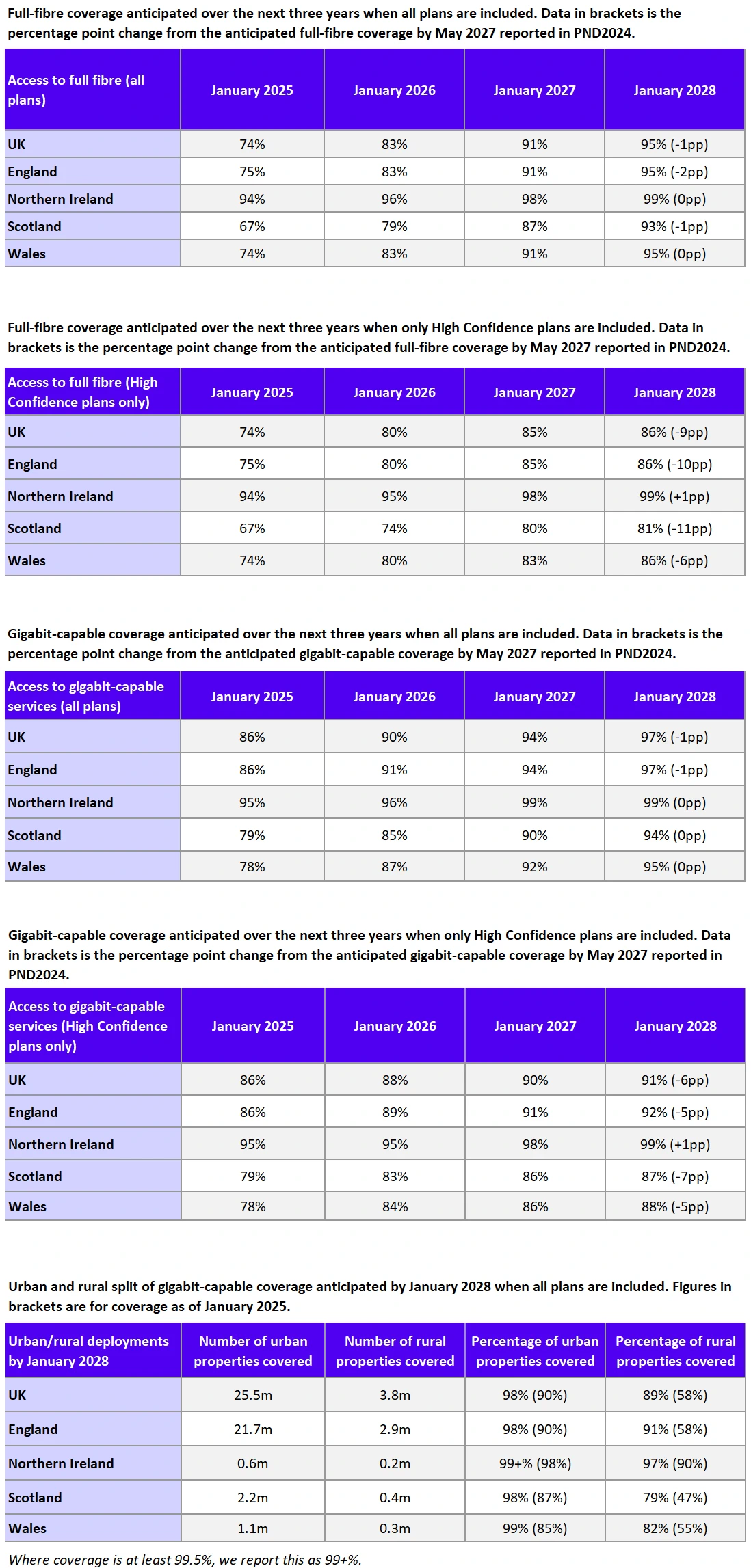
The change is important because the age of traditional terrestrial TV signals, which came via the airwaves, is expected to gradually come to an end as gigabit-capable broadband nears almost universal UK coverage by 2032 (currently c.88%).

NOTE: Just to be clear. Freeview provides access to live TV over a DTT connection (Freesat uses satellite to achieve something similar), while Freeview Play is a separate app that can be used to access content on-demand.

Squirrel Internet Launch 2.3Gbps Broadband Package via Freedom Fibre | ISPreview UK

Original article ISPreview UK:Read More

Broadband ISP Squirrel Internet has introduced their first 2.3Gbps (2300Mbps) speed unlimited usage packages for UK homes via Freedom Fibre’s network, which will set those able to access such services back just £55 per month on a 24-month minimum term.

The new package reflects Freedom Fibre’s recent move to introduce a new 2.5Gbps tier at wholesale for partner ISPs and those covered by their FTTP (XGS-PON) network (here), which reaches 350,000 premises across various parts of England and North Wales.

Customers of the new package will also receive a free installation and Zyxel Wi-Fi 6 router, as well as a commitment not to introduce mid-contract price hikes. Prices also start at just £23 per month for their entry-level 150Mbps package.

Ookla Examine Impact of WiFi on Real vs Subscribed UK Broadband Speeds | ISPreview UK

Original article ISPreview UK:Read More

Network testing firm Ookla, which collects data via their popular broadband Speedtest.net service, has published a new study that examines the “striking gap” between the home broadband speeds users are promised by ISPs and the speeds they actually experience – “the biggest factor behind this disconnect is the in-home Wi-Fi environment“.

The new study, which uses data collected during Q1 2025, looks at the percentage of households in a country achieving specific broadband speed levels, based on real-world measurements taken from users’ devices. But in order to do this it appears to manufacturer its own speed tiers by looking at the percentage of their panel that experience different speed levels, which isn’t necessarily an accurate reflection of the package class that end-users have actually taken from their ISP.

These indicators categorise household-like Wi-Fi environments, which are approximated based on user device behaviour and network characteristics, by the maximum download speeds measured over home Wi-Fi. We look at three performance tiers: equal to or above 30Mbps, 100Mbps, and 250Mbps,” said Ookla.

For example, the study found that 92% of home broadband users in the UK achieved the maximum download speed on Wi-Fi in the 30Mbps+ profile, which drops to 45% for those in their 100Mbps+ profile and 24% for those deemed to be on 250Mbps+ tiers. The United Kingdom actually does reasonably well in this table.

Ookla-Experience-Broadband-Speeds-Q1-2025

The table shows that nearly all broadband users across the analysed markets achieved download speeds equal or above 30Mbps on their home Wi-Fi networks. But the proportion of users achieving speeds meeting the 100Mbps tier was significantly lower across all countries, “indicating that access to this experienced performance tier remains relatively limited and may be considered a premium level of service in most markets,” said Ookla.

In the UK, speeds of c.100Mbps are considered more of an entry-level “full fibre” FTTP tier, and can be taken by 88% of premises (definition of gigabit-capable broadband coverage), so we’d tend to disagree that it’s a “premium level of service“. The realty in the UK is that a lot of consumers are still on slower packages because they haven’t felt a need or been able to upgrade yet.

In fairness, Ookla does point out that, based on Ofcom’s data, 83% of UK fixed broadband users were on plans offering download speeds of at least 100Mbps as of July 2024, with less than half, 44%, subscribing to tiers of 300Mbps or more.

Ookla then compares their experienced speed tiers against the network take-up of high-speed infrastructure in each of the countries tested, which naturally finds that the “two are not directly correlated“. As above, take-up of full fibre is a big factor, as is the end-user’s choice of package when they do adopt it (i.e. we don’t all buy the fastest tiers available to us as they’re often the most expensive and might not be necessary).

Lest we also forget that WiFi performance will vary based on the quality of your router (WiFi standard, chipset, antennas etc.), the device the end-user is testing with (Smartphone vs desktop computer etc.), distance from the broadband router and how much load their local network is under at the time. Suffice to say that we’re not sure how useful this data is.

Ookla-Fibre-Takeup-vs-WiFi-Broadband-Speeds-Q1-2025

Speaking of WiFi technology, Ookla noted that 23% of user tests conducted in the UK were spent while connected to devices using the old Wi-Fi 4 standard, while 57% were on Wi-Fi 5 and just 20% were connected via Wi-Fi 6 (support for Wi-Fi 7 is still too small to even register). Naturally, the more modern the Wi-Fi standard, the faster your local speeds are likely to be; assuming you have a broadband connection that can maximise it.

Ookla-WiFi-Generation-vs-Broadband-Speeds-Q1-2025

In an ideal world, the way to conduct a study like this properly would require everybody to be running speedtests in a much more scientifically controlled environment, which could compare wired vs WiFi speeds against the actual packages consumers have chosen across a broad spectrum of networks/providers. But that’s quite tricky to do at scale. Otherwise, Ookla’s research, while interesting, doesn’t really tell us anything new.

KCOM to Launch Broadband Infrastructure Sharing in Hull UK on 1st August 2025 | ISPreview UK

Original article ISPreview UK:Read More

Hull-based network operator KCOM, which has already deployed their own full fibre (FTTP) broadband network across a big chunk of East Yorkshire and Lincolnshire, has today confirmed that their new infrastructure sharing solution (i.e. giving rivals access to their cable ducts and poles) will officially go live on 1st August 2025. But is it too little, too late.

The development won’t come as a surprise to ISPreview’s readers because we already reported on the launch of their Physical Infrastructure Access (PIA) Reference Offer Product and pricing at the start of this month (here). At present, KCOM’s network is still deemed by Ofcom to hold Significant Market Power (SMP) in the Hull area, but until recently they haven’t been offering a true PIA solution like Openreach to help rivals gain access to run new fibre via the incumbents existing cable ducts and poles.

NOTE: KCOM’s full fibre network is mostly underground and currently reaches 305,000 premises across parts of East Yorkshire and Lincolnshire (England), but the relevant Hull-area reflects around 200,000 of that total.

KCOM’s local rivals (MS3, Connexin etc.) have long argued for a PIA solution because it would reduce their civil engineering costs and speed up deployments of gigabit-capable broadband, while also helping to avoid some of the anti-pole protests that have impacted a few recent roll-outs. The latter became somewhat of a political issue in 2023 and 2024 (here, here and here), which ultimately ended up placing greater pressure on KCOM to produce a PIA-alike solution.

Since last year, the local incumbent has thus been busy developing a PIA solution alongside MS3, Connexin (CityFibre) and Grain, which is now due to go live tomorrow. The first iteration of the KCOM-PIA product is still somewhat of a manual process (akin to Openreach’s early approach from about a decade ago) and one that isn’t quite as attractive as Openreach’s solution (some costs still look expensive), but it’s still a big step forward.

Jan Collins, Managing Director of KCOM Enterprise, said:

“We’re committed to working collaboratively with all parties who have an interest in accessing KCOM’s infrastructure, and we’ve been grateful for the support and encouragement of our local MPs during the past year. It’s evident that Hull now has a thriving broadband sector. That is ultimately good news for residents and businesses who more than ever need fast, reliable and good value connectivity. Infrastructure sharing is an important part of delivering that across the city efficiently and without undue disruption to residents.”

Guy Miller, CEO of MS3 Networks, said:

“MS3 Networks acknowledges KCOM’s decision to launch its infrastructure sharing product, a long-overdue development. MS3 is reviewing whether the commercial variations to the national PIA product provided by Openreach are too significant to overcome or whether this product will be sufficient to avoid future infrastructure overbuild, something we all hope is the case. We remain committed to our ongoing trial, which is poised to bring network choice to an additional 3,000 homes and appreciate the continued support of local MPs for this vital community project.”

The catch in all this is that it comes at a time when Connexin is in the process of being acquired by CityFibre (i.e. future expansion across Hull is thus uncertain and had already been on somewhat of a pause). At the same time, MS3, which is currently dealing with wider financial / market pressures (like many altnets), has reduced its build to focus on greater commercialisation of what they’ve already deployed (in Hull specifically they’ve already covered around 130k premises RFS).

Ofcom are also preparing a separate Telecoms Access Market Review 2026 (TAR) specifically for the Hull area, which will no doubt take a closer look at KCOM’s solution. But the first proposals under that won’t be published for quite a few months. The key problem here is that KCOM’s PIA solution is the sort of development that would have had much more impact a few years ago and is now arriving a bit too late to the party to have a major impact.

The official announcement also included a lot of welcoming quotes from MPs in various parts of KCOM’s network patch, including some areas that saw complaints when rivals deployed new poles. But most of those say the same thing (too spammy to post), so we’ve just picked one:

Graham Stuart, MP for Beverley and Holderness, said:

“All people in and around Beverley and Hedon have wanted is for KCOM to work with other internet providers to stop the erection of ugly and unnecessary poles and help bring prices down for all of us. So I was delighted when KCOM announced that they would start a pole sharing trial and it’s great for everyone in our area that we now have a competitive market in broadband, just like everyone else in the country. I’m grateful to everyone at KCOM who have made this happen and now the ball is in other telecoms companies’ court. I’ll be watching with great interest to see whether the likes of MS3 and CityFibre take KCOM up on this offer, having asked for it for so long!”

Virgin Media O2 Joins Age UK to Help Raise Awareness of 3G Switch-Off | ISPreview UK

Original article ISPreview UK:Read More

Mobile operator O2 (Virgin Media) has this morning announced that they’ve partnered with leading charity, Age UK, to help raise awareness of the 3G switch-off and provide customers using older devices with “tailored guidance and support” to help with the transition to more modern (4G, 5G) networks.

Just to recap. O2 started the process of switching off their older 3G mobile (mobile broadband) network in March 2025 (here and here), which is due to reach completion by the end of 2025. After that it will separately also take them several years to completely retire their even older 2G service (here) as it remains necessary for various devices (e.g. Energy Smart Meters), as well as a fallback in areas of poor 4G and 5G signals.

NOTE: The UK government and all major mobile operators are jointly aiming to phase-out existing 2G and 3G signals by 2033 (here). EE, Vodafone and Three UK have already switched-off the majority of their 3G platforms, with a few exceptions. O2’s 3G network first launched more than 20 years ago and today carries less than 2% of all network data.

The 3G switch-off will free up radio spectrum so that it can be used to further improve the network coverage and mobile broadband performance of more modern 4G and 5G networks, as well as future 6G services. The change will also reduce the operators’ costs and power consumption.

At present O2 already has a programme running alongside their 3G switch-off that works to notify customers of the change and support those who need help, particularly users who have been identified as using incompatible devices. Various discounts, free device upgrades for vulnerable users and tariff upgrades have already been promoted (here). The new work with Age UK is intended to build on all that and will also extend to O2’s MVNO providers (i.e. giffgaff, Tesco Mobile and Sky Mobile).

As part of this Age UK will launch a targeted awareness campaign and bespoke over-the-phone support through its Advice Line service. The activity will also provide direct support for older people through Age UK’s Digital Champions programme (VMO2 are helping to fund this), which delivers local awareness sessions, hands-on digital skills tuition and one-to-one guidance.

Jeanie York, VMO2 CTO, said:

“We’re continuing to push ahead with our plans to switch off 3G across the UK by the end of this year, allowing us to reallocate mobile spectrum to more efficient 4G and 5G services and give our customers a better overall experience.

While we know that the vast majority of our customers already have a 4G or 5G handset and do not need to take any action, our priority has always been to support the minority who may be impacted.

Given that many of these customers are likely to be older and potentially less tech-savvy, it makes perfect sense to partner with Age UK as we carry out this migration. We’ll draw on their expertise and significant reach to raise awareness among customers who will need to upgrade their device to continue using mobile data once 3G is withdrawn.”

Caroline Abrahams, Charity Director at Age UK, said:

“The 3G switch-off may feel daunting for many older people so it’s important that we do all we can to support those affected.

We’re very grateful for this funding from Virgin Media O2 as this will enhance our services, including our Advice Line, so that older customers can get the help needed when 3G is switched off.

It’s important to note that for those using a 3G network who don’t wish to change their handset, for now they will still be able to make phone calls and send texts as they do today – it’s just their mobile data this change will affect.

Anyone who is feeling worried and would like some support can get in touch with their provider to find out more about their options and make sure they are ready for the change, or they can call Age UK’s Advice Line for free on 0800 169 65 65.”

Virgin Media O2 and Age UK County Durham collaborated in a similar way earlier this year when the city of Durham became the first area to have the company’s 3G network switched off. Further local switch-offs have since been completed in other parts of the UK – Norwich, Telford and Guildford on 16 July, and Torquay will follow in August – ahead of a wider programme that will see the 3G network withdrawn across the country by the end of 2025.

Customers who don’t upgrade to a 4G or 5G device before 3G is switched off will still be able to use voice calls and send text messages as they currently do for now (that’s 2G), but they will not be able to use mobile data (mobile broadband).

Zayo Europe Highlights Fibre Network Expansion Across UK and Germany | ISPreview UK

Original article ISPreview UK:Read More

Network firm Zayo Europe, which operates a large high-capacity (400G capable) metro and long-haul fibre optic network across Europe, has today revealed that they’ve increased the route miles they power by 61% in H1 2025, compared to H2 2024. Both the UK and Germany have had the biggest impact on this.

For example, significant growth in the operator’s powered route miles occurred during H1 2025 in both the United Kingdom (241%) Germany (173%). This growth is set to continue into H2 and beyond, following the recent announcement of Zayo Europe’s full acquisition of the Emerald Bridge subsea cable that provides G.652D dark fibre and high-capacity wave services from the UK to Dublin in Ireland.

In addition, Zayo Europe has been working to connect more data centres across the continent and reached a total of 600 in H1. The business has also increased its workforce by 10% over the same period.

Colman Deegan, CEO at Zayo Europe, says:

“We always viewed H1 2025 as a pivotal period for Zayo Europe, marking a full year since we established ourselves as an independent entity. While growth has always been a key success metric, the pace at which our best-in-class fibre infrastructure is now connecting data centres and points of presence across major European markets is especially encouraging as we look ahead to the remainder of 2025 and beyond.

Our continued network expansion not only enhances our service capabilities but also empowers our customers with greater reach, flexibility, and resilience, enabling them to scale operations, optimise performance, and react to evolving demands with confidence.

The growth achieved so far this year is testament to the strength and dedication of our team at Zayo Europe. Service excellence is in our DNA and is frequently cited as a driving force behind our ability to secure new partnerships and mission-critical connectivity projects. That said, we’re not standing still. We’re aiming to continue this momentum throughout the rest of the year and well into 2026.”

London ISP CommunityFibre Discounts 500Mbps Broadband to £20 | ISPreview UK

Original article ISPreview UK:Read More

Alternative UK broadband ISP CommunityFibre, which has deployed their 5Gbps speed full (FTTP) network to cover 1.342 million homes (plus c.200k businesses) – mostly across London, has launched a flash sale that discounts their 500Mbps (symmetric speed) package to just £20 per month on a 24-month term.

The package itself includes a wireless router and free installation. But take note that CommunityFibre do apply annual price hikes of £2 each March, which means that you’ll be paying £20 for 500Mbps initially, albeit rising to £22 from April 2026 and then £24 from April 2027. At the end of your contract your price will then increase by £4 versus your last month.

The flash sale is due to run until 5th August 2025. A shorter 12-month contract term is also available at extra cost.