G.Network Reapply for Code Powers to Build UK Full Fibre Broadband | ISPreview UK

Original article ISPreview UK:Read More

Alternative UK ISP and network builder G.Network, which has deployed a full fibre (FTTP) broadband network across parts of London and recently came out of administration “debt-free” (here), is once again seeking Code Powers from the telecoms regulator, albeit under their new company of G.Network Holdco Limited.

The application reveals that G.Network’s full fibre infrastructure now claims to be providing symmetrical gigabit connectivity of up to 10Gbps, capable of serving residential and business markets, supporting “approximately 420,000 premises passed and around 375,000 connectable premises” (last year’s data from Thinkbroadband put their ready for service figure at closer to 260,000).

The application for Code Powers from Ofcom is typically sought in order to help speed-up deployments of new fibre networks and cut costs, not least by reducing the number of licences needed for street works. The powers can also help with supporting access to run new fibre via Openreach’s (BT) existing cable ducts and poles (PIA). The operator had such powers before, albeit under a different company (G. Network Communications Limited).

The new application makes clear that this is more about ensuring they can continue to connect new customers and upgrade their infrastructure, although it does also leave the door open for wider network expansion. But for now, they remain more focused upon commercialisation of the infrastructure that already exists.

Extract from the Code Powers Application

The Applicant, having now acquired the network, intends to continue providing retail connectivity services to residential and business customers and wholesale services to Internet Service Providers (ISPs, to both existing and any new customers.

The Applicant seeks Code powers to facilitate the effective operation of the network and to enable any future network deployment, including the network’s extension for the connection of new customers within Greater London and inspect, maintain, repair and/or upgrade the network.

Hyperoptic and Community Fibre Backers Reportedly Hunt for UK Buyers | ISPreview UK

Original article ISPreview UK:Read More

A major newspaper report has claimed that private equity firms Warburg Pincus, which backs alternative full fibre broadband network CommunityFibre, and KKR, which backs Hyperoptic, are allegedly exploring sales of their respective UK fibre broadband businesses. Both operators arguably represent some of the UK market’s more financially credible alnets.

Just to give this some context. Hyperoptic so far claims to have deployed their “full fibreFTTP/B broadband network to cover 1.9 million UK homes (mostly across blocks of flats / MDUs in cities and major towns) and is home to 400,000 customers (9th Jun 2025). The company’s most recent accounts (here) to the end of 2024 show that gross profit rose 20% to £87m, while their statutory pre-tax losses for the year stood at £144m (similar to 2023). Revenues also grew by 22% to £114m and their customer base jumped 20%, while EBITDAi increased significantly to £24m.

NOTE: KKR acquired a majority (75%) equity stake in Hyperoptic during 2019 (here) and the operator has a committed debt and loan facility of c.£1.25bn. By comparison, CommunityFibre is backed by shareholders Warburg Pincus LLC, DTCP, Railpen and NDIF, and its lenders, including names like JP Morgan and Barclays etc.

As for CommunityFibre, they’ve so far covered 1.4m homes (inc. 185k businesses within 200 metres of their network) and are home to 450,000 customers (May 2026) – mostly in London and the South East, at a total cost of over £1bn. But the operator recently announced a return to network build and now aim to cover over 2m premises by 2028-2029 (here).

According to the company’s most recent accounts to the end of 2025, revenues jumped 48% in the year to £113m and adjusted EBITDA surged by 530% to £50m. But crucially we haven’t yet seen figures for their latest losses (losses before tax for 2024 were £118.5m, down from £134.6m in 2023).

However, despite some clear positives, both alternative networks have – over the past few years – had to contend with pressures from the rising cost of network build, strong market competition and high interest rates. All of this previously caused a slowdown in their respective FTTP rollouts and some redundancies as they switched to focus more on commercialisation (although CommunityFibre are now returning to build).

Talk of a sale

According to a new FT report (paywall), both Warburg Pincus and KKR are now said to be hunting buyers for their respective networks and have allegedly also explored the possibility of a merger, but neither are believed to be in a rush (they’ve more flexibility than others). Admittedly it’s not the first time that both operators have been linked to such speculation and indeed it’s somewhat par for the course in today’s debt strained market, where altnets often seem to be engaged in such discussions.

The challenge is that there are only a few network operators able to consider consolidation at this scale and many of them are dealing with pressures of their own. For example, nexfibre / VMO2 are currently focused on getting their £2bn purchase of Netomnia through a competition review. But assuming that goes through, they still don’t have unlimited billions to throw around and competition rules will become harder to avoid as they get bigger.

Meanwhile, CityFibre remain focused on altnet consolidation and should be in the frame, but their inability to secure a deal for Netomnia did deal a blow to such ambitions, and they still have significant debts of their own to keep an eye on. The rest of the altnets are simply too small to be considered realistic buyers for either operator at this scale, until more of them consolidate.

James Ratzer, Analyst at New Street Research, said:

“Buyers are now very selectively focused on good fibre assets — and Community Fibre is one of those.”

TMT Finance recently reported that CommunityFibre had appointed JPMorgan to advise it on strategic options, although none of the operators or their backers have officially confirmed or commented on the FT’s latest report. But in the meantime, we suspect there’s likely to be much more consolidation activity at the smaller end of the altnet market, where the potential for deals is much greater and many operators are having to make difficult decisions as funding nears the red.

The recent move by lenders to take control of Gigaclear (here and here), while G.Network just came out of administration “debt-free” (here), help to highlight some of the alternative and very costly paths (if you’re an investor or lender) that may yet be taken by some operators if they struggle to consolidate sooner.

Ofcom UK Shut Enforcement Programme for Checking 999 Calling Access | ISPreview UK

Original article ISPreview UK:Read More

The telecoms regulator, Ofcom, has closed the own-initiative compliance programme that it opened in October 2025 (here) for assessing whether regulated UK phone providers were meeting their obligations concerning the need to ensure access to emergency calls (e.g. 999 and 112). The good news is they found no major issues, but they have still proposed a few changes.

The original move came after a string of broadband and VoIP providers, including BT, Gigaclear and Vonage, had been fined over various related failings in this regard (here, here and here). The regulator’s General Conditions (e.g. General Condition A3.2 and sections 105A, 105C and 105K of the Communications Act 2003) require every communications provider to “ensure the fullest possible availability of public communications services at all times, including in the event of a disaster or catastrophic network failure, and uninterrupted access to emergency organisations.”

Suffice to say, any failure of such systems, particularly to the emergency services, is extremely serious and could result in a loss of life. The risk of a failure becomes particularly relevant now that broadband providers are increasingly switching away from traditional landline phone services and on to IP-based digital phone alternatives (inc. VoIP), which may be more exposed to connectivity problems, power cuts and complexities around location reporting etc.

The good news is that Ofcom’s programme has not identified any specific issues “that warrant a targeted investigation using our formal enforcement powers at this time“. While this is a positive indicator, the regulator has written a new Open Letter to the industry, which reminds telecoms providers of how it “remains essential” that they “continue to prioritise compliance with their obligations“, given the critical role they play in this regard.

Ofcom said that they would still continue to monitor compliance and remain “prepared to take firm enforcement action where serious compliance concerns arise“. But they have still proposed several measures to support the compliance and resilience of such services.

Ofcom’s Open Letter on Emergency Calling

Further letter to communication providers: the importance of complying with your obligations regarding emergency calls

On 31 October 2025, Ofcom opened a compliance programme to assess whether communications providers are meeting a number of their obligations concerning emergency calls. We also published an open letter to remind providers of those obligations.

As explained in that letter, providers are required to take all necessary measures to ensure uninterrupted access to emergency organisations as part of any voice communications services they offer. They must also ensure that accurate and reliable information about the caller’s location is provided for all calls to emergency numbers, to the extent it is technically feasible.3 It is of vital importance that consumers across the UK can contact emergency services whenever they may need to and that any call is accompanied by accurate location information.

Last year, we concluded two enforcement investigations into failures affecting access to emergency services. These cases highlighted the importance of providers having appropriate measures in place to meet their obligations. We therefore opened this compliance programme – and analysed information from a range of providers – to assess whether providers across the sector have such measures in place. The observations we have made in this compliance programme will be considered, alongside all other relevant factors, when assessing what measures providers have taken to comply with their regulatory obligations.

This letter sets out our findings and highlights a number of measures that support compliance with providers’ obligations, and which we consider will ensure the continued resilience of networks providing access to 999 and 112 services. Our expectation is that providers should take steps to ensure these measures are in place where it is appropriate and proportionate to do so. These expectations apply, whether as individual measures or as a combination of measures, as part of complying with their regulatory obligations to take all necessary measures to ensure uninterrupted access to emergency organisations and to provide accurate and reliable caller location information.

Findings

We have not identified specific issues that warrant a targeted investigation using our formal enforcement powers at this time. While this is a positive indicator, it remains essential that providers continue to prioritise compliance with their obligations given the critical role that communications networks and services play in facilitating access to the emergency services.

Providers’ responses described a range of approaches to managing emergency calls, reflecting differences in network design and operational practices. Based on our review, we have identified a number of measures that providers should look to take to support the ongoing resilience of 999 services. These are set out below.

Measures to support compliance and resilience

1. Monitoring and escalation of emergency call issues

We have found that providers take different approaches to monitoring emergency calls and escalating complaints related to them. Through previous investigations we know some resilience incidents impact only emergency calls, and may not be picked up by wider monitoring. It is therefore important that emergency calls are effectively monitored to ensure that providers can act swiftly when issues arise to prevent interruptions to services.

As such, we would expect providers to have specific monitoring in place to identify issues affecting emergency calls, including having in place continuous, real-time monitoring or alert systems that can identify outages impacting emergency calls, rather than relying on general network alarms. Complaints can also be a crucial channel for identifying potential problems impacting emergency calls, and appropriate complaint-handling processes can reduce the impact of incidents.

As such, where feasible all providers should ensure they have clear policies and procedures in place for the prioritisation and escalation of customer complaints that relate to emergency calls.

2. Use of test calls to verify emergency calling connectivity

Our analysis found that, while all network providers conduct some form of test call to establish whether emergency calls are working as expected, not all providers make regular end-to-end test calls.

Test calls are quick and easy method to reassure providers that emergency calls are being connected and that accurate location information is provided. While certain test call simulations can confirm that a network is able to initiate emergency calls, end-to-end test calls provide additional assurance by verifying that calls are correctly routed to BT’s Call Handling Centre and that accurate caller location information is provided.

We have seen in recent investigations that disruption to services could have been reduced if regular end-to-end test calls had been made.

As such, we would expect to see providers conducting end-to-end test calls to proactively test the resilience of emergency calls on the network. As part of test call arrangements, we would expect all providers to:

• conduct end-to-end test calls in a manner that is proportionate to the scale of the network – whether those are scheduled routine test calls and/or specific test calls as part of network changes; and

• schedule test calls with the BT 999 Call Handing Centre to ensure there is no impact on the live 999 service.

3. Assessment and testing of network changes with potential impact on emergency calls

We found that providers take a range of approaches to managing the impact of network changes on emergency calls. Some providers carry out testing of emergency calling functionality as part of their change management processes, while others place greater reliance on post-implementation testing where it has been identified that a change may affect emergency calls.

Where providers rely on assessments of likely impact to determine whether testing is required, the quality and robustness of those assessments is critical. A failure to identify the potential impact of a network change can result in appropriate testing not being carried out.

In our recent investigation into Vonage, shortcomings in the provider’s internal assessment processes meant that a change with the potential to affect emergency calls was not identified as such, and post-implementation testing was therefore not conducted. This contributed to the failure of its emergency calling service.

Therefore, we would expect providers to:

• work from a default assumption that any significant network change may impact emergency calls unless there is a credible basis for concluding otherwise;

• conduct all necessary testing where network changes may impact emergency calls; and

• where providers rely on post-implementation testing, we would expect there to be robust procedures and processes in place, with appropriate oversight and checks, to minimise the risk of errors in assessing whether a network change could affect emergency calling services.

4. Accuracy of location information

Location information helps emergency services locate the caller and GC A3.6 sets out a number of requirements to follow in order to ensure accurate and reliable information. Based on our analysis, we consider there are three ways in which providers could improve how they provide location information:

Provider assurance of location information accuracy

To demonstrate compliance with the obligation to provide accurate caller location information to the extent technically feasible, providers need to have appropriate assurance over the accuracy and reliability of the location information associated with emergency calls made from their network or service.

Providers generally appear to rely on reports provided by BT’s CHA to identify errors in location information. Many providers do not collect their own data about location information errors.

Whilst BT’s reports are helpful, providers should be aware that not all the errors associated with location information will be identified and fed back to BT and so may not be included in the reports.

Therefore, to reduce the potential for errors, providers should compile their own data to identify and analyse any issues with location information.

Use and management of proxy location data

We believe that some providers are using proxy location data. This is a substitute number or code that providers use when the original location data is corrupted in some way.

The use of this proxy data ensures that the emergency call can be put through to the emergency Call Handling Centre. However, it also means that the location information provided on these calls is not always correct, which could impact the response from the emergency services.

There may be circumstances where providers need to use proxy data. However, given the potential risks to callers, we would encourage providers to identify and analyse where proxy data is used and take proactive steps to minimise its usage.

Also, we would encourage providers to make BT aware of any standard proxy data that they regularly use. This would help emergency services identify if and when location information provided is possibly incorrect.

Sustained accuracy of address information

Finally, we noted that there was some variability in the frequency of how often address information is updated for the Emergency Services Database (“ESDB”) and that providers audit this information at different frequencies. The ESDB is a central system used to pass caller location information from landline telecoms networks to emergency services. If this information is not updated regularly, it increases the likelihood that an out-of-date address may be used in an emergency.

We recognise that the volume and frequency of updates will vary by the size of each organisation. However, we would encourage all providers to update the ESDB in a matter of days or weeks of an address being added or changed. To ensure address information remains accurate over time, we would also expect providers to carry out audits of ESDB data at least annually, or more frequently where appropriate.

Next Steps

In this letter we have set out a range of measures that providers should look to take to support compliance with regulatory obligations and the continued resilience of emergency calling services. In addition, Ofcom is planning to:

• begin monitoring the volume of test calls made to BT’s CHA; and

• gather and review additional information from BT’s CHA regarding the accuracy of providers’ location information.

We continue to keep under review our Resilience Guidance, as it relates to emergency calls, to determine whether further clarity is necessary regarding our expectations on providers.

Additionally, we encourage all providers to proactively take note of any Ofcom publications relating to the protection of emergency calling services, as well as signing up for regular Ofcom updates. While it remains for individual providers to determine the measures that are appropriate and proportionate to take to protect access to these services, providers are reminded of their obligation in GC A3.2(b) to take all necessary measures.

Ofcom will draw on the observations from this compliance programme as part of its ongoing assessment of how providers are meeting their obligations in relation to emergency calling, taking into account the specifics of each provider’s arrangements. We will also discuss the measures above as part of our regular engagement meetings and ongoing supervision of CPs.

Given the importance of these critical services, we remain prepared to use our formal enforcement powers to investigate where we identify concerns with provider compliance.

Finally, we would like to thank the providers involved in this programme for their positive engagement and the measures they already take in the interests of safe and reliable access to emergency services.

Yours faithfully

George Lusty (Enforcement Director)

Orange acquires 100% ownership of MasOrange | Total Telecom

Original article Total Telecom:Read More

Press Release

Orange today announced that it has completed the acquisition of the 50% stake in MasOrange held by Lorca, its joint venture partner in Spain. The Group now owns 100% of the operator’s capital and will fully consolidate MasOrange’s results in its financial statements from going forward.

This transaction follows the  signing of a binding agreement with Lorca on 12 December 2025, under which Orange agreed to acquire full ownership of MasOrange for a cash consideration of €4.25 billion. Since then, Orange has obtained all the necessary approvals for the transaction to be completed, including from the European Commission.

A key milestone in the Group’s strategy in Spain

Christel Heydemann, Chief Executive Officer of the Orange group, said: “Acquiring full ownership of MasOrange is a strategic step of our Trust the future plan and strengthens Orange’s position in Spain, our second-largest market in Europe. It paves the way for accelerated industrial, operational and commercial synergies, supporting greater value creation. With full ownership comes full agility, MasOrange can now move at full speed backed by the strength and scale of the Orange group.”

Meinrad Spenger, Chief Executive Officer of MasOrange, added: “By becoming fully part of the Orange group, MasOrange now has an even stronger foundation for future growth. It will allow us to accelerate our momentum in the Spanish market, supported by a greater capacity for investment and innovation as well as global expertise. This is good news for the Spanish consumers, enterprises and public administrations, since we will continue to provide them high-quality and innovative services, while benefiting from the Orange group’s industrial strength and scale to create even more value in Spain.”

As a follow-up to this transaction, Meinrad Spenger will join the Orange group’s Executive Committee. This appointment reflects the strategic importance of Spain for the Group and will further leverage his recognized experience in the telecommunications market and his leadership in advancing MasOrange’s development.

MasOrange is currently the leading operator in the Spanish market by customer base and customer satisfaction. At the end of the first quarter of 2026, it had 26 million mobile customers and 7.1 million fixed broadband customers. MasOrange relies on the most advanced leading fiber and 5G mobile infrastructure, enabling it to provide high-quality connectivity and other innovative services across the country to meet the needs of public administrations, consumer and business customers.

After closing, the Group intends to refinance MasOrange financial debt over time.

The post Orange acquires 100% ownership of MasOrange appeared first on Total Telecom.

VodafoneThree Allegedly Places Bid for UK Consumer Broadband ISP TalkTalk | ISPreview UK

Original article ISPreview UK:Read More

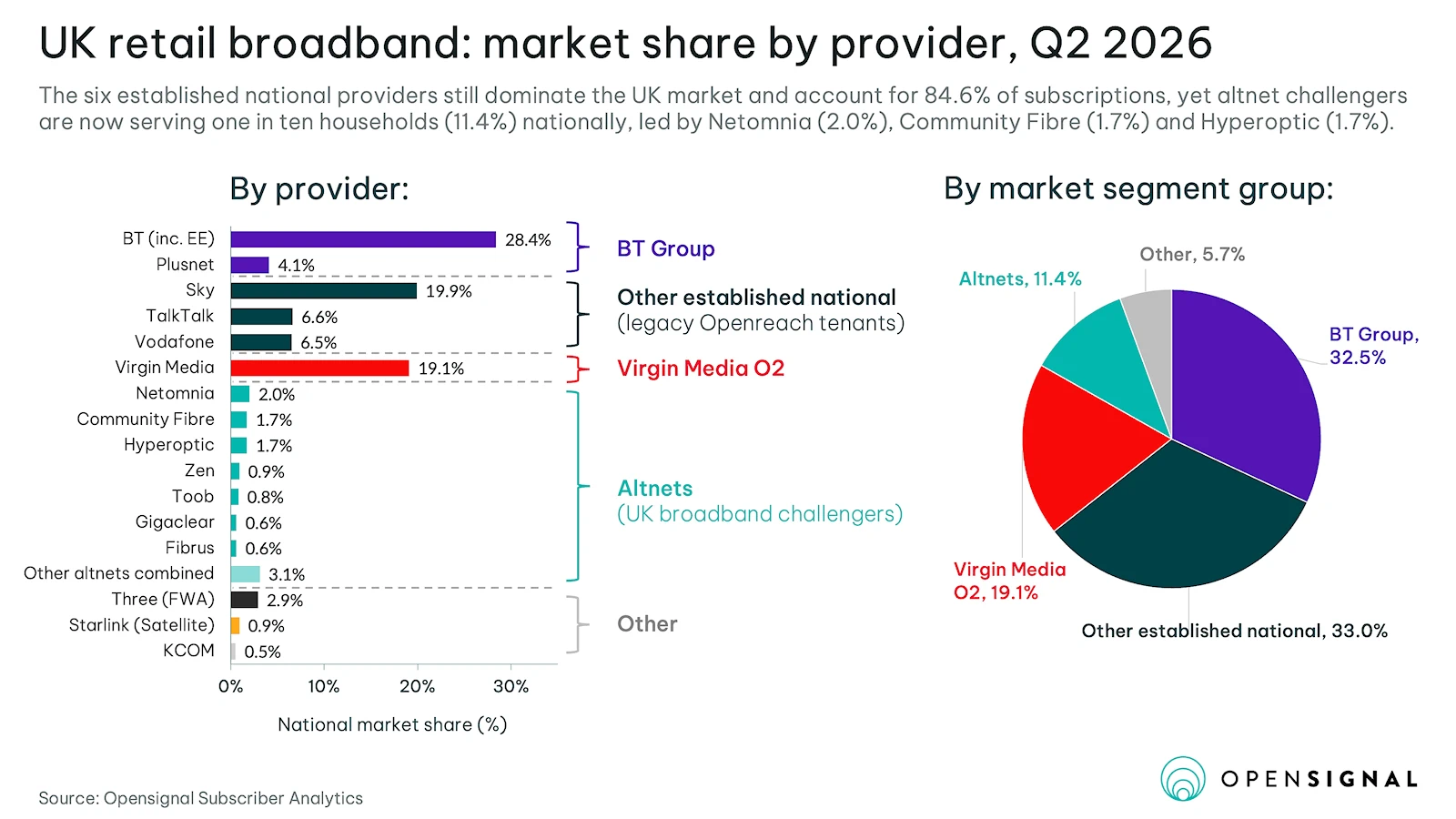
A new report claims that broadband and mobile giant Vodafone (VodafoneThree) has made an offer to acquire the consumer internet and phone business of debt-strained rival TalkTalk (home to 1.75 million customers as of May 2026), which could turn them into a much bigger fixed line ISP (Vodafone has 1.83m fixed broadband customers).

Regular readers will already be aware that the TalkTalk Group has reportedly been engaging in talks with several prospective bidders for their various divisions since around the start of this year (here). At the same time the consumer side of their business has been through a major brand refresh and advertising push in an attempt to try and entice customers back to their refreshed products (here), while continuing to cut costs as part of efforts to tackle the group’s underlying debt problems.

NOTE: The Group’s last set of annual accounts (here) revealed that TalkTalk made a statutory loss before tax of £465m for the year ended 28th February 2025 (up from £153m last year). The overall level of net debt (excluding leases) has also hit £1.2bn – rising to £1.96bn if you include leases.

According to a new report in the FT (paywall), VodafoneThree has now tabled a bid for TalkTalk’s consumer broadband and phone business, which could in theory create a single provider with around 3.6 million broadband customers.

A spokesperson for VodafoneThree, however, said they are currently “very happy with our organic strategy” for growing fixed broadband (they’re one of the fastest growing retail ISPs), but would “always keep a close eye on movements in the market and the sector“. TalkTalk itself declined to comment.

The potential for a deal between VodafoneThree and TalkTalk would appear to make sense, as they both harness several alternative broadband networks and tend to target more cost-conscious consumers with cheaper bundles. At the same time the TalkTalk Group are still seeking a buyer for their PXC wholesale division, although we’ve yet to see any solid developments on that for the past few months.

Connect Fibre Expands Derbyshire UK Project Gigabit Broadband Rollout | ISPreview UK

Original article ISPreview UK:Read More

The UK Government (DSIT) appears set to slightly expand their Project Gigabit contract with altnet ISP Connect Fibre (Fibre Assets) for the £33m (public subsidy) Derbyshire (LOT 3) Project Gigabit contract; this originally (here) aimed to build a full fibre (FTTP) broadband network to cover “around” 17,000 premises in hard-to-reach areas.

However, it’s important to remember that such contracts are not static and their scope, as well as committed levels of public funding, can change over time for a number of different reasons – informed by regular reviews of existing UK deployment plans. For example, commercial operators may expand or reduce their roll-out plans in the same region(s), which can reduce or grow the scope for public investment within those same contracted areas.

NOTE: Project Gigabit aims to help extend gigabit broadband (1000Mbps+) ISP networks to “nationwide” coverage (c.99% of UK premises) by 2032, focusing mostly on the final 10-20% in hard-to-reach areas. Some 90% of premises can already access such a network (here) and Ofcom are forecasting this could reach up to 95% by January 2029 (here).

The contracted operator could also find the deployment to be more expensive, or possibly even cheaper, than previously envisaged. Such adjustments may occur due to changes in build costs and interest rates / inflation, as well as any unexpected obstacles to street works or greater efficiencies of build than planned or expected. Suffice to say, there can be various reasons why the contracted scope of related builds and the level of allocated public funding may change over time.

In this case Connect Fibre’s deployment contract for Derbyshire (LOT 3) has just been modified to increase its public subsidy by £1,577,558 (total funding of c.£35m) and reach an additional 790 premises. The contract’s new “total scope” is 18,651 premises.

The additional scope is to be welcomed, albeit with the catch that there may be further changes in the future, which could go in a different direction. So, it’s not always easy to tell what the final picture will be until you actually reach the end.

According to the latest May 2026 data from the government’s umbrella Building Digital UK (BDUK) agency (here), Connect Fibre has so far only managed to complete the build for 1,200 premises in Derbyshire, which is fairly slow-going given that the contract was first awarded all the way back at the end of 2023.

NOTE: Connect Fibre is backed by investment from the Foresight Group and originally aspired to cover 100,000 premises across the East of England.

BT takes shelter under Anthropic’s Glasswing | Total Telecom

Original article Total Telecom:Read More

BT logo

 News

The company will gain access to Anthropic’s Claude Mythos Preview to help boost its cybersecurity amidst the growing threat of AI cybercrime

BT has become the first UK company to join Anthropic’s Project Glasswing, a defensive coalition of critical infrastructure providers from around the word.

The partnership will give BT access to Anthropic’s powerful frontier AI model Claude Mythos Preview, which recently shocked the global cybersecurity community by discovering decades-old vulnerabilities hidden in what were considered highly secure foundational systems.

Project Glasswing, which was launched in April, aims to give key players in critical national infrastructure access to this powerful model in order to identify and remove systemic vulnerabilities before cybercriminals begin using similarly advanced AI for attacks.

“AI models have reached a level of coding capability where they can surpass all but the most skilled humans at finding and exploiting software vulnerabilities,” Anthropic explains on the Project Glasswing website. “Given the rate of AI progress, it will not be long before such capabilities proliferate, potentially beyond actors who are committed to deploying them safely. The fallout—for economies, public safety, and national security—could be severe. Project Glasswing is an urgent attempt to put these capabilities to work for defensive purposes.”

Project Glasswing was launched with 12 core launch partners, including Amazon Web Services (AWS), Apple, Google, Microsoft, CrowdStrike, NVIDIA, Palo Alto Networks, and the Linux Foundation, alongside roughly 40 other critical infrastructure organisations.

For BT, joining this group emphasises the company’s key role in securing the UK critical national infrastructure.

“AI is changing cyber security fast, and businesses need trusted partners who can help them stay one step ahead. By joining Project Glasswing, BT will strengthen its own cyber security capability to protect our networks, our customers and the wider UK,” said Jon James, Chief Executive Officer of BT Business.

How is AI supercharging the UK’s digital economy? Join the discussions at Connected Britain 2026

Also in the news
TELUS and L-SPARK give Canadian startups access to AI supercomputer
Belden to acquire RUCKUS Networks for $1.85bn
VMO2 taps Suffolk solar farm for 10 years of clean energy

The post BT takes shelter under Anthropic’s Glasswing appeared first on Total Telecom.

WightFibre’s Broadband Gigabit Island Project Slowly Nears Completion | ISPreview UK

Original article ISPreview UK:Read More

Alternative network provider WightFibre, which runs its own independent gigabit speed Full Fibre broadband (FTTP) network across the Isle of Wight (situated off the South Coast of Hampshire in England), has published their annual accounts to September 2025 and revealed that their fibre lines now cover c.90% of premises (74,000+) and they’re home to 28,000+ customers.

In case anybody has forgotten. The operator previously stated that they were expecting to have invested around £110m by 2030 as part of their ongoing “Gigabit Island Project”, which was aiming to extend their full fibre network to reach 96% coverage by the end of 2027 (c.80,000+ premises).

NOTE: WightFibre is backed by Infracapital, which also supports various other alternative broadband networks, such as Gigaclear, Fibrus and Ogi etc. The operator has also benefitted from several million pounds worth of gigabit vouchers from the UK government (BDUK).

The latest results confirm that they’re slowly “nearing completion” of this major effort, which is despite facing plenty of competition from Openreach’s (BT) roll-out of competing FTTP technology. But 2026 will be a particularly notable year because it will see them celebrate “25 years of connecting the Isle of Wight” (here), originally starting as the Isle of Wight Cable and Telephone Company.

Otherwise, the latest annual accounts show that the company delivered revenues of £9.158m (up 27% from £7.196m in 2024), although losses hit £19.32m (2024: £18.95m) and the company had net liabilities of £75.96m (2024: £56.64m). But the rate of customer acquisition is reported to be running “ahead of plan” with 36% penetration, which is a strong result given the competition on part of their network (retail price competition from rival ISPs is also a concern).

The other good news is that WightFibre delivered a full year of positive adjusted EBITDA (i.e. earnings before interest, taxes, depreciation, and amortisation) of £951k (2024: -£673k), which has been helped by their revenue growth and recent cost control measures. The company, which is also home to 119 employees (all based at their Cowes HQ), will however need to keep an eye on those ongoing losses (a fair bit that is to be expected while they continue to build fibre).

Elon Musk Previews Two New Starlink Broadband Dish Terminals | ISPreview UK

Original article ISPreview UK:Read More

The boss of SpaceX, Elon Musk, has given a subtle preview of two new dish (terminals) for their Starlink broadband service as part of a new video interview, both of which look set to be thinner and lighter than before. But the internet provider has yet to reveal any solid official details about the new kit, which is expected to launch soon.

Starlink currently has nearly 10,600 satellites in Low Earth Orbit (LEO) – mostly at altitudes of between c.340-550km. Residential customers in the UK usually pay from £40 a month for the ‘Residential 100Mbps’ unlimited data plan (kit price may vary due to different offers), which also promises uploads of c.15-35Mbps and low latency connectivity. Faster packages exist at greater cost, while more restrictive (data capped) options also exist for roaming users (e.g. £55 per month for 100GB of data).

NOTE: Starlink’s network currently has 12 million customers (up from 6m in July 2025). The service had 110,000 customers in the UK as of July 2025 (up from 87,000 in 2024) – mostly in rural areas.

However, we’ve recently reported on how some people had spotted strong indications that Starlink were preparing to launch two new dishes (here), one of which looks set to replace their Standard dish and the other of which appears to be a rugged battery-powered alternative or replacement for the more portable Mini dish.

The latest development occurred yesterday after SpaceX posted a new video chat with Elon Musk, which was focused on their future plan for AI satellites. But the video also featured two brand-new dish models sitting on a table directly in front of Musk, which he does confirm as being “the new Starlink terminals, which we made in much higher volume than the current terminals.” Unfortunately, that’s pretty much all he says about them.

Survey Work Starts on New Subsea Fibre Cable Between UK and Denmark | ISPreview UK

Original article ISPreview UK:Read More

Long-haul fibre company Midgard Infra (formerly Altibox Carrier) has begun the process of surveying the seabed ahead of deploying a new 630km long high-capacity subsea fibre optic cable – VERENA – to help link the United Kingdom with Denmark, which is expected to boost broadband and network data connectivity with Europe.

The cable itself, which will run between Scarborough (England) and Esbjerg (Denmark), is said to feature 16 fibre pairs capable of 512Tbps (Terabits per second) in total design data capacity to help handle surging international and AI traffic demands across the North Sea.

NOTE: Midgard Infra owns and operates one of Norway’s largest fibre-optic networks, extending across 30,000+ kilometres and connecting more than a million homes, businesses and data centres.

The survey work for this will take place across summer 2026, which it’s hoped should reduce the negative impacts of stormy weather – the sort that tends to be more common when surveying during the autumn to winter months. All being well, the new cable should then be laid and become fully Ready for Service (RFS) in the fourth quarter of 2028.

Delivery of the Verena programme is being led end-to-end by JTD Associates, while the survey activities are being delivered in partnership with Pelagian acting as Engineering Consultants, and XOCEAN, utilising their fleet of advanced Uncrewed Surface Vessels (USVs) to conduct offshore data acquisition.

The use of USVs supports a more sustainable and cheaper approach to offshore data acquisition through lower fuel consumption, reduced emissions and simplified offshore logistics compared with traditional survey operations.

Survey data collected will enable the project team to:

➤ Identify the safest and most resilient route alignment.

➤ Understand seabed conditions and burial requirements to maximise long-term system protection.

➤ Safely manage interactions with existing offshore infrastructure including telecommunications cables, power assets and pipelines.

➤ Support environmental and regulatory approvals.

➤ Improve installation efficiency and reduce intervention requirements over the operational life of the system.

Espen Vestli, Chief Operating Officer, Midgard Infra, said:

“The North Sea presents a complex operating environment, and high-quality survey data is fundamental to reducing risk before installation begins. The survey programme will provide the detailed seabed and route intelligence needed to support informed engineering decisions, optimise system design and ensure Verena is delivered to the highest standards of resilience and reliability.”

Regular readers will no doubt note that this is only the latest in a string of recent subsea cable announcements, including the new AUÐUR cable between the UK and Iceland (here), as well as the IOEMA Fibre project that will connect the UK with Northern Europe (here). Not to mention others, like 2Africa (here). Several other subsea links have also been proposed, such as a new one to link with Shetland (here).

The UK Government has at the same time also proposed “tougher fines and prison sentences” for those who damage subsea infrastructure essential for UK broadband access and trade, with a consultation planned to take place later this year (here).