Liberty Global eying purchase of Three Ireland | Total Telecom

Original article Total Telecom:Read More

blue and black city buildings photography

News

The deal could be valued at up to €1.5 billion, according to analysts

Telecoms giant Liberty Global is in talks to purchase Ireland’s largest mobile operator, Three Ireland, according to a report from The Financial Times.

Formal discussions are already underway with Three Ireland’s owner, Hong Kong’s CK Hutchison, with the deal potentially worth €1.5 billion. However, no formal decision has yet been made.

Three Ireland currently has around 5 million subscribers, representing around 49% of the market, according to telecoms regulator ComReg.

For Liberty Global, the deal would present an opportunity to tie its Irish telecoms businesses together into a single entity.

The company currently operates an Irish mobile virtual network operator (MVNO), Virgin Mobile, which delivers services to around 140,000 customers using Three’s network; it also owns Virgin Media Ireland, which controls around 21.5% of the Irish fixed broadband market.

The acquisition of Three Ireland would allow Liberty to combine these businesses into a single converged entity, offering major cross-selling opportunities and theoretically network synergies.

By contrast, CK Hutchison’s recent focus has been on the potential launch of an initial public offering (IPO) for its global telecom assets, valued at around £20 billion

First reported in March last year, the planned IPO was initially on hiatus until the closure of the £16.5 billion Vodafone–Three merger, but it now appears to be regaining momentum, according to reporting this week. The assets could be listed as early as Q3 this year, according to anonymous sources.

However, this direction is far from certain for Hutchison, which has also been exploring sales of its units in Denmark and Sweden in recent years, as well as a tie-up between its Italian unit WindTre and local rival Iliad.

If any of these deals were to gain significant traction, they could significantly delay any plans for an IPO.

Keep up to date with all the latest telecoms news with the Total Telecom newsletter

Also in the news
World Communication Award Winners 2025
Ofcom clears the way for satellite-to-smartphone services
LG Uplus’s AI voice call app glitch leaks user data

The post Liberty Global eying purchase of Three Ireland appeared first on Total Telecom.

Housing Provider Peabody to Deploy SCCI’s Shared UK Full Fibre Infrastructure | ISPreview UK

Original article ISPreview UK:Read More

The not-for-profit housing association, Peabody, which is responsible for almost 109,000 homes (220,000 residents) across London and the Home Counties of England, has signed a new framework agreement with SCCI Alphatrack (SCCI Group) to deploy their single shared full fibre broadband infrastructure solution (4Fibre) to residents homes.

Instead of installing multiple networks from different network operators, SCCI’s 4Fibre solution builds one open-access network that any broadband supplier can use. The goal is to help minimise disruption for residents, while protecting the structure and safety features of buildings, and reducing environmental impact.

NOTE: SCCI Alphatrack is a specialist in the design, supply, installation and maintenance of Fibre, Media and Fire Life safety systems.

The announcement is a little vague on precisely how much of Peabody’s housing stock is to benefit from this, although we’ve been informed that the main focus seems to be on large high-rise and complex residential buildings. Peabody has over 250 such buildings, mainly in London.

ISPreview has been informed that the first site to benefit from this will be Cumberland Market near Regents Park in Camden, which consists of about 500 units on one estate, including about 120 premises that are being supported by the Building Digital UK (BDUK) agency’s Urban Vouchers (Gigabit Broadband Voucher Scheme). But more will follow.

Elizabeth Connelly, Head of Landscape and Telecoms at Peabody, said:

“This is about making things easier for residents and safer for their homes. We understand the importance of being connected and we want all of our residents to have access to faster, affordable and more reliable broadband.”

A spokesperson for SCCI Alphatrack added:

“The new partnership also supports the national ambition to bring faster broadband to more homes and ensures the homes of Peabody’s residents are ready for the digital demands of the future. It makes it easier to keep accurate building records, supports safer installations, and provides a scalable solution that can grow with demand.”

Eagle-eyed readers may well recall that two alternative broadband operators, G.Network and Netomnia, have previously also signed agreements to build FTTP into Peabody’s homes (here and here). But it’s worth noting that Netomnia haven’t yet expanded their full fibre network into London (i.e. their deal was perhaps more about the Home Counties) and G.Network has just gone into administration, although 4Fibre’s solution was used to help wire a few blocks for G.Network before that happened (about 300 units).

Solutions like the one being delivered by SCCI have potentially become more attractive since delays in the Building Safety Regulator’s (BSR) updated processes for minor works began causing wider problems and pushing up costs, often unpredictably (here).

Only One Telecoms Firm Makes Top 50 UK Companies for Customer Satisfaction | ISPreview UK

Original article ISPreview UK:Read More

The Institute of Customer Service (ICS) has today published their first biannual UK Customer Satisfaction Index for 2026 (January), which reveals that Tesco Mobile was – for the second consecutive report – the only mobile and broadband (telecoms) provider to make it into their table of the country’s top 50 organisations. But both Virgin Mobile and Three UK were still named among the most improved.

The research typically reflects the results from a large online survey of over 15,000 customers – balanced to be representative of the UK adult population, which asked each of them about their experiences across hundreds of different organisations and market sectors (a total of 59,500 responses were gathered). This was then used to produce a score out of 100 for each organisation.

NOTE: Tesco Mobile’s service is supplied via an MVNO deal with O2 (Virgin Media).

Overall, the “Telecommunications & Media” sector reported another improvement in its general ranking since the last report in July 2025, with average customer satisfaction rising to a score of 76 out of 100 (up from 74.4 in July 2025 and 73.3 in Jan 2025). The number of customers in the same sector who feel the organisation they dealt with cares about them as a customer has also increased to 63.7% (up from 59.5% in Jan 2025).

The good news is that the only telecoms operator to make the top 50 companies table, Tesco Mobile, did improve their ranking from 9th place in July 2025 to 8th place today. The operator’s score also improved from 82.5 to 85.3 over the same time period. Take note that the limited sample size means that some highly rated telecoms providers simply didn’t receive enough feedback to be included into the top table.

Elsewhere, the UKCSI also named two telecoms providers in their top 20 table of the “most improved organisations“, including Virgin Mobile on a score of 76.3 (up from 70 in Jan 2025) and Three UK on a score of 77.3 (up from 71.8 over the same period). The inclusion of Virgin Mobile is a little bit odd as they no longer exist as a standalone brand and most customers were moved on to O2’s plans some 2-3 years ago.

2026-January-Customer-Satisfaction-Survey-UK-Top-50-Companies

United Group B.V. targets growth with €1.5bn refinancing | Total Telecom

Original article Total Telecom:Read More

News

The move will allow the company to save roughly €15 million in annual interest repayments

United Group B.V., the Netherlands-based telecommunications and media operator, has completed a €1.5 billion bond refinancing package, a move it says reflects its strong potential for long-term growth.

The refinancing saw the company issue €1.13 billion of new floating rate notes (FRNs) and €355 million of new PIYC PIK (Pay-if-you-Can, Pay-in-Kind) Notes. This new debt matures in 2031 and 2033, respectively.

The proceeds used from the refinancing will pay off €480 million of existing FRNs due 2029, €650 million of FRNs due 2031, and €351 million of existing PIYC PIK notes due 2029.

As a result, the company expects to save €15 million of annual interest as well as an extension of the Group’s debt maturity profile.

“We are delighted with the outcome of this transaction. It has not just reduced our funding cost, but this was a further vote of confidence from our bond investors and builds on the positive momentum following our strong Q3 results,” said Stan Miller, CEO of United Group. “It reflects our disciplined approach to capital structure management and enhances our financial flexibility, allowing us to continue executing our strategy in our core EU markets, advancing our growth agenda, and creating long-term value for our stakeholders.”

This is the second round of bond refinancing in two months, with the company having reshuffled €400 million of debt in December last year, according to the company’s latest fiancial results.

Alongside debt refinancing, United Group has also been active in simplifying its portfolio in recent years, selling non-core infrastructure and assets to deleverage and focus on core markets.

Last year, the company agreed to sell Serbia Broadband (SBB) to Abu Dhabi-based e& for €825 million. It also sold NetTV Plus, SBB’s direct-to-home services, and sports rights to local rival Telekom Srbija for €652 million.

The operator continues to operate telecoms companies in Bulgaria, Croatia, Slovenia, Montenegro, Bosnia and Herzegovina, Greece, and North Macedonia.

Keep up to date with all the latest telecoms news with the Total Telecom newsletter

Also in the news
World Communication Award Winners 2025
Ofcom clears the way for satellite-to-smartphone services
LG Uplus’s AI voice call app glitch leaks user data

The post United Group B.V. targets growth with €1.5bn refinancing appeared first on Total Telecom.

CityFibre Make Business FTTP Broadband Available to 4.5 Million UK Premises | ISPreview UK

Original article ISPreview UK:Read More

The country’s largest alternative broadband operator, CityFibre, has this morning announced that they’ve “unlocked” their nationwide footprint and made their business Fibre-to-the-Premises (FTTP) services available across 4.5 million premises – offering wholesale business products at data speeds of up to 2.5Gbps (Gigabits per second).

The move comes shortly after CityFibre completed its upgrade from slower GPON to XGS-PON (Symmetric 10Gbps PON) technology, which is how they were recently able to launch a 5.5Gbps speed broadband product at wholesale (here) for residential ISP partners like Sky Broadband to use. But in the meantime, the operator’s business FTTP products have tended to lag behind a bit, although today’s announcement helps to rectify that.

NOTE: CityFibre is owned by Antin Infrastructure Partners, Goldman Sachs, Mubadala Investment Company, Interogo Holding etc. The network is supported by UK ISPs such as Vodafone, TalkTalk, Zen Internet, Sky Broadband and more (local ISP availability does vary). Some 730,000 customers use the network, which as of Oct 2025 covers 4.6 million UK premises (4.3m RFS).

The operator’s new business FTTP services are primarily designed to meet the needs of small businesses, small or home offices (SoHos) and home workers with symmetrical speeds of up to 2.5Gbps, which is useful for data backup, remote collaboration, scalable connectivity, work-ready WiFi for multiple users and more.

CityFibre’s business services also boast of “rapid fix times of less than eight hours and plans to introduce a greater choice of install points, bringing a connection directly to a home office“. The expansion follows CityFibre’s tripling of the availability of its dedicated, enterprise-grade Ethernet services to serve over 260,000 UK businesses, which resulted in over 50% YoY growth in the Ethernet sector for them in 2025.

Andy Nash, Director of Business, Government and Mobile at CityFibre, said:

“Opening up our full FTTP footprint is a game-changer for UK businesses and a great opportunity for our reseller partners. There are hundreds of thousands of small businesses across CityFibre’s network and we’re designing the Multi-Gig, ultra-reliable products they need to innovate and grow.”

Nathan Marke, Chief Strategy Officer at CityFibre partner Giacom, said:

“UK businesses, both large and small, increasingly rely on technology to operate, so reliable, Multi-Gig broadband is key. CityFibre has listened to the market and is making the most of its next generation network to bring greater choice and exceptional products and services to even more businesses across the UK.

Enabling access to the residential as well as business postcodes served by CityFibre’s network, through Giacom’s Cloud Market platform, is great news for our community of 6000 MSPs and expert technology resellers, and means even more SMBs can benefit from high speed, reliable, secure, great value connectivity.”

CityFibre still retains an ambition to extend their network to cover 8 million premises at some point in the future, through a mix of market consolidation and new fibre build. The operator has also recently spoken of their plans for upgrading the network to handle speeds of up to 100Gbps in the not-too-distant future (here).

Virgin Media O2 UK Pledges to Donate 12,000 Smartphones in 2026 | ISPreview UK

Original article ISPreview UK:Read More

Broadband ISP and mobile operator Virgin Media and O2 (VMO2) have today announced that they will once again aim to donate “up to” 12,000 pre-owned Smartphones during 2026 to help people in need get online and reduce e-waste, which mirrors their previous pledge for 2025 that succeeded in donating the same figure.

As usual, VMO2 intend to source these Smartphones from customer returns and its O2 Recycle service, which helps to ensure unwanted devices are given a second life and assists those who might otherwise struggle to afford such a device. Free O2 mobile data (i.e. 25GB with rollover, plus 50 international minutes to 42 countries, unlimited minutes + texts) will also still be available from the Good Things Foundation and VMO2’s National Databank.

NOTE: Since its launch in 2009, O2 Recycle has recycled over 4 million devices and paid out over £356m to consumers (up by £6m from last year). A total of more than 30,000 phones have also been rehomed under previous efforts.

The initiative, supported by Hubbub, will rehome phones through VMO2’s nationwide network of charity partners and community groups (e.g. The Multibank).

Nicola Green, Chief Comms and Corporate Affairs Officer at VMO2, said:

“We know having access to a phone is a lifeline for people experiencing financial hardship.

That’s why Virgin Media O2 is proud to lead the way in providing 12,000 free phones this year to those who need them so they can get online and stay connected to loved ones.

This builds on our comprehensive, industry-leading measures to tackle digital exclusion, whether that’s through our National Databank that provides free O2 mobile data, Community Calling that rehomes phones to those who need them, or our social tariffs for people who receive government support payments.”

Ookla Examine Mobile Broadband Upload Speeds and Capacity in the UK | ISPreview UK

Original article ISPreview UK:Read More

Global network benchmarking firm Ookla, which collects data from consumers via their Speedtest.net service (inc. apps), has published a new report that takes a broad look into the impact of mobile (4G, 5G etc.) upload speeds in the age of AI and also reveals how much importance UK operators place upon it (EE, O2, Vodafone and Three UK).

Historically fixed and mobile broadband connections have always tended to prioritise download speeds (i.e. the rate at which data is pulled from the internet to your device), which makes perfect sense because that’s how most of the information we want to access arrives on our devices (loading websites, downloading files, streaming videos etc.).

However, in recent years the importance of upload speeds has steadily risen (i.e. the rate at which you send data from your device to the internet), driven by increasing usage of cloud / remote gaming services, video blogging, video calls, social media and Artificial Intelligence (AI) etc.

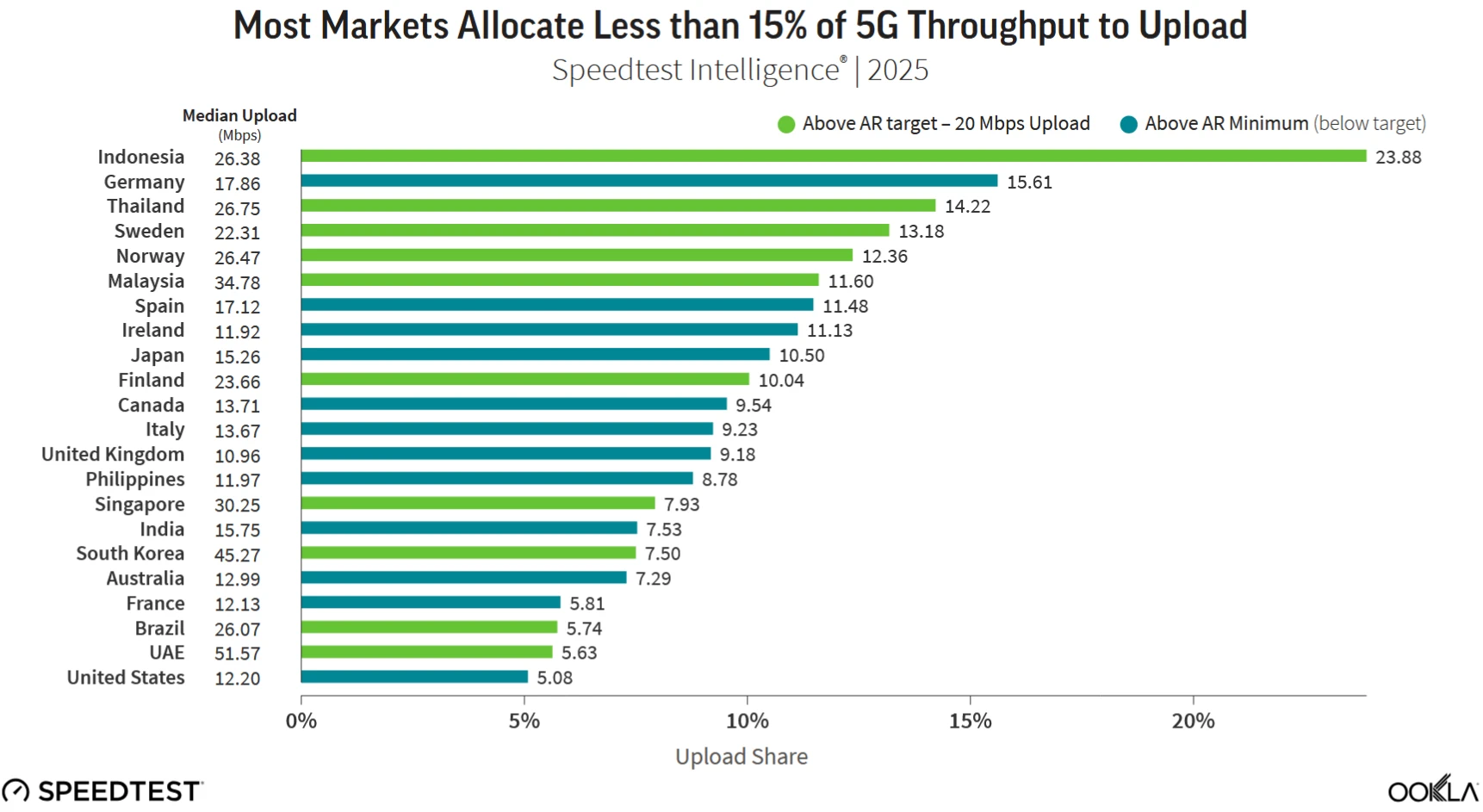
Ookla’s new report finds that upload speeds from mobile operators have been rising globally from 2021 to 2025, thanks largely to the release of additional spectrum and a variety of technological advances (both within the network and via end-user devices). But it also claims that operators have not been increasing the percent of network capacity allocated to uplink connections during this period, and some have even been reducing that percentage.

For example, mobile upload speeds for the fastest 10% of UK connections increased by approximately 36% between 2021 and 2025, while mobile download speeds in the UK increased by around 58% between 2021 and 2025. But Ookla states that, out of all the mobile operators analysed, EE (BT), O2 (Virgin Media) and Vodafone in the UK “follow Chinese operators as leaders in network resources allocated to uplink connections“. Not that you’d notice.

Ookla capacity allocation to uploads by uk mobile operators

Ookla-network-resources-allocated-to-uploads-by-global-operator

Yes, mobile upload speeds have been rising globally, but that’s mainly because 5G enables faster overall connections, both on the uplink and the downlink. In some countries, like Brazil, the percentage of network capacity allocated to upload speeds has been falling. In other countries, like China, the capacity allocated to the uplink has been holding relatively steady. In no country in this study is the percentage of capacity allocated to the uplink rising in a significant way,” said Ookla’s report.

Suffice to say that while upload performance is improving, the proportional importance of download capacity continues to dominate mobile operator investment and network configuration choices. Overall, Ookla’s report doesn’t really say anything new or terribly surprising, but it is a useful additional piece of research to consider.

On the flip side, when we look at fixed broadband connections – where spectrum capacity is not a constraint, the rapid adoption of XGS-PON technology within Fibre-to-the-Premises (FTTP) based broadband lines has resulted in a rise in symmetric speed packages (i.e. downloads run at the same speed as uploads). But of course, that’s more an example of technology change taking precedence over changes in consumer behaviour, since end-users still make much more use of downstream than they do upstream on fixed lines.

Five Alternative UK Broadband Networks Ranked in Sunday Times 100 Tech List | ISPreview UK

Original article ISPreview UK:Read More

The latest 2026 Sunday Times 100 Tech list has been published, which reflects a ranking of Britain’s fastest-growing private technology companies. The good news is that five broadband network operators have managed to make it into the 2026 hardware list, with Netomnia topping the table in 3rd place and CityFibre just edging in at 48th.

The list itself is split into a top 50 for software companies and a top 50 for hardware companies, with altnet operators all being ranked under the hardware list. But it’s worth remembering that being one of Britain’s fastest-growing private technology companies doesn’t always equate to overall success. For example, the last year’s (2025) list only ranked two broadband operators, toob (4th) and G.Network (33rd), but the latter is now in administration (here).

The 2026 ranking manages to include five alternative networks, including toob that remains well ranked (9th) for the second year running. The 100 businesses in the full list are said to have combined revenues of £3.7 billion and plan to create 4,300 “well-paid roles” this year, although there’s no mention of how redundancies might weigh against this (probably because companies tend not to broadcast such things until they happen).

Nick Parbutt, toob CEO and Founder, said:

“It’s an honour to be ranked in The Sunday Times 100 Tech listing for the 2nd year running. This achievement reflects our rapid growth, thriving customer base and is a testament of our dedicated team who work incredibly hard to deliver ultrafast full-fibre connectivity to homes and businesses across England and Scotland.”

2026 Sunday Times 100 Tech List (Hardware)

Rank
Name
Activity
Location
Sales
Growth
Profit
3 Netomnia Fibre broadband provider Tewkesbury £38.7m 352.78% No
9 toob Fibre broadband provider Portsmouth £14.0m 169.89% No
13 Fibrus Fibre broadband provider Belfast £29.5m 116.05% No
18 CommunityFibre Fibre broadband provider London £76.0m 101.93% No
48 CityFibre Fibre broadband provider London £133.5m 27.82% No

Quickline Build UK Full Fibre Broadband to 200,000 Premises and Start New Campaign | ISPreview UK

Original article ISPreview UK:Read More

Alternative rural broadband provider Quickline, which is deploying a new gigabit-capable full fibre (FTTP) and fixed wireless (FWA) network across parts of Yorkshire and Lincolnshire in England (3-Year Rollout Plan), has today revealed that their fibre network now covers 200,000 premises (plus 200k more via wireless) and they’re launching a new brand campaign.

Just to recap. Quickline is currently aiming to extend gigabit-capable broadband to a further 360,000 UK premises across thousands of rural communities (roughly 170k via publicly funded projects and almost 200k from commercial builds) and the provider was previously aiming to end 2025 with a total of 200,000 premises passed. Suffice to say, they seem to have hit their target.

NOTE: Quickline is supported by funding of c.£500m from Northleaf Capital Partners, as well as c.£300m of public subsidy from four Project Gigabit contracts (here, here and here), plus c.£225m in term loans and debt guarantees from the National Wealth Fund and a £25m term loan from NatWest.

The internet provider has now decided to launch a major new regional campaign championing “proper broadband, done right“, which aims to raise awareness of their service and thus boost take-up. The campaign will highlight “what matters most to customers; fair pricing, reliable connectivity, fast speeds and great service“. It also puts a spotlight on Quickline’s commitment to price certainty, at a time when many broadband other ISPs are increasing prices mid-contract.

The multi-channel campaign will run across billboards, bus stops, local press, TV and radio, significantly increasing Quickline’s visibility across the region.

Mark Bowden, Quickline CEO, said:

“We know we’re not one of the big household-name providers, and we don’t take trust for granted. As an independent broadband provider, we have to earn it, by doing exactly what we say we’ll do.

That’s why we’ve launched 2026 with a campaign that clearly sets out who we are, what we deliver and why customers can depend on us. People right across Yorkshire and Lincolnshire will start to see a lot more of Quickline as we continue to build our network and connect more homes and businesses.

This year is about growth, but it’s also about delighting customers and being visible in the communities we serve. That’s how we build long-term relationships and a network people can truly rely on.”

BDUK Updates on Project Gigabit Broadband Contract for Cheshire UK | ISPreview UK

Original article ISPreview UK:Read More

The Government’s Building Digital UK (BDUK) agency recently provided a small but useful update on their stalled £43m (public subsidy) Project Gigabit broadband roll-out contract for Cheshire (Lot 17), which was originally held by Freedom Fibre until they “mutually agreed to terminate” it in March 2025 (here). But Openreach (BT) may now be set to take it on.

Just to recap. The contract for Cheshire (England) was originally valued at £43m (public subsidy) and aimed to extend gigabit-capable broadband connectivity to cover 15,000 premises in hard-to-reach areas, including villages like Kingswood, Allostock, Minshull Vernon and beyond. But this was sent into limbo after the contracted supplier, Freedom Fibre, suddenly pulled out just as the build phase was supposed to start.

NOTE: Project Gigabit aims to help extend gigabit broadband (1000Mbps+) ISP networks to “nationwide” coverage (c.99% of UK premises) by 2032, focusing mostly on the final 10-20% in hard-to-reach areas. Some 89.6% of premises can already access such a network (here), with Ofcom forecasting between 91% and 97% by January 2028 (here).

At the time a spokesperson for BDUK told ISPreview that they were “now moving swiftly to put in place alternative plans with other suppliers to connect premises that were due to be connected. Freedom Fibre has not received any public funding for this contract“. Since then, we’ve been patiently waiting for an update on the plan for Cheshire (Lot 17) and the first clue came in an easily overlooked update to one of the contract’s old documents.

According to a recent update to the old Cheshire Public Review Closure Notice document, BDUK has since put the intervention area through an “alternative procurement under the Type C regional framework as part of call off 8” (details of this contract haven’t yet been published). We initially overlooked this last week because it had been inserted into the middle of some older paragraphs (credits to one of our readers, Peter, for spotting).

Just to give this some context. Openreach currently holds the existing Single Supplier Framework agreement with BDUK (here) – valued at c.£1.2bn, which is focused on Cross-Regional (Type C) procurements (no other suppliers currently tackle Type C). This reflects remote areas where no or no appropriate market interest had previously been expressed before to BDUK, or areas that have been descoped or terminated from a prior procurement. Such areas are often skipped due to being too expensive (difficult) for smaller suppliers to tackle.

A similar thing happened to the Project Gigabit contract for Mid West Shropshire (Lot 25.01) last year, which saw Voneus drop out. Openreach eventually ended up securing the intervention area and merging that into their existing call-off 3 contract (here).

Suffice to say that the mention of Type C and Call Off 8 together would strongly point to Openreach being the preferred bidder, although ISPreview understands that BDUK are still reviewing the bid(s) and nothing has been formally awarded. Openreach declined to comment, and we are awaiting BDUK’s response.

NOTE: Freedom Fibre is backed by investment from InfraBridge (DigitalBridge) and Equitix. The network primarily operates in the Cheshire, Greater Manchester, Staffordshire, Suffolk, Essex and North Shropshire areas of England and North Wales – covering 350,000 premises and being home to 25,000 customers (Jun 2025 data).