

Original article ISPreview UK:Read More
The City of Bradford Metropolitan District Council (CBMDC) in West Yorkshire has told UK broadband and phone operator Openreach (BT) to remove their external wall boxes (CSP) from homes within the World Heritage Site area of the city, such as those around the Saltaire UNESCO area and possibly others. Such boxes are usually installed as part of copper and fibre deployments.
According to locals in the affected area (special credit to ISPreview readers Danny and Chris for the tip), residents recently began reporting that men dressed as Openreach engineers had been dropping letters into homes where they’d previously installed the wall boxes (these are better known as ‘Customer Service Points‘ – CSP).
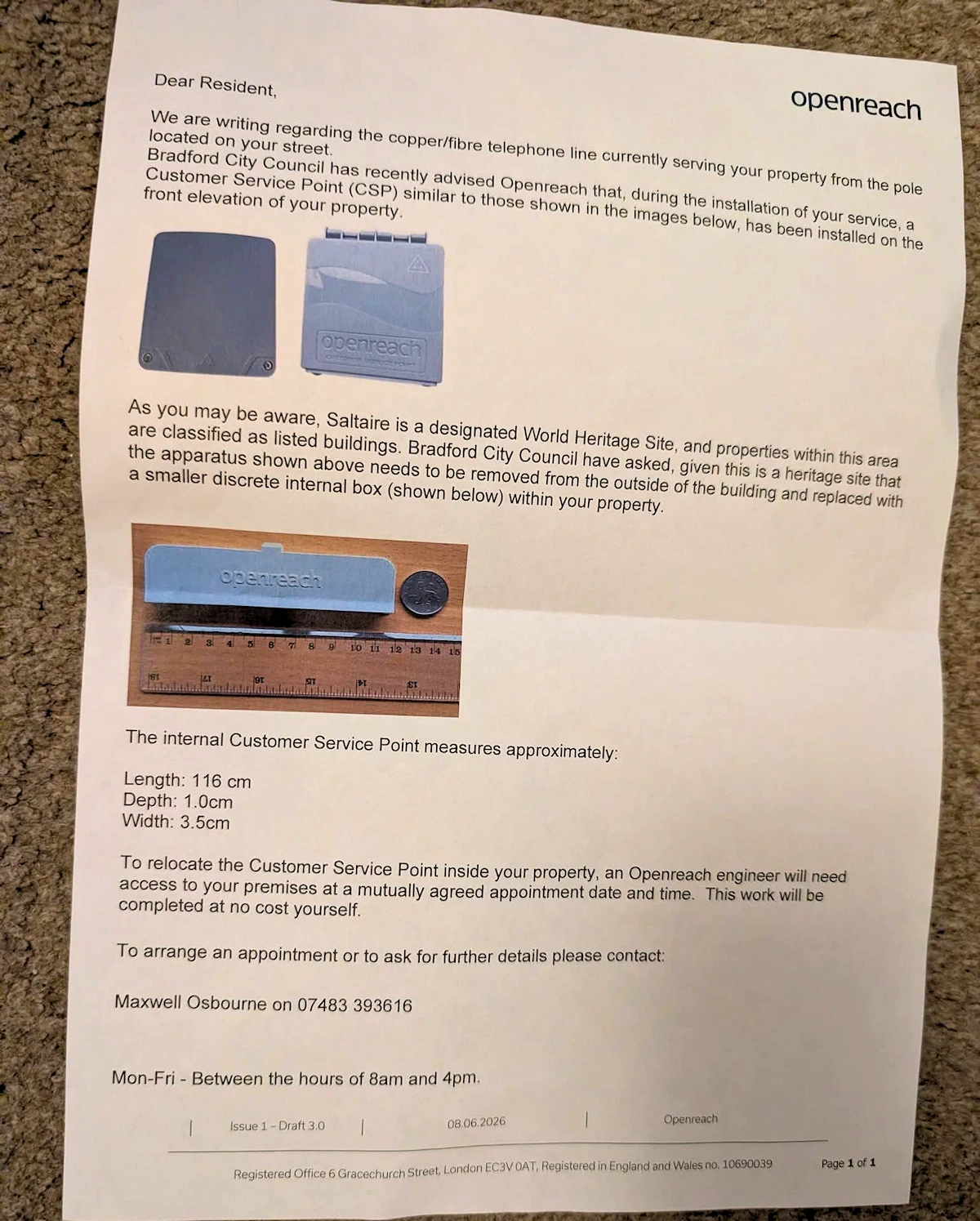
The letters state that Bradford City Council recently advised Openreach that, during local customer installations of their new copper and full fibre (FTTP) broadband services, the operator had installed a CSP “on the front elevation of your property … As you may be aware, Saltaire is a designated World Heritage Site, and properties within this area are classified as listed buildings. Bradford City Council have asked, given this is a heritage site, that the apparatus [pictured above] needs to be removed from the outside of the building.”
The notice goes on to state that Openreach would then install a “smaller” and more “discrete internal box” within impacted homes. A copy of the letter can be found below (article continues below) and promptly caused some residents to question whether it was legitimate or not via local Facebook groups.
Picture of Openreach’s Letter to Local Homes
A spokesperson for Openreach told ISPreview:
“The letter is genuine, we’re dropping all properties with an external CSP within the World Heritage Site area with a view to changing the install, so it has a small internal CSP. The plan is to give them all a letter and follow up in person to try and arrange appointments.”
The good news is that the perhaps mildly embarrassing episode will be corrected free of charge by the operator, although arranging all that work to take place across local homes is naturally a bit of a choir and one that may put some unexpected short-term pressures on local engineering resources.
Otherwise, it’s not the first time that we’ve seen network operators being asked to shift a piece of their infrastructure in protected areas, although only very rarely have we ever seen this take place across multiple homes at the same time (it normally occurs due to singular incidents).