London Full Fibre ISP G.Network Prep 10Gbps Home Broadband and New Funding | ISPreview UK

Original article ISPreview UK:Read More

The CEO of alternative London-focused UK broadband operator G.Network, David Sangster, has issued a progress update – the first since the ISP was reorganised through administration earlier this year. The business is now said to be “EBITDA and cashflow positive” and plans to launch a 10Gbps speed package for homes next month. Fresh funding has also been secured.

Just to recap. G.Network finally came out of a brief period of administration in March 2026 (here), after being acquired by distressed debt specialist FitzWalter Capital (here and here). At the time the internet provider (G.Network Holdco Limited) said it had been “successfully reorganised through administration“ and would now move forward on a “debt-free, well-capitalised, growth-oriented footing“.

The operator originally aspired to expand their FTTP lines to cover 1.3 million premises in London by the end of 2026, but ultimately ended up being impacted by an increasingly competitive environment and rising costs (high build costs, high interest rates etc.); this resulted in job cuts and a greater focus on commercialisation instead of new fibre build (here), which is a not unfamiliar direction for the UK’s many altnets.

The latest update from David Sangster claims that both residential and business monthly sales are “up substantially, as are installations“, while recent price increases are also said to have boosted the Average Revenue Per User (ARPU) on residential lines by 30% in the last four months to over £40. Despite this, new customers can still take speeds of 300Mbps from £29 per month on a 24-month term (rising to £39 for 900Mbps), although you do have to pay between £19 to £29 for the one-off installation.

In terms of the operator’s independent full fibre network, this is now claimed to cover 395,000 premises ready-for-service (up from 375k in June 2026), which is out of more than 420k premises “dug past“. But interestingly Sangster said the central London focused network would also be introducing new 2.5Gbps and 10Gbps residential products in September.

David Sangster, G.Network CEO, said:

“We are fortunate to operate in central London, with limited overbuild and where over 50% of our customer homes are worth over £1m. To better serve this market, we are introducing new 2.5 Gbps and 10 Gbps residential products in September, and expect this to drive up ARPU further.

Business ARPU is up by 50%, with the productivity of our sales teams doubling versus last year. The number and value of renewals have increased, and underlying churn is down.

Throughout this period of transformation and growth, we continue to maintain our Trustpilot score at 4.8 out of 5. I’m particularly proud of the near-perfect Trustpilot scores our industry-leading engineering teams receive for the quality of their installations, which can be challenging in central London.

Turning to the network, we have increased the number of RFS’d premises to 395k out of more than 420k premises dug past. In parallel, we continue to reduce our network opex, which was already low given the geographic concentration of our network.

We have addressed a number of process inefficiencies, especially in the web order journey, where we have seen the proportion of web sales double. Our plans to embrace AI and further standardise our extensive Salesforce stack will also pay dividends in H2.

The new management team and I inherited a company with strong fundamentals but different priorities. An amazing, wholly-owned, ducted network in the heart of central London underpins this rapid resurgence, coupled with the fantastic G.Network team adapting quickly to our new culture. I’m grateful to the whole team for their hard work and embracing this change.”

In addition, Sangster revealed that their main shareholder, FitzWalter Capital, had agreed to commit a “substantial further investment to accelerate growth in H2“, although he wasn’t yet ready to provide any details but believes the “refocused” operator now has a “bright future” as they embark on a new “3-year journey“.

On the subject of that proposed new 10Gbps package, it’s worth noting that G.Network’s infrastructure is based on the XGS-PON standard for Fibre-to-the-Premises (FTTP) lines. In practice this means that their average advertised package speeds – after the usual caveats and overheads – will probably need to be promoted to consumers at around the 7-8Gbps mark.

Otherwise, the newly restructured business is naturally now also a lot more attractive as a consolidation target for other altnets and such an outcome would probably suit FWC, which normally prefers to be more of a short-term holder of the businesses they rescue.
TalkTalk Business Merge with UK Tech Services Provider ARO – Creates £200m Group | ISPreview UK

Original article ISPreview UK:Read More

Business broadband and communications provider TalkTalk Business (TTB), which in 2023 was demerged from the TalkTalk Group and sold to the same group’s own shareholders for £95m (here), has today announced that they’ve agreed to merge with technology services provider ARO to create one of the UK’s largest independent connectivity and managed service providers (MSP).

The new group will bring together approximately 650 employees, annual revenues of around £200 million and a combined customer base of more than 70,000 organisations across its digital connectivity, cloud, cybersecurity and managed IT services.

“Together, the combined group will have the scale, expertise and resources to accelerate investment in technology, service delivery and innovation, strengthening its ability to support customers at every stage of their digital transformation journey,” states the announcement.

The deal means that ARO will extend its impact as part of a larger organisation with expanded capabilities and scale. For TalkTalk Business, the merger continues their evolution toward becoming a managed technology services provider, which also builds on their previous acquisition of Planet IT.

Ciaran Rafferty, CEO at ARO, said:

“This is a defining moment for both ARO and TalkTalk Business. Together, we are creating a business with the scale, expertise and ambition to become a leading independent provider of connectivity and managed technology services in the UK.

By bringing together our complementary strengths, we are creating a stronger partner with broader capabilities, deeper expertise and greater capacity to invest in innovation, service delivery and long-term customer success.”

Ruth Kennedy, CEO of TTB, said:

“This merger represents another important step in our transformation into a leading managed services provider and brings together two highly complementary businesses to create a leading independent technology partner for UK organisations.

The market is evolving rapidly, with organisations increasingly seeking technology partners that can combine strategic expertise, operational excellence and broad service capabilities at scale. This combination creates a business that is uniquely positioned to meet those expectations and support customers across every stage of their technology journey.

We are creating a platform with the scale to invest, innovate and grow. Together, we have an exciting opportunity to play a leading role in the future of the UK technology services market.”

According to the announcement, the newly merged business will “initially” continue to operate under their existing brands to ensure continuity for customers, employees and partners. But over time this may well change. As it stands the merger is still subject to final approval under the National Security Investment Act (NSIA), which is not expected to throw up any obstacles and should thus conclude by the end of the summer 2026.

The development comes shortly after both TalkTalk’s debt-strained consumer and wholesale (PXC) businesses were both separately linked to potential acquisitions by different companies and investors (here and here). But it’s worth noting that TalkTalk Business formally completed their separation from the wider Group back in Feb 2026 and are “now operating as a fully independent organisation“ (here).

Starlink Reveals Forthcoming Wi-Fi 7 Satellite Broadband Router | ISPreview UK

Original article ISPreview UK:Read More

A new regulatory filing by SpaceX has revealed that Starlink are preparing to release a new Wi-Fi 7 capable home wireless router (UTR-261 – this is same line as the Router Mini UTR-251) for customers of their ultrafast satellite broadband constellation in the UK, USA and other countries.

The details are presently quite thin on the ground, although the product supports Power over Ethernet (PoE), 1 x WAN port (AC power is also handled through this via a POE adapter), 2 x LAN ports and a USB-C port. The Wi-Fi 7 capability should naturally deliver better speeds, congestion management and faster latency times, although testing of a sample device only seemed to show use of the 2.4GHz and 5GHz band (no 6GHz).

NOTE: By mid-2026 Starlink’s global network had 12 million customers (up from 6m in July 2025) and they added 1.7m in Q2 2026 alone (consumers). The service had 110,000 customers in the UK as of July 2025 (up from 87,000 in 2024) – mostly in rural areas.

The new router, which is to be “Made in Vietnam“, is expected to launch very soon and will probably accompany Starlink’s V5 dish terminal for consumers (details here and here), which incidentally will not support either Standby Mode or In-Motion use.

Starlink currently has around 11,000 satellites in Low Earth Orbit (LEO) – mostly at altitudes of between c.340-550km. Residential customers in the UK pay from £40 a month for the 100Mbps unlimited data plan, which also promises uploads of c.15-35Mbps and low latency connectivity (c.20ms). Faster packages exist at greater cost, while more restrictive (data capped) options also exist for roaming users (e.g. £55 per month for 100GB of data).

150 Government Funded 4G Mobile Mast Upgrades Now Live Across UK | ISPreview UK

Original article ISPreview UK:Read More

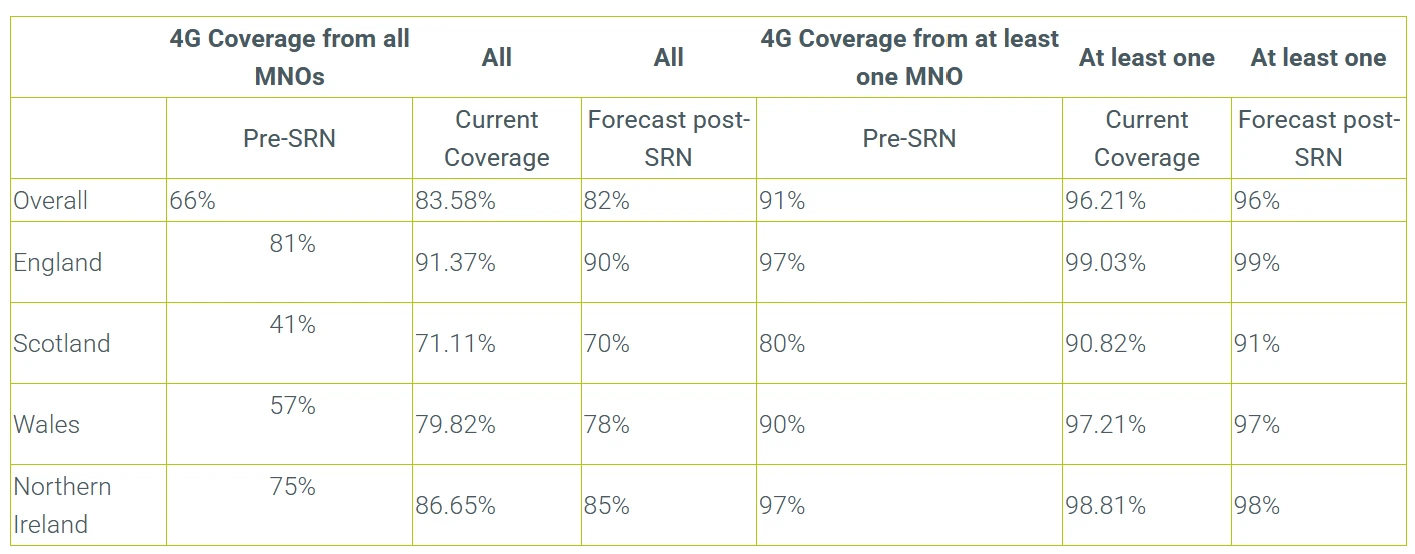
The UK Government has published a progress update on their part of the industry-led £1bn Shared Rural Network (SRN) project this morning, which reveals that a total of 150 publicly-funded rural 4G (mobile broadband) mast upgrades have now gone live across the United Kingdom (up from 140 in June 2026).

The SRN – originally supported by a commitment of £501m in public funding and £532m of private investment from operators – involves both the reciprocal sharing of existing masts in certain areas and the demand-led building and sharing of new masts in others between the operators.

NOTE: The target varies between regions, thus 4G cover from at least one operator is expected to reach 98% in England, 91% in Scotland, 95% in Wales and 98% in N.Ireland. But this falls to 90% in England, 74% in Scotland, 80% in Wales and 85% in N.Ireland when looking at coverage from all MNOs combined.

The SRN last year achieved its first target a year ahead of schedule by ensuring that 96% of the UK’s landmass can now access a 4G mobile network from at least one operator (here), although the coverage range drops to 89-90% when looking look across all operators (here). The project is now focused on tackling the second target to reduce Total Not-Spot (TNS) areas by January 2027.

The upgrades – all delivered through existing infrastructure to protect scenic spots – mean additional 4G is now available across more than 5,684 square kilometres combined across the UK and includes three of the UK’s most iconic hiking landscapes: the Lake District, Snowdonia and Exmoor. Previously, these areas would only be in range of EE’s coverage – or none at all, but now O2 and Vodafone / Three UK can also reach them.

Some of Britain’s most iconic national parks are among the biggest winners from the SRN. Compared to other parks, the Yorkshire Dales and Eryri (Snowdonia) have seen the biggest boosts in mobile coverage rising by around 7 percentage points in each, according to latest government figures, helping visitors stay connected.

New analysis shows 42 Shared Rural Network sites have now been activated across the UK’s national parks: 

  • 25 sites in England, including seven in the Lake District and six in the Yorkshire Dales.  
  • 16 sites in Wales, including 12 in Eryri/Snowdonia.  
  • 1 site in Scotland, in Loch Lomond and The Trossachs. 

Ian Murray, Minister of State for the DCMS, said:

“You should be able to switch off in the countryside without being cut off from the help and services you need.

These 150 masts are helping change that – giving walkers, visitors and rural communities better access to signal when they are checking a route, contacting family, running a business or calling for help.”

In terms of how much work is left to do before the start of 2027. According to DCMS, up to 40 government funded mast upgrades will be going live across Britain and up to 44 new publicly funded masts will also be built across Scotland, with the first already live in the Western Isles.

Current SRN 4G Geographic Coverage Progress (June 2026)

SRN-Coverage-Progress-June-2026

Altnet ISP Lightning Fibre Surpasses 20,000 UK Broadband Customers | ISPreview UK

Original article ISPreview UK:Read More

Eastbourne-based alternative internet provider Lightning Fibre, which is building a full fibre (FTTP) network across Sussex and Kent in England (they also hold a partnership to use CityFibre’s wider UK network – here), has reached a key take-up milestone by surpassing 20,000 customers – reflecting a quarter of homes taking up broadband across their new network.

The company says this growth reflects “sustained demand for a simple, fixed price, human-centric approach to delivering broadband“, one they say contrasts well with national providers who often annoy customers by applying multiple in-contract price increases in a way that’s rarely seen as fair.

NOTE: Lightning Fibre was acquired by existing backer Foresight Group in 2024 and put under a new company – LF Holdco2 Ltd. The same group also backs other altnets, such as Connect Fibre and F&W Networks. The altnet aims to cover 140,000 premises with their full fibre network.

According to the company’s most recent results to the end of March 2025, Lighting Fibre has so far built their full fibre network to cover 80,000 premises (RFS), which aligns with the announcement’s claim of “achieving 1 in 4 homes taking up broadband“. But it also suggests that they’re network roll-out hasn’t expanded much in the past 18 months or so, and we don’t know how many of that 20k come from the CityFibre (off-net) side.

“Lightning Fibre remains focused on sustainable growth, expanding network availability, enhancing its product offering and continuously improving the customer experience,” added the announcement.

Bertrand Mazieres, CEO at Lightning Fibre, said:

“Achieving 25% residential take-up in this highly competitive market shows that our approach resonates with customers. People want broadband that simply works, at a fair price, with local support they can rely on. And that’s exactly what the team delivers every day – with more than 9 in 10 of our Trustpilot reviews rated 5 stars. Thank you to all our customers for buying local and joining the Lightning Fibre family.”

Altnet ISP Highland Broadband Discounts Gigabit Packages in Scotland | ISPreview UK

Original article ISPreview UK:Read More

Alternative network operator and UK ISP Highland Broadband (Lothian Broadband), which is deploying a 10Gbp capable full fibre (FTTP) network across various rural parts of Scotland, has discounted their 1000Mbps (symmetric) speed package to just £34.99 per month on a 24-month term and reduced their 5Gbps tier to £49.99 (inc. £100 gift card).

Customers of the service can typically expect to receive unlimited usage, free installation, a Wi-Fi 6 wireless router (Wi-Fi 7 on their 5Gbps package), 24/7 network monitoring, a 28 day cooling off period, up to 12 months’ worth of Switching Credit to help you join while still under contract with your old ISP and the option to add Whole Home Wi-Fi for £10/month (free on their 5Gbps plan).

NOTE: Highland Broadband is supported by investments worth c.£110m from a mix of shareholders, including SNIB and Alpha Real Capital. The provider originally aimed to pass 100,000 premises by the end of 2024, but we haven’t had a progress update since.

Customers of their 1Gbps and 5Gbps packages also receive Dynamic Parental Controls and Advanced Cyber Security features, but take note that Highland Broadband also applies a pricing policy like the big ISPs that hikes your monthly prices by £4 in April each year. Otherwise, their packages currently start at £29.99 per month for speeds of 150Mbps.

The provider’s network can currently be found across around 150 rural Scottish towns and villages in parts of Argyll, Fife, the Highlands, Lothians, Moray and Stirlingshire.

London ISP Vorboss Brings 100Gbps to One Triton Square Businesses | ISPreview UK

Original article ISPreview UK:Read More

London-focused UK ISP Vorboss, which has deployed and operates a 100Gbps speed fibre optic network for businesses in the UK’s capital city, has just connected their new infrastructure to businesses and research organisations located inside the One Triton Square building at Regent’s Place – each floor will be able to access their top speeds.

Just to recap. The operator has so far completed the deployment of a 900km long dedicated point-to-point fibre optic network across Central London (covering most of zones 1 and 2) and a few areas beyond – connecting businesses, landlords, and commercial buildings across the city.

NOTE: Vorboss is backed by c.£250m of investment from Fern Trading, advised by Octopus Investments, which also separately backs the AllPointsFibre Network (APFN).

In terms of today’s announcement, the ‘British Land and Royal London Asset Management’ building provides more than 300,000 sq ft of purpose-built space, bringing together fitted laboratories, flexible workspace, offices, and shared meeting and event space. But more buildings under the same group may well follow in the future.

Rhod Morgan, Co-CEO of Vorboss, said:

“Connecting One Triton Square with 100Gbps gives its occupiers the capacity they need not only for the way they work today, but for the technologies and opportunities that come next. It perfectly complements the vision British Land and Royal London Asset Management had for the building – a space designed around the needs of ambitious, innovation-led organisations.

One Triton Square sits at the centre of London’s science and technology ecosystem, and we’re incredibly proud to be providing the infrastructure it needs to thrive.”

Broadband ISP Zen Internet Top 225,000 UK Subscribers as Profits Jump to £3m | ISPreview UK

Original article ISPreview UK:Read More

We’re playing late catch-up today with the latest company results for Rochdale-based ISP Zen Internet, which reveal that the venerable UK internet provider grew their broadband customer base to 225,000 at the end of Sept 2025 (up from 208k in 2024) and saw operating profit jump from £1.9m to £3m – partly fuelled by the sale of some IPv4 address blocks.

The company’s full year revenues increased by 5% to £127m (2024: £121m), while EBITDA (i.e. earnings before interest, taxes, depreciation, and amortisation) grew to £7.1m (2024: £5.7m), Zen’s net assets totalled £30.3m (2024: £28.4m) and their gross profit grew by 17.2% (2024: 19.9%).

The reduction in gross profit compared with 2024 is largely down to the fact that Zen’s supply chain costs of providing their services have risen, but the ISP didn’t pass most of that on to their customers due to their price promise guarantees (bigger ISPs rarely do the same). Zen has also faced some costs from migrating end-users away from legacy copper services to “lower margin full fibre” lines.

Otherwise, Zen said much of the growth in their consumer broadband base (up 15%) came from newer full fibre services and their partnership with CityFibre. On the flip side some customer losses were recorded in their business and partner divisions, which meant the overall broadband base grew by 8% (this is still up from 5% in 2024).

The improvement in EBITDA and operating profit is more interesting, since this is said to be the “result of the profit on disposal of £4.8m made on the sale of IPv4 address blocks and income from [alternative network] integration arrangements of £1.3m (2024 – £0.2m).” This perhaps give context to some of Zen’s recent IP address migrations (here).

Zen are reinvesting this into their technology resources, AltNet aggregation work (Fibre Hub), greater use of AI and customer self-serve applications. Some £2.1m of capital was invested by Zen into its core business in the year (2024: £2.9m).

Finally, Zen’s results revealed that the operator had a total staff count of 569, which is unchanged from the previous year.

Virgin Media Add Free Live Streaming Tennis Channel to UK TV Service | ISPreview UK

Original article ISPreview UK:Read More

Broadband, phone and TV provider Virgin Media (O2) has this morning announced that customers of their pay TV service, at least those on their Virgin TV360 and IP-based Stream (Flex) platforms, can now access a brand-new channel that offers viewers 24/7 access to Tennis content “at no extra cost” – including live coverage of some of the sport’s biggest competitions.

The somewhat self-descriptive ‘Tennis Channel‘ is available to Virgin TV customers directly via their set-top box on channel 542 and will provide them with access to live coverage of the Davis Cup and Billie Jean King Cup, as well as the ATP Challenger Tour, with live coverage beginning on Tuesday 18th August, and the Ultimate Tennis Showdown (UTS). Plus there are exclusive interviews, player profiles and magazine shows etc.

NOTE: Free Ad-Supported Streaming Television (FAST) channels are special dedicated channels that tend to only offer content and schedules based on either a single TV show or theme.

The new addition joins the existing 40 streaming channels available on Virgin TV. Andy Reif, SVP International and Programming at Tennis Channel, said: “We’re thrilled to bring world-class tennis coverage to millions of UK fans through this new partnership with Virgin Media O2. “This marks another milestone in Tennis Channel’s ongoing international growth and reinforces our commitment to delivering the best tennis coverage to fans everywhere.”

Tennis Channel rights include:

1. PREMIER COUNTRY vs COUNTRY COMPETITIONS

  • UNITED CUP
  • DAVIS CUP
  • BILLIE JEAN KING CUP
  • HOPMAN CUP

2. ATP & WTA UK GRASS COURT EVENTS

  • ATP 500 QUEEN’S (HSBC CHAMPIONSHIPS)
  • WTA 500 QUEEN’S (HSBC CHAMPIONSHIPS)
  • ATP & WTA BIRMINGHAM
  • ATP & WTA ILKLEY
  • WTA 250 & ATP NOTTINGHAM
  • WTA & ATP 250 EASTBOURNE

3. ATP CHALLENGER TOUR

35 events from January to November

4. ULTIMATE TENNIS SHOWDOWN

4 events:

  • GUADALAJARA
  • NÎMES
  • HONG KONG
  • LONDON

Streetwave UK Study Tests Mobile Network Reach and Speed on M4 Motorway | ISPreview UK

Original article ISPreview UK:Read More

Network analyst firm Streetwave have published the results from a new study they’ve just conducted, which examined the mobile network coverage and mobile broadband (4G, 5G) performance of EE, Vodafone, Three UK and O2 across the entire M4 motorway from Cardiff to London – a 127-minute journey.

The live and admittedly somewhat anecdotal study, which used Streetwave’s portable network measurement and monitoring kit placed in a Toyota Aygo on 3rd August 2026, found that “most” of the mobile operators delivered high levels of ‘Basic Coverage‘ along the M4 motorway (see below for the definition). The M4 is the third-longest motorway in the United Kingdom, running from West London to Southwest Wales

NOTE: Throughput speed (consumer experience), signal strength, network generation and frequency band information are collected across all the main UK mobile operators.

Streetwave typically defines Basic Coverage as reflecting locations where the mobile network provides users with data speeds of above 1Mbps download, 0.5Mbps upload, and below 100ms (milliseconds) of latency (i.e. supporting only the most basic of use cases or needs).

Overall EE delivered the strongest result and were closely followed by Vodafone and Three UK, while O2 were by far the poorest. Most of the poor coverage areas for the latter came in multiple smaller segments as opposed to long stretches – particularly between Swindon and Reading.

M4 Motorway – Mobile Basic Coverage Scores

➤ EE – 97%
➤ Vodafone – 95%
➤ Three UK – 93%
➤ O2 – 78%

Time each network fell below the ‘Basic Coverage’ threshold

➤ EE – 4 minutes
➤ Vodafone – 6 minutes
➤ Three UK – 9 minutes
➤ O2 – 28 minutes

Such figures are useful for business travellers who may need to make calls or passengers who want to use the mobile broadband connectivity on their devices. But in that respect it would have been nice to see the ‘Good Coverage’ scores for each operator too, which set a higher performance bar for data connectivity.