Vodafone touts latest attempt to bridge the UK’s digital divide | Total Telecom

Original article Total Telecom:Read More

a red double decker bus driving down a street

News

Vodafone says it’s using its £11bn UK network expansion to help people unlock career and personal goals

Telecom operator Vodafone is leveraging its £11 billion UK network investment to bridge the country’s digital opportunity gap, according to an announcement last Thursday by the firm.

The company says more than half (55%) of Britons say digital tools make it easier to find career and personal opportunities, with 42% stating improved mobile connectivity has directly helped them achieve key goals.

To support digital inclusion, Vodafone opened an “Opportunity Hub” on 6 August. The initiative sits alongside the group’s infrastructure expansion, which includes eliminating 16,500 square kilometres of mobile not-spots to support public ambitions.

The research revealed that 85% of Britons are pursuing a major life goal but wait an average of two years before acting, Vodafone said. Meanwhile, financial constraints (22%) and unreliable connectivity were cited as key hurdles, particularly for prospective entrepreneurs.

“Britain isn’t short of ambition. The challenge is turning ambition into action,” a Vodafone spokesperson said, noting that access to reliable network coverage remains vital to helping individuals seize new opportunities.

Some AI tools assisted in the crafting of this report.

The post Vodafone touts latest attempt to bridge the UK’s digital divide appeared first on Total Telecom.

Appliances Retailer AO.com Launches Own Virtual UK Mobile Network | ISPreview UK

Original article ISPreview UK:Read More

Bolton-based electrical appliances’ retailer AO.com has today become the latest UK company to try their hand at launching their own 4G and 5G virtual mobile network operator (mvno) with AO Mobile, which reflects a new partnership with Vodafone. Not that the market needed another one, but you’ve got it now anyway.

AO Mobile will support both physical SIMs and eSIM functionality from launch, which makes it a bit more sophisticated than the myriad of eSIM-only providers that have been popping up from every direction in recent months. But at launch the service will only offer a single SIM-only plan called Ultimate 500GB.

The 30-day rolling plan is priced at £12 a month for AO members and £18 a month for non-members. As you might expect this will get you unlimited UK calls and texts, a 500GB monthly data allowance (this is pretty close to the soft Fair Usage cap that many mobile operators apply to “unlimited data” plans), 15GB of inclusive EU roaming allowance and “99% UK population coverage with access to fast and reliable 5G“.

Customers can also add up to 9 additional SIMs under the same account, making the service suitable for individuals and families alike.

AO’s Founder and CEO, John Roberts, said:

“We’ve been disrupting the status quo since 2000 to make things better, simpler, and cheaper for customers. We want to remove complexity and keep mobile simple so that it’s easy for customers to understand. Our pricing is transparent, our contracts are flexible, and our prices are fixed.

For AO, this feels like the right approach because a mobile phone is so central and critical to everyday life. AO Mobile simplifies everything with just one tariff. AO members get 500GB for only £12 including 15GB of EU Roaming every month. No gimmicks, no price rises in the first 12 months, no surprises and a rolling 30 day contract.

It is typical AO value. We don’t need to tie you in because you’ll never want to leave. It is simply amazing value, which is why AO is the most trusted electrical retailer.”

The catch, if you can call it such, is that to benefit from the lowest pricing mentioned above you need to be an AO member and membership typically costs £39.99 per year. Otherwise, at £18 a month, the price is still good for a 30-day plan, although giffgaff and iD Mobile, among others, can do similar without the need for an additional membership.

YouFibre Follow Netomnia’s UK Full Fibre Build Slowdown with Hiring Spree | ISPreview UK

Original article ISPreview UK:Read More

The decision by alternative broadband operator Netomnia (Substantial Group) to significantly scale-back their roll-out of full fibre (FTTP) broadband across the UK, which was recently followed by another round of redundancies (here), needs to be tempered against the fact that their retail ISP – YouFibre – are now busy hiring lots of new staff.

Netomnia has certainly had quite a busy year so far. At the last count the operator’s 7-8Gbps speed broadband network had already covered over 3 million UK premises (inc. 500,000 customers) and they were initially still expanding at pace. But the combination of wider market pressures and nexfibre’s (some shared parentage with Virgin Media and O2) agreement to buy Netomnia, which is still subject to an ongoing competition review, was later followed by a bit of a change in strategy.

NOTE: The Substantial Group is backed by £1.6bn+ of equity and debt from investors Advencap, DigitalBridge, and Soho Square Capital etc. But it’s worth noting that Netomnia are currently in the process of being acquired by InfraVia, Liberty Global and Telefónica for £2bn (here).

Since then, Netomnia has been reducing their roll-out, which is also partly what fuelled some of the recent redundancies. But like many other vertically integrated altnets they’ve responded to this challenge by focusing on greater commercialisation, which has involved hiring a sizeable number of new sales agents on the YouFibre (retail) side of the business.

YouFibre has never stopped hiring, although a quick check of their careers feed by ISPreview (credits to Shaukat for the tip) identifies that they’re now in the process of seeking to recruit around 80 or so sales agents across the various localities they service (many of them described as being full-time “Door to Door Sales Executives“); that’s a fairly significant amount of local and regional sales staff. Some good news then, after the recent job cuts in their network business.

The above is of course to be expected from a commercialisation strategy and, now that Netomnia have switched to focus more on retail growth, we should also start to see take-up climb at a much stronger rate than before. Of course, this may become a moot point once the nexfibre deal gets clearance (assuming that to be the outcome), as the retail base will eventually be merged into VMO2’s figures.

The group’s most recent results to the end of Q4 2025 revealed that their revenues had increased to £104m (up 168% year-on-year) and they were delivering positive adjusted EBITDA (earnings before interest, tax, depreciation and amortisation) of £5m (up from £0.3m in Q3). However, Netomnia’s prior network build also meant that their Net Debt had grown by 69% in the year to total £905m (debt drawn to date including accrued interest less cash), which is up from £801m in Q3.

Mobile UK Tower Provider Cornerstone Tackles Site Renewals with TIP | ISPreview UK

Original article ISPreview UK:Read More

Mobile infrastructure firm Cornerstone (CTIL), which was originally established as part of a UK network sharing deal between O2 (Virgin Media) and Vodafone (Vantage Towers), has expanded their partnership with Telecom Infrastructure Partners (TIP) to improve how they manage and renew existing telecommunications site agreements (wayleaves etc.).

The change is said to involve establishing a “more streamlined approach” to managing and renewing telecommunications site agreements across TIP’s portfolio, helping to “reduce complexity, improve collaboration and provide greater certainty for infrastructure providers and landowners“. But they don’t explain how this will work.

NOTE: Cornerstone oversees more than 16,500 cell sites across the UK, including some from Three UK (now VodafoneThree), EE and Arqiva.

According to TIP, this should mean that CTIL spends less time managing administrative complexity and more time investing in their critical mobile infrastructure. Meanwhile, landowners have been told to expect a “more open, collaborative process centred on lasting relationships and mutual trust,” although in reality this may struggle to overcome the usual disputes over rental payments and site access etc.

The press release is quite wordy but doesn’t include a lot of useful detail or any comments from the leadership of either organisation, so we’ll leave it at that.

Tracking the Mobile Broadband Speed and Latency Penalty of Travel eSIMs | ISPreview UK

Original article ISPreview UK:Read More

A new study from network benchmarking giant Ookla, which collects data from consumers via their popular broadband and mobile Speedtest.net service, has done a deep dive to expose the often hidden ways in which travel eSIMs work and the negative performance impacts (particularly on mobile broadband speeds and latency) this can sometimes have.

In recent years there has been an explosion in travel eSIMs, which despite sometimes being a bit tricky to manage can often be a more cost-effective way of maintaining a mobile phone service while roaming in another country than using the roaming options of your domestic UK provider. But experiences do vary and much also depends on your intended location.

NOTE: Check out ISPreview’s recent ‘Summary of Mobile Travel eSIMs‘ for a closer look at what options are available and the various caveats involved.

The new report from Ookla goes beyond the surface layer of consumer choice and instead examines how the network routing itself works, as well as some of the caveats this can introduce. According to the research, just a “handful of wholesale networks” underpin most of the market (via over 50 retail brands), with some of the biggest being Hutchison’s networks in Austria and Hong Kong, China Mobile Hong Kong, KPN, Orange, Singtel, Telna, Webbing, Transatel, Proximus, BICS, Plus in Poland, and even Sky in the UK.

However, the route your eSIM traffic must travel to reach the internet isn’t as dependent upon your physical roaming location as you might think, with the data packets often being sent back through a provider’s core network first and that can be based in another country – sometimes even halfway around the world. But it can get even more complicated.

Some brands use a single hub, such as Madrid, London, or Singapore, while others spread traffic across several regional hubs. True local breakout, where traffic exits in the country being visited, is said to remain “uncommon” (unless you buy a local eSIM of course).

Naturally this kind of complex traffic routing is going to impact network response times like latency (sadly Ookla didn’t look at other factors, such as packet loss). For example, on the same Japanese network, median latency ranged from 54ms (milliseconds) with local routing to 543ms (over half a second!) when traffic was sent through Madrid, despite identical radio conditions. But as above, there’s a lot of variation between eSIM providers, as can be seen below in the examples for Japan and Thailand.
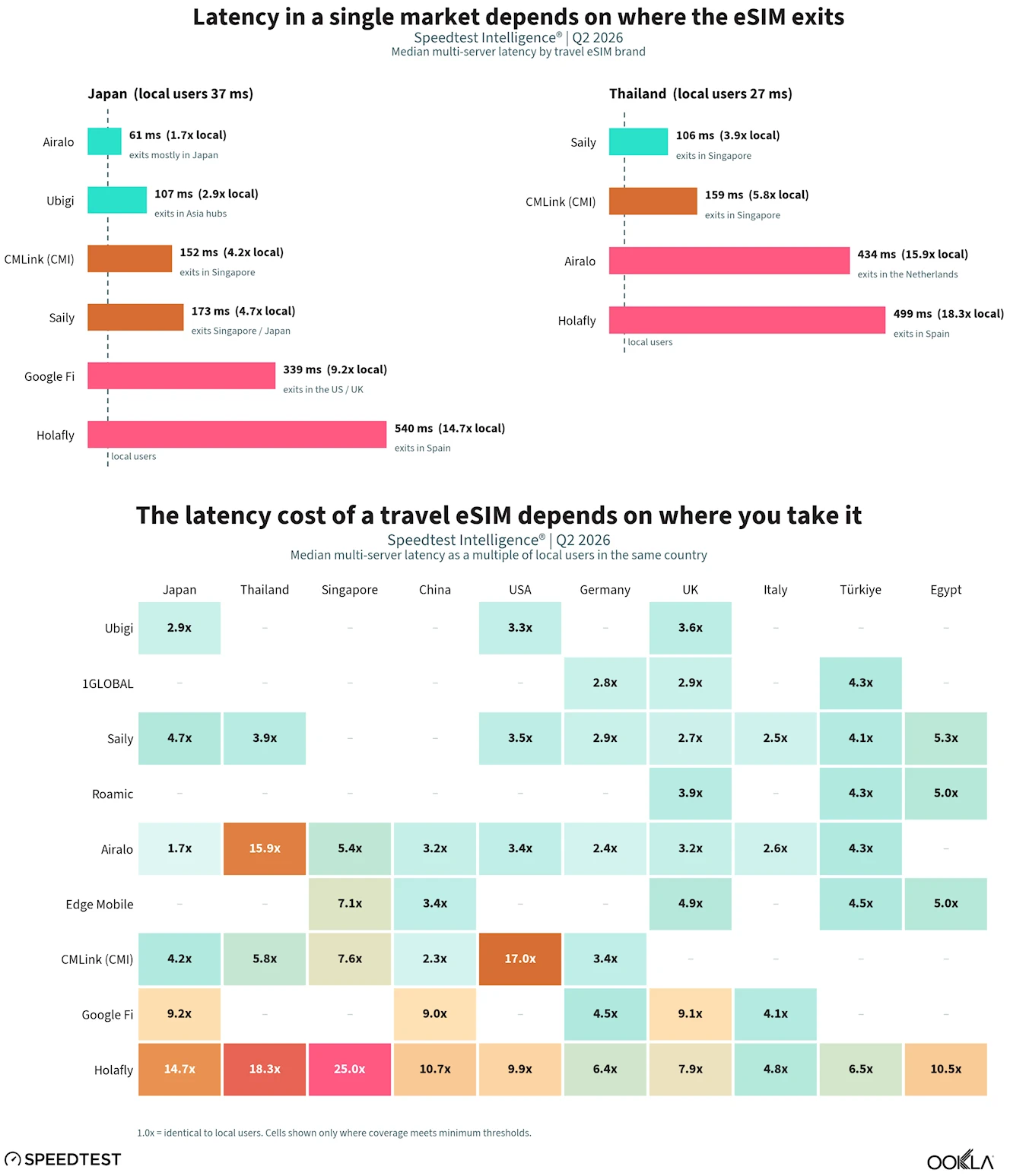
Ookla Travel eSIM Latency by Provider and Country

Naturally mobile broadband speeds can also vary between countries due to the different capabilities of various network operators. But in the past, when mobile roaming mostly only happened directly through agreements between domestic operators and the primary network operators in other countries, raw data speeds often weren’t as radically different between local and roaming connections (example).

However, the complex network routing of travel eSIMs turns the above expectation on its head, instead showing a much greater performance difference. The download speed distributions on travel eSIMs reveal caps and throttled plans, with one major brand clustering near 6Mbps and a free tier near 0.2Mbps.

For example, Yesim’s global median download speed of 6.03Mbps and Instabridge’s 10.23Mbps point to throttled unlimited plans. Firsty’s free tier was intentionally limited to 0.21Mbps. Airalo reached a global median of 30.11Mbps, but repeated plateaus near 20Mbps across several Asian markets suggest profile-level speed caps in its wholesale agreements or tariff design.

On the flip side, 1GLOBAL (80.21Mbps), Nomad (80.26Mbps), and Ubigi (75.89Mbps) delivered download speed medians that did approach local norms, and Holafly’s 56.87Mbps shows that a hub architecture can still move bulk data quickly even while adding a third of a second to every round trip in terms of latency.
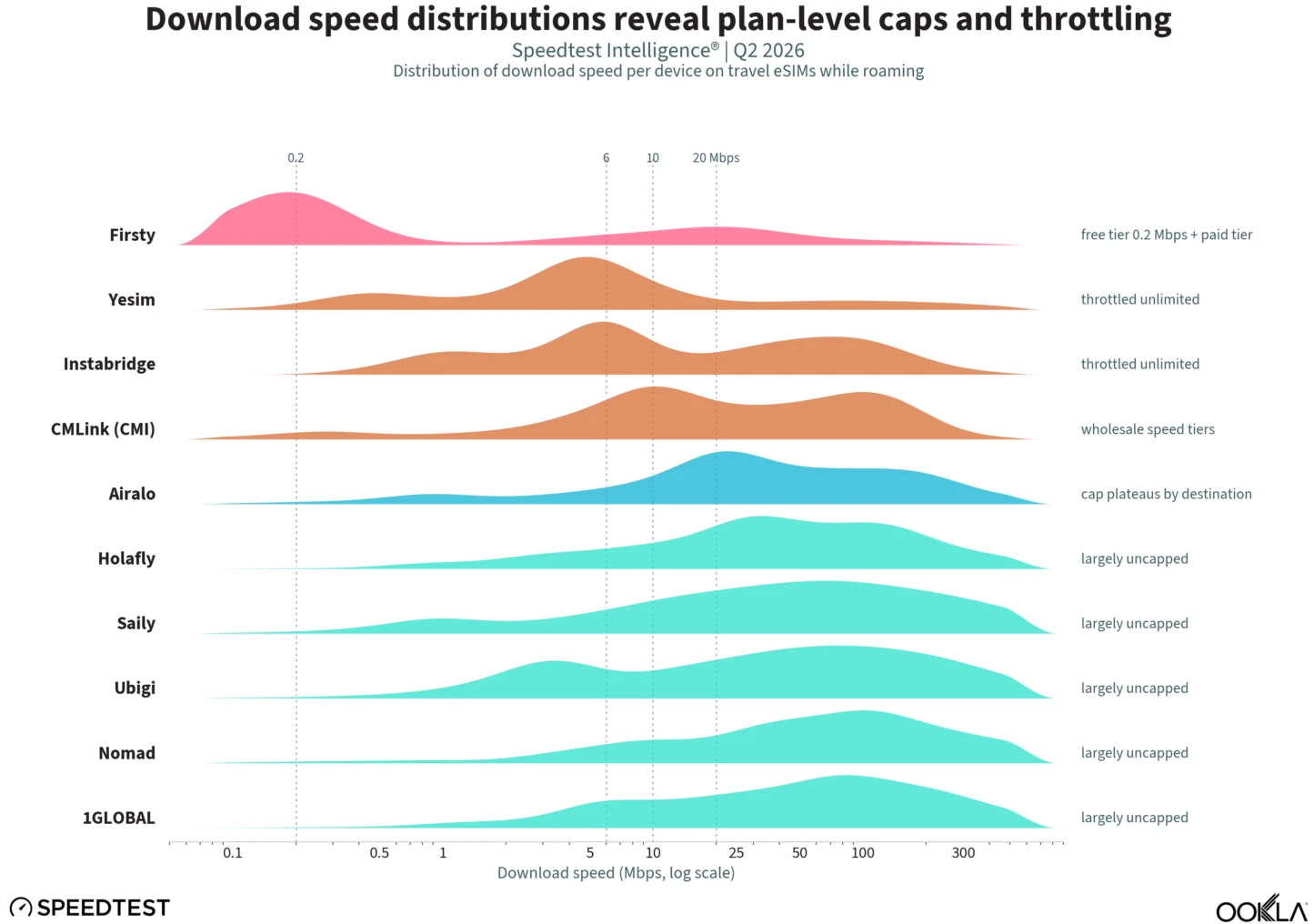
Ookla Travel eSIM Mobile Download Speeds by Provider

Elsewhere, Ookla found that 5G access appears to be shaped more by commercial agreements than technical limits. Most major brands now connect to 5G in at least half of their samples in Ookla’s data during Q2, led by Ubigi at 62%. Others remain largely 4G-based, with 5G shares of just 20% to 36%, suggesting that wholesale 5G access has not been secured in every market, especially for smaller players.

One crucial thing to remember in all this is that what we see today will vary tomorrow, not least because Ookla found that the wholesale market underpinning travel eSIM brands is “constantly shifting“, which can impact performance (latency and mobile broadband speed) as network relationships and hub sites change.

For example, Saily, which entered the market on rented wholesale anchors, stood up its own registered network in late 2025 and now runs 95% of its measured samples through its own distributed core, a move that coincided with the strongest latency profile among the large brands in Ookla’s data.

The full report is worth a read and Ookla concludes that the “best travel eSIM for a given trip is the one whose exit door is closest to the destination“. The only problem with this is that regular consumers have almost no prior visibility of this changeable chain, until you’re actually connected to the service. Instead, if you want the best performance, then we’d say it’s often better to buy a local eSIM for your country of destination (assuming they’re available).

EE UK Offers Free Calls and Data to Colombia After Major Earthquake | ISPreview UK

Original article ISPreview UK:Read More

Mobile network operator EE (BT) has notified UK customers in Colombia (South America) that, due to the devastating impact of Monday’s 7.4-magnitude Earthquake, they’re promising to credit back charges for mobile calls, texts and data (mobile broadband) used in the country, as well as mobile and landline calls from the UK to Colombia.

The time-limited offer has been backdated to start from Monday 10th August, although it will only continue to run until Friday 14th August this week: “Our thoughts are with everyone affected by the Colombia earthquakes. We’re crediting back charges for mobile calls, texts and data used in Colombia, as well as mobile and landline calls from the UK to Colombia, between 10 August and 14 August (inclusive),” said EE.

However, EE warns that mobile signals in the area might be affected by damage to local networks and equipment. The earthquake itself struck shortly after 1.30pm UK time on Monday and had a magnitude of 7.4, making it Colombia’s strongest tremor in the 21st century.

The epicentre has been reported in San Jose Del Palmar, where more than 250 have already been killed and rising. Other nearby cities, including Cali some 125 miles southwest of the epicentre, have also been badly hit. We wouldn’t be surprised if other mobile operators followed EE’s lead.

Disney+ Internet Streaming Service Wins Formula E Streaming Rights | ISPreview UK

Original article ISPreview UK:Read More

Internet video streaming provider Disney+, which already carries ESPN’s sports TV content, has announced that they’ve reached a multi-year agreement to show all Formula E races via Disney+ and ESPN+ in the USA and in “most” international markets beginning with the 2026/27 season.

The deal will span 21 rounds across 13 events in various cities around the world. The next (13th) season is currently due to start on 18th December 2026 in Jeddah (Saudi Arabia), with stops in Austin, Miami, Monaco and Mexico City, culminating in the final round on 25th July 2027, in Tokyo.

The addition expands on the platform’s growing slate of global live programming, which has already included the 2026 FIFA World Cup in South America, select LALIGA football rights in Denmark, Sweden, Finland, Iceland, the UK, Ireland and France, NBA games in the Philippines, and UEFA Women’s Champions League across Europe and Latin America. “All of these and more create a compelling destination for sports fans,” said Disney.

“Formula E combines world-class competition, groundbreaking technology, and sustainability in a way that’s unlike any other sport,” said Joe Earley, Co-President, Direct-to-Consumer, Disney Entertainment. “We’re excited to help power the championship’s next chapter on Disney+ and to give fans around the globe front row access to every adrenaline-fuelled race as it happens.”

The current (12th season) ABB FIA Formula E World Championship will reach its climax in London this weekend, with the World Championship set to be decided in the final race of the season.

Virgin Media O2 cuts 5,200 tonnes of carbon dioxide emissions | Total Telecom

Original article Total Telecom:Read More

forest and mountain partially covered with fog

News

How Virgin Media O2 is cutting network emissions with hardware circularity and reuse

Virgin Media O2 has avoided 5,262 tonnes of carbon dioxide emissions over a decade through a network equipment circularity programme with TXO, equivalent to taking 1,100 cars off the road for a year, the company says.

The initiative avoided 4,575 tonnes by refurbishing and reselling infrastructure like switches and routers, with a further 687 tonnes saved by purchasing secondary-market replacement gear. Savings were calculated via TXO’s Carbon Calculator, developed alongside the Carbon Trust, Virgin Media O2 announced August 11.

Additionally, TXO also recycled over 690 tonnes of end-of-life hardware, with steel, aluminum, and copper making up nearly 60% of recovered materials. The domestic processing supports Virgin Media O2’s target to reach net zero carbon emissions by 2040, according to the company.

“This partnership shows that circularity can deliver measurable carbon savings, reduce waste, recover valuable materials and create commercial return,” said TXO Chief Product and Asset Recovery Officer David Evans.

Some AI tools assisted in the crafting of this report.

The post Virgin Media O2 cuts 5,200 tonnes of carbon dioxide emissions appeared first on Total Telecom.

Kearney’s Global Telecom Health Index Ranks UK 33rd out of 34 Countries | ISPreview UK

Original article ISPreview UK:Read More

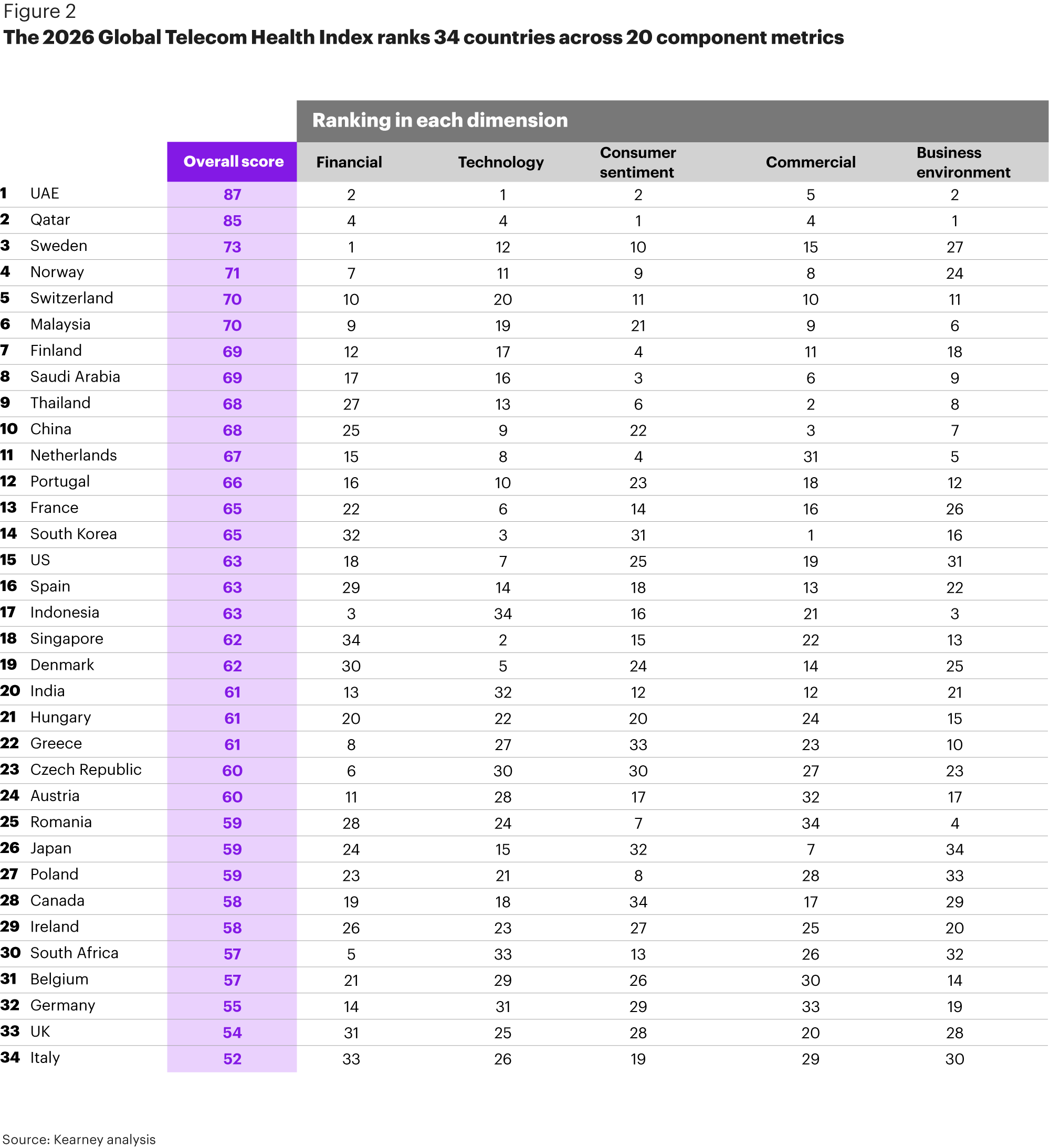
Management consulting firm Kearney has today published their latest annual Global Telecom Health Index, which ranks 34 countries across various metrics in order to measure and compare the health of the telecoms (broadband, mobile etc.) sector on a country-by-country basis. Overall the United Kingdom placed near the bottom on a rank of 33rd.

The index broadly considers five core dimensions (or categories, if you prefer) and 20 individual metrics on a country-by-country basis, including technology (network coverage, speed etc.); customer satisfaction with fixed and mobile services; financial returns (capacity for investment, EBITDA etc.); commercial (spend relative to income, convergence, pricing etc.) and the business environment (level of competition, talent pool etc.).

Unfortunately, the UK ended up ranking in the bottom 10 markets, where low financial scores were common, which typically lead to poor technology deployment and, in turn, lower customer satisfaction. Canada and the UK were thus found to be examples of markets that “rank particularly low on customer sentiment and also rank in the bottom half on technology deployment and commercial dimensions“.

The above is perhaps a nod to the UK’s long delay in deploying full fibre broadband at scale and the many challenges mobile operators have faced in expanding 5G coverage. In the UK, the index also highlights that “mid-contract price rises have become the norm, leading to customer discontent and a value perception gap when paying more for a service that is not seen as having improved” – few of our readers would disagree.

The report goes on to add that government and regulatory intervention, coupled with negative press coverage, has made these price increases particularly visible. “There is an opportunity for operators to revisit their pricing and bundling models to drive higher value perception, especially in markets with the potential for higher service convergence,” said the report. But we’ve seen no sign of mid-contract pricing policies being reversed.

Kearney-Global-Telecom-Health-Index-2026

Kearney’s report then goes on to indicate that some markets would benefit from more market concentration, which it suggests would support larger consolidated operators to “invest more effectively in a single network infrastructure (or work more closely with a wholesale partner in the case of retail Internet service providers)“.

The above is certainly something that could be said to reflect the UK’s fixed line broadband market, which is still chocked full of many financially struggling alternative full fibre networks – those that have been hit hard by rising build costs, high interest rates and competition that often spreads customers too thinly across multiple networks.

“In both mobile and fixed, financial and commercial health scores are higher in markets with fewer than four operators,” adds the report, while admitting that the difference is still smaller than might be expected. We’ve seen a fair bit of consolidation in the UK already (ISPreview’s Consolidation Tracker), although that does seem to have slowed a bit in 2026 and there are strong differences of opinion on which is the right consolidation partner for whom (e.g. VMO2/nexfibre’s £2bn move to acquire Netomnia vs CityFibre’s attempt to acquire Netomnia). Speaking of which..

Rajiv Datta, CEO of nexfibre, told ISPreview:

“The results of Kearney’s inaugural Global Telecom Health Index offer clear counsel; the research finds that more concentrated markets achieve higher fibre coverage and take-up, as well as more positive customer outcomes.

The UK’s telecoms market is fragmented and fragile. To deliver greater choice and quality for consumers and businesses alike, it requires a scaled financially-secure, wholesale challenger. Consolidation will be crucial as the route to sustainable competition and a healthier sector.

The UK now has an opportunity to move beyond fragmentation and build a competitive, resilient fibre market that can support the country’s digital and economic ambitions for generations to come.”

The full report is worth a read, although it does seem to generalise a lot of its points and doesn’t include a detailed breakdown of each country and its scores, which would have been useful to get the proper context for how they arrived at some of the scores.

EE Gives UK Mobile Customers an Early Phone Swap at No Extra Cost | ISPreview UK

Original article ISPreview UK:Read More

EE Mobile has today announced that all one million UK customers on their Flex Pay mobile contracts will, from today, benefit from the roll-out of Early Phone Swap. As the name suggests, this feature enables them to upgrade to any new or refurbished handset a year early “at no extra cost“.

For those who might have forgotten. The Flex Pay pay monthly plans are designed to split your mobile phone (handset) cost and your network (airtime) service into two separate contracts. You get an interest-free device loan (usually lasting 24 or 36 months) alongside a flexible airtime plan. But under the previous plan you had to pay off your existing Flex Pay agreements before being able to upgrade.

The change means that customers can quickly and easily switch to a better phone, without having to wait until the end of their contract. Unlike other providers, customers can use Early Phone Swap to choose any new phone that they fancy. Users simply need to pick the handset they want and send their old one back to EE in good working order. If the phone is worth more than the balance left to pay on their device plan, EE will credit the difference to their bank account.

“Buying a handset with EE means customers get much more than just a new device. Whether choosing a brand-new or refurbished phone, customers can spread the cost interest-free with a choice of flexible 12, 24, 36 or 48-month Flex Pay plans to suit their budget. Those opting for a refurbished device can also choose from EE’s newly launched ‘Very Good’ range, offering even more value without compromising on quality,” said the announcement.

The launch of Early Phone Swap also comes alongside the introduction of new 12 and 48 month Flex Pay contract lengths, giving customers additional options when choosing a plan that suits their budget.

Sharon Meadows, MD of Marketing & Commercial at EE, said:

“We know our customers want the very best devices and the freedom to get the phone they really want. Early Phone Swap puts that power firmly in their hands, letting them swap their old phone and get something new every year, on the UK’s best network and at no extra cost.”

Whether you’re dealing with a cracked screen, a phone that’s past its best or you simply want to get your hands on the latest and greatest handsets, Early Phone Swap makes the whole process simple and straightforward for our Flex Pay customers.”

Customers are considered eligible for Early Phone Swap if they bought their old phone from EE on a Device Credit Agreement with a 24-month airtime plan, but you must also have 12 months or less left on your current Device Credit Agreement (but not in the final month); and have made at least 12 device monthly payments. This feature is available both in-store and over the phone, but there’s no mention of online availability.

Every handset from EE also comes with an extended warranty for added peace of mind, while “expert support” is on hand if anything goes wrong, with repairs available from as little as 2 hours or fast access to specialist technicians.