Major UK Phone Providers Agree to Crackdown on Scam Calls and Fraud | ISPreview UK

Original article ISPreview UK:Read More

A new landmark Telecommunications Charter has today been agreed between several of the UK’s leading broadband, mobile and phone providers, which commits BT (EE), Virgin Media (O2), VodafoneThree, Tesco Mobile, TalkTalk, Sky (Sky Broadband) and the Comms Council UK to a “crack down on scam calls and fraud“. A sub-charter also exists for B2B phone services.

Just to recap. Most of the United Kingdom’s major telecoms providers have already implemented various technical measures to tackle Nuisance Calls and Scam Calls. But these aren’t always 100% effective, and not all operators have introduced the same level of protections. Suffice to say, there’s still plenty of scope for improvement, and Ofcom are forever pushing new changes to boost national defences against such fraud (here, here and here).

NOTE: Scam calls come in all sorts of different shapes and sizes, from people claiming that your computer has been infected with viruses, to those pretending to represent your bank, insurance company, HMRC or even using AI to clone the voice of a family member etc. The goal in all these cases is to extract personal and financial details for abuse.

The new Telecommunications Charter – due to be signed at the BT Tower in London today – seeks to support those efforts, not least by committing the signatories to actively engage with the development of a UK Traceback Solution (i.e. allowing providers and the police to trace the origin of suspicious or fraudulent calls across interconnected networks).

In addition, they’ve also agreed to put more effort into improving related consumer awareness and enhancing the protection and support given to victims of fraud (i.e. help times will be slashed to two weeks). The group has further agreed to designing scalable, collaborative data-sharing models between the telecoms, banking, and tech sectors to support a more co-ordinated approach with the police, which will help to track the scammers down and stop them.

The top mobile networks have further committed to block foreign call centres from impersonating banks within the next year, which follows on from some of Ofcom’s recent work. Data shows that 96% of mobile users decide whether to answer a call based on the number displayed on their screen, with three-quarters unlikely to pick up if it’s from an unknown international number.

All of this is intended to help support the government’s upcoming Fraud Strategy, which will broadly aim to unite industry, disrupt criminal networks and better protect the public. O2 have separately been pushing the government to create a dedicated, centralised national policing agency to handle all fraud investigations (here), although it remains to be seen if that will materialise.

Minister for Fraud, Lord Hanson, said:

“Spoofed calls allow scammers to deceive the public with fake identities and false promises. This government is committed to tackling fraud.

In a major upgrade of our mobile network, call spoofing will be eliminated within a year – stripping away the tools scammers use to cheat people out of their hard-earned cash.

We’re stepping up our defences to protect victims and make sure the UK is the hardest place in the world for scammers to operate.”

The announcement goes on to mention that “AI will also be deployed to identify and block suspicious calls and texts“, although most of the major mobile and phone operators are already using such tools to tackle the problem – some for several years. So we assume they mean that the use of such tools will now be expanded upon and spread to more providers.

Finally, the Comms Council UK (CCUK), which represents the UK’s VoIP sector, will work to “create practical guidance for members” to help prevent and tackle fraud. This reflects the aforementioned B2B voice and telephony sub-charter, where CCUK will help business customers by developing business victim support principles and best practice guidance to raise standards in identifying and responding to fraud.

We’ll finish with the usual barrage of industry comments:

Claire Gillies, CEO at BT’s Consumer Division, said:

“Protecting BT, EE and Plusnet customers from scams and fraud is an imperative for us. To be the network customers can trust we have developed cutting-edge, AI-driven solutions to keep everyone safe. We’re proud that in 2025, we’re blocking 3 million scams a day across our network and continuing to innovate at pace to protect our customers from the growing threat of fraud. This second fraud charter is an important and timely intervention for the telecoms industry. It’s vital that we collaborate as an industry to protect the nation from this growing crime.”

Rachel Andrews, Fraud Director at VodafoneThree, said:

Vodafone and Three block millions of scam texts and fraudulent calls for their customers every day. The second Telecommunications Fraud Charter will take this even further, strengthening how we work across the industry and with government to stay one step ahead of criminals. By combining data, collaboration and innovation, we can keep people and businesses safe and build the trusted, secure digital networks the UK depends on every day.”

Murray Mackenzie, VMO2’s Director of Fraud Prevention, said:

“Fraud has a devasting impact on its victims and costs the telecoms industry many millions of pounds each year. We’re committed to preventing fraud and to date, we’ve blocked more than 1 billion scam texts from reaching our customers and are using AI to flag 50 million scam calls every month.

No industry alone can completely prevent fraud but by working across sectors we can stop scams, disrupt organised gangs and help people protect themselves. We’re playing our part and urge government to match our resolve in the forthcoming Fraud Strategy by providing law enforcement with the resources needed to bring fraudsters to justice.”

Tracey Wright, Chair of Comms Council UK, added:

“The launch of the second Telecommunications Fraud Charter marks a significant step forward in the fight against fraud in our sector. We are proud to support this initiative, which brings together government and industry to deliver real, lasting change for consumers and businesses alike. As part of the Charter, we commit to continue to release best practice guidance to our membership that will raise standards and reduce opportunities for fraudulent behaviour using voice and telephony. The Charter’s overall message around collaborative data sharing, advanced technology solutions, and unified public messaging will strengthen our collective defences and help disrupt fraudulent activity at scale.

Through my work with Comms Council UK, I have seen first-hand the positive impact of sector-wide collaboration and intelligence sharing. By aligning our efforts through this Charter, whether through joint initiatives on fraud detection or stronger customer protections, we are building a safer, more trusted communications environment for everyone. The Charter sets a clear path for the telecoms sector to lead by example, and we look forward to working alongside our partners to deliver on its commitments and create a future where fraudsters find it harder to succeed.”

INCA Continues Work to Standardise Wholesale Full Fibre Among UK Altnets | ISPreview UK

Original article ISPreview UK:Read More

The Independent Networks Co-operative Association (INCA), which represents many of the UK’s alternative broadband networks, has today provided a progress update on their work to standardise wholesale access (‘Wholesale Standards Initiative‘) and make it easier for retail ISPs to purchase services from such operators.

The initiative, which first launched a year ago (here), helped to establish clear commercial and technical frameworks for wholesale access. The work has now evolved into a cross-industry effort, involving some of the leading wholesale networks, retail ISPs, aggregators and solution providers.

At its core, the initiative has been working to provide all industry players with a “simple, common baseline of language and understanding” that can be used in framework contracts and supported by a detailed set of Application Programming Interfaces (APIs).

The latest development in this effort is that supporting members are now working to create a Common Care Framework. This is said to be designed to ensure services are supported by consistent processes, as well as a smooth, predictable, and reliable service experience being available regardless of the underlying network provider. An initial set of draft technical APIs have already been produced to support these principles.

Max Fernando, Chair of the Wholesale Standards Initiative, said:

“The initiative has made significant progress in just a year and is well placed to boost the marketplace by enabling ISPs, aggregators and Altnets to interconnect on a common platform. This in turn helps to facilitate integration across the industry and add value and enhance the quality of service that the sector can offer to residents and businesses.

The Altnet market is rapidly shifting from a focus on building networks to serving end users — and with it, wholesale standards need to evolve to ensure that the full potential of UK’s fibre footprint is unlocked. Previously, retail ISPs have pointed out the costs and complexity associated with needing to onboard new networks – the initiative aims to tackle these issues head on.”

The goal of all this seems to be to align the UK’s fibre market with similar models in Spain and Sweden, where independent standards have helped to drive efficiency and support aggregators. The success of the UK’s initiative has already attracted some of the UK’s leading aggregators, including AllPointsFibre Networks, Zen Internet, PXC and ITS Technology. It’s also supported by a growing ecosystem of solutions providers, including Sonalake, Fibre Cafe, NetAdmin and CWP, who plan to embed the standards into their UK market solutions.

Zoom to open UK data centre as part of AI-focused expansion | Total Telecom

Original article Total Telecom:Read More

News

Zoom has announced plans to open a UK data centre in early 2026, aiming to meet local data residency requirements and broaden its appeal to regulated sectors including the public sector, healthcare and financial services.

The facility, which Zoom says will host services such as Meetings, Webinars, Rooms, Team Chat, Phone, Notes, Docs and its AI assistant, is intended to give UK organisations greater choice over where their data is stored and processed. The company plans UK‑only meeting zones and telephony gateways with local dial‑in numbers at launch. Additional services such as Zoom Contact Center and integrations to support PCI compliance are expected to follow.

Details of the new facility, including investment and location, have not been announced.

“Launching a UK data center is a significant milestone in Zoom’s journey to provide secure, compliant, and high‑performance services for all of our customers. By investing in local infrastructure, we are ensuring that organisations across the UK, from financial services to government, can confidently embrace the future of AI‑first collaboration,” said Louise Newbury‑Smith, Head of UK & Ireland at Zoom.

The move reflects Zoom’s evolution from a video‑conferencing provider to what it describes as an “AI‑first collaboration suite”, a platform encompassing telephony, workspace booking, document tools and automation alongside meetings and chat.

The planned UK data centre will join a network of regional facilities that Zoom already operates in Germany, the Netherlands and Saudi Arabia. By building this new facility in the UK, Zoom is aiming to preempt sovereignty and compliance concerns that can be a barrier for highly regulated organisations considering cloud services.

The planned investment by Zoom adds to a growing trend of cloud and collaboration providers establishing UK data centres to address data sovereignty and regulatory compliance — a priority heightened by post‑Brexit data arrangements and sectoral rules for healthcare and finance. For the UK market, such local infrastructure can lower barriers to adoption among risk‑sensitive organisations, while also signalling continued vendor confidence in Britain as a strategic tech hub.

The investment follows other recent UK activity from Zoom, including the opening of an “Experience Centre” in London in June 2024, which the company said has hosted more than 5,500 guests.

Also in the news
Connected Britain Award winners 2025 announced!
Netomnia announces ‘powerful and ambitious’ rebrand ahead of Connected Britain
VodafoneThree drops Samsung, relies on Nokia and Ericsson for £2bn network upgrade

New Spec Looks to Make 5G Fixed Wireless Broadband Viable for Blocks of Flats | ISPreview UK

Original article ISPreview UK:Read More

The Broadband Forum has published a new technical report that outlines how multiple tenants and apartments (MDU – Multi-Dwelling Units) could receive gigabit broadband connectivity through a single 5G based Fixed Wireless Access (FWA) network connection, not least by reusing some of the building’s existing infrastructure.

Sadly, not every large residential apartment building (MDU) can have a new fibre optic connection installed (yet), and using FWA solutions is often problematic due to issues of performance or coverage limitations for individual tenants inside such large and complex buildings. This is especially true once you get into the mmWave spectrum bands of 24-40GHz, which don’t penetrate well through walls and are needed for the best multi-gigabit service speeds.

One way around this is to install lots of external receiving equipment / antenna outside each individual apartment. But the wireless signal will often only be able to reach one or two sides of the building and the MDU will usually place tight restrictions on the use or placement of such equipment (issues of safety, power, cosmetics etc.).

The new specification seems to be promoting a hybrid approach, with FWA signals bringing the connection to a central point in the building and then the building’s existing property infrastructure (i.e. twisted pair, telephone wiring, or coaxial cabling – from the attic or basement of the building) being used to reach individual flats / apartments.

The project, which first began in 2023, has now defined the architecture and requirements to show how this would work via TR-507 and MR-516.

Christele Bouchat, Broadband Forum Network Architecture Work Area Co-Director, said:

“In the past, restrictions set by property owners or the design of existing MDU buildings have limited the possibilities for making high-capacity broadband services available to these subscribers. The latest specification addresses these limitations by allowing the installation of a high-performance 5G outdoor FWA system that can be shared by potentially dozens of tenants and connected through existing cabling already in the building.”

The idea of using existing cabling to distribute a broadband service within an MDU is nothing new, although such approaches often run into the limitations of such infrastructure at some point. In this case it’s a little bit hard to judge because we haven’t yet jumped from this specification to a commercially viable product and, at least for the UK, such an approach seems likely to be superseded by the existing deployment of full fibre (FTTP/B) networks.

AWS unveils plans for transatlantic cable Fastnet | Total Telecom

Original article Total Telecom:Read More

Press Release

Amazon Web Services (AWS) has announced plans for a dedicated transatlantic subsea cable, Fastnet, that will link Maryland in the United States with County Cork in Ireland. The system, due to enter service in 2028, is pitched as a high‑capacity route intended to bolster resilience and capacity for cloud and artificial intelligence traffic between North America and Europe.

Fastnet is designed with route diversity in mind. Rather than following established corridors, the cable will land at two strategic points intended to provide alternative pathways if other subsea cables are damaged or disrupted. AWS says the system will use advanced optical switching branching units to enable future changes in topology and to add landing points if required, a feature that could make the route more adaptable to evolving traffic patterns and growing AI workloads.

The cable is being built with protective measures in nearshore areas – including extra armouring and steel wire layers – to mitigate risks from natural hazards and human activity. AWS is quoting a design capacity in excess of 320 terabits per second (Tbps). The company illustrates that figure by saying the system could stream around 12.5 million HD films simultaneously, and could transmit the digitised Library of Congress several times per second.

Fastnet will be integrated into AWS’s private global network rather than the public internet. AWS highlights that its centralised traffic‑monitoring and automated network management tools offer complete visibility over routes and perform continuous optimisations to avoid congestion, claiming the capability to resolve the majority of network events automatically. For customers, the proposition is access to secured, scalable transatlantic bandwidth for applications ranging from generative AI to business continuity and research.

Local engagement is also a feature of the project. AWS says it has been working with communities on Maryland’s Eastern Shore and in County Cork and will establish Community Benefit Funds in both locations to support locally identified priorities, including STEM education, workforce development, environmental programmes and social services.

Irish and Maryland officials welcomed the investment. Taoiseach Micheál Martin described the cable as a “vote of confidence” in Ireland’s digital future, framing County Cork as a gateway to Europe for submarine cables. Maryland Governor Wes Moore said the project would help position the state as a centre for innovation and high‑tech investment.

Fastnet will join an expansive AWS infrastructure footprint that the company says already spans 38 regions and roughly nine million kilometres of fibre – a figure AWS uses to convey the scale of its private network. The subsea cable market remains competitive and politically sensitive: while large cloud operators and consortia continue to invest in bespoke links to secure capacity and control, regulators and governments are increasingly attentive to the strategic implications of undersea connectivity. Fastnet’s landing choices and resilience features suggest AWS is continuing that trend by seeking greater redundancy and control over transatlantic traffic.

Orange offers €4.25bn to take full ownership of MasOrange | Total Telecom

Original article Total Telecom:Read More

News

The buyout would come less than two years since the merger

On Friday, Orange announced that it had reached a non-binding agreement to acquire full control of its joint venture with MasMovil, called MasOrange.

The deal would see the Frech telecoms group purchase the 50% stake it does not own from MasMovil’s private equity owners KKR, Cinven, and Providence, for €4.25 billion.

A binding agreement is expected before the end of the year, with Orange hoping to complete the transaction in H1 2026.

MasOrange was formed by the €22 billion merger of Orange and MasMovil’s Spanish units in 2024. It created the country’s largest telco, with around 1 million mobile and 7 million fixed-broadband subscribers.

Previous rumours had suggested that the joint venture’s private equity owners were preparing for an Initial Public Offering (IPO), with anonymous sources saying they were looking to “cash out some of their assets”.

Both Orange and MasMovil have the right to initiate an IPO process from April 2026, as per their agreement.

Keep up to date with all of the latest telecoms news from around the world with the Total Telecom newsletter

Also in the news
Connected Britain Award winners 2025 announced!
Netomnia announces ‘powerful and ambitious’ rebrand ahead of Connected Britain
VodafoneThree drops Samsung, relies on Nokia and Ericsson for £2bn network upgrade

Vodafone UK Launch New Together Discount on Mobile and Broadband Bundles | ISPreview UK

Original article ISPreview UK:Read More

Telecoms giant Vodafone (VodafoneThree) has just refreshed their “Together” discount, which now also offer new savings to families that combine (bundle) their unlimited Pay Monthly mobile (4G / 5G) plans with one of their fixed line full fibre broadband packages (supplied via either Openreach or CityFibre). Savings of up to £636 are being promoted.

Customers with an existing Pay Monthly plan can now add unlimited mobile plans to their account for just £16 per month. Each additional unlimited plan is said to deliver savings of £408 across a 24-month contract term — equivalent to £17 per month. Vodafone Together also simplifies things with one bill payer for the whole account, so the whole family’s connectivity needs can be managed in one place, through the MyVodafone App.

For those combining unlimited mobile plans with full fibre broadband, the ‘Together‘ savings grow even further. For example, a family of four could potentially make savings of £636 across 12 months, while each enjoying an unlimited mobile plan, plus full fibre broadband for the whole household. But this is based on a customer taking an entry-level full fibre service at £24pm with the existing £2 Vodafone Together discount, plus one full-price unlimited mobile plan at £33pm, and three additional unlimited plans at £16pm each (normally £33pm).

Alongside the savings, Vodafone is giving families access to a host of extras through their reward scheme: VeryMe Rewards. For example, Vodafone Together customers can enjoy three months of Amazon Prime for just £1, and they also have the chance to win a Walt Disney World Resort in Florida holiday.

Rob Winterschladen, Consumer Director at VodafoneThree, said:

“We know families are looking for ways to save without compromising on their day-to-day connectivity needs. With Vodafone Together, unlimited mobile plans cost just £16 per month, delivering savings of over £400 on each additional line. Whether it’s browsing online, video calling cousins abroad, or sharing pictures in the family group chat, Vodafone Together gives families the freedom to stay in touch without worrying about data, texts or minutes. And when paired with full fibre broadband, the savings grow even further — helping families stay always connected, wherever they are.”

eSIM.net Launch eSIM Using iOS 26’s Automatic Travel Activation Feature | ISPreview UK

Original article ISPreview UK:Read More

Virtual mobile provider eSIM.net, which specialises in offering travel eSIMs (electric SIMs) for roaming use, has launched a new travel eSIM – Global64 – that claims to be “the first” to take advantage of Apple’s latest iOS 26 innovation — automatic travel SIM activation.

In short, customers with an Apple iPhone running iOS 26 or later can now detect when a user travels abroad and automatically activate a preloaded travel eSIM, before seamlessly switching back to the user’s domestic SIM upon return. The new Global64 eSIM claims to be “the first product globally to integrate with this feature“, enabling travellers to enjoy effortless connectivity in 64 countries worldwide.

The new feature should help to eliminate some of the friction that still exists when needing to manage multiple SIMs or roaming plans. This can be especially irritating to users that aren’t comfortable messing around with the settings for different SIM profiles.

Gerry O’Prey, CEO of eSIM.net, said:

“Global64 marks a major milestone for mobile connectivity. For the first time, travellers can land in another country and their phone simply works — no SIM swaps, no settings, no stress. This is how travel connectivity was always meant to be.”

We haven’t yet been able to play around with the new iOS 26 feature ourselves and so don’t yet know if it has any caveats, since there’s often some merit in retaining more manual control over how profiles are setup (e.g. using one for calls/texts and the other for data etc.). Suffice to say that anything which automates these sorts of changes can sometimes make a wrongful assumption.

So far as we’re aware, Apple’s feature should work with any travel eSIM as it gives you the option when first installing a new profile (i.e. asking if the eSIM is for ‘home’ or ‘abroad’), but we could be wrong.

Business ISP 4Com Criticised Over UK Broadband and Phone Contracts | ISPreview UK

Original article ISPreview UK:Read More

Bournemouth-based communications, IT and broadband provider 4Com has come in for criticism from some of their UK customers, who have complained about being hit by dramatically higher prices than they originally agreed over the phone. Sadly, business-to-business contracts lack many of the same protections as consumers enjoy, leaving some small firms in a dire situation.

According to the BBC News report, the owners of the Ashleigh Residential Home in Chesterfield thought – based on a 2023 call they had with a 4Com sales agents – that they were signing a contract for a fixed cost of £329 a month for two desk phones, two handheld phones, broadband and services on a 5-year contract.

However, when the first invoice arrived a couple of days later, the charges that it set out as being in the contract, which they had now signed, were different from what had been verbally promised over the phone (what’s that old saying.. “a verbal contract isn’t worth the paper it’s written on“). The BBC states that two years into the contract, they could be paying as much as £600 per month, which the owners claim “could finish the business“.

The catch is that 4Com did set out all of the charges in the paperwork that the business owners were ultimately sent and signed, albeit clearly without the owners realising that those charges were not what they thought had been agreed. In addition, the contract terms they had been sent ran for 7 years, not 5 years as discussed, and they had also signed a rental agreement with a separate finance company to hire the equipment.

A second business, a tool hire shop in Hinckley run by Craig Lakin, also complained about a similar experience to the BBC and has since been threatened with legal action if he does not pay more than £12,000 to the finance company who he said 4Com signed him up with to rent the phones. Craig said he would “rather close the business down, than give them the money” as “a matter of principle“.

In response, 4Com said they took the complaints seriously and were “extremely sorry to hear that these two customers are unhappy“. But the company added that it has had multiple interactions with the customers to confirm awareness of key contractual points prior to installation, and continually reviews processes to ensure communications are clear and easy to understand.

A 4Com Spokesperson told the BBC:

“Having thoroughly investigated the customer accounts and call records, we have seen no evidence that they were misled, in relation to either the contract price and structure, or the availability of a cooling-off period.”

Sadly, it’s not the first time we’ve seen situations like this crop up in the industry from different providers, and the BBC notes that they’ve also had a fair few other complaints about 4Com in the recent past (here). At the same time such customers can’t benefit from the Consumer Rights Act 2015 and Consumer Protection from Unfair Trading Regulations (CPR), as these don’t govern business-to-business contracts

Instead, business contracts tend to be subject to the Sale of Goods Act 1979 and Unfair Contract Terms Act 1977. For businesses the only real avenue is thus to complain to the ISP and then, if that fails, take the matter to court. But the costs and fear of taking the legal route often discourages its pursuit.

The Federation of Small Businesses (FSB) has suggested that the government could respond by bringing in a cooling-off period for small businesses. At the same time, the UK Small Business Minister, Blair McDougall MP, said it was “disgraceful to hear that small businesses are being taken advantage of in this way” and called on telecoms regulator Ofcom to do more to protect them.

The regulator itself reiterated that telecoms providers are required to give small businesses clear contract information and warned that, when they “see evidence of widespread issues, we’ve shown we can and will consider taking action“. For those with a long memory, Ofcom’s 2014/15 investigation and subsequent £200,000 fine of business comms provider Unicom may serve as a useful example (here).

In the meantime, while many consumers can often get away with simply skimming through contract terms, it’s particularly important for smaller businesses to always read the terms properly due to the lack of protections available if they fail to do so.

Gov Push Ofcom to Tackle Mid Contract UK Broadband and Mobile Price Hikes | ISPreview UK

Original article ISPreview UK:Read More

The Secretary of State for Science, Innovation and Technology (DSIT), Liz Kendall, has now joined the chorus of displeasure at O2’s recent decision (here) to increase their annual mid-contract price rises beyond what customers agreed when they signed-up. In response, the minister has directed Ofcom’s CEO, Dame Melanie Dawes, to “look at in-contract price rises again“.

At the start of 2025 the industry regulator began requiring telecoms providers to adopt a new approach to mid-contract price hikes, which did away with the confusing percentage and inflation-based model (i.e. ISPs promoted mid-contract increases as CPI + 3.8% or similar) – replacing it with one that must now set out such price rises “clearly and up-front, in pounds and pence, when a customer signs up” (here). This made annual price hikes clearer and more transparent, but not necessarily cheaper.

NOTE: The Consumer Price Index (CPI) level of inflation started the year at 3% (Jan 2025) and has since crept up to 3.8%. But last year it was originally forecast to be closer to 2% by now and many telecoms providers will have set their policies based, in part, on that expectation.

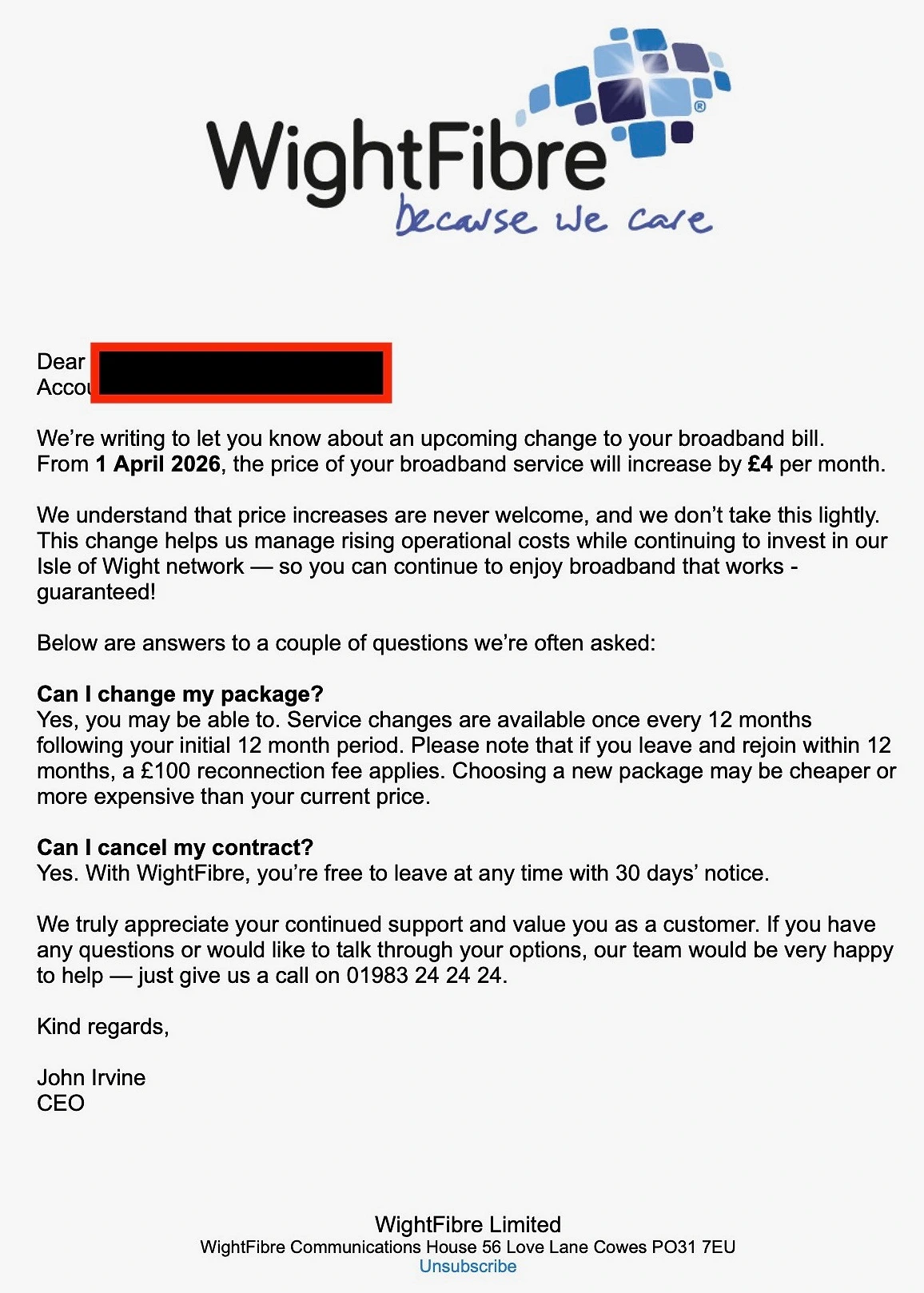
In response, many providers later followed BT’s lead by setting out a new pricing policy that would increase the monthly price that customers pay by a flat £3 extra – effective from March or April each year (the level of increase can vary a bit between providers). But inflation has remained higher than originally anticipated and, partly as a result of that, BT recently announced that they would increase their annual hikes by an extra pound to £4.

Other providers have since started to follow by BT’s lead, but what really seems to have caught everyone’s attention was O2’s decision to go a step further by applying this to existing customers too (i.e. those who had signed-up via the previous policy). In fairness, O2 did allow customers impacted by this to exit their contract penalty free, which Ofcom acknowledged when expressing their own somewhat weak “disappointment” at the change last week (here).

However, the regulator also pointed out that O2’s approach goes against the “spirit” of their change, not least by ruining price transparency for consumers (i.e. we’re back to not being able to trust that ISPs won’t change the rules on us mid-flight). But Ofcom also failed to address the fact that the policies being adopted by most providers have a nasty tendency to unfairly penalise those on cheaper packages (the same increase is applied, regardless of how much your monthly package costs).

The Government’s Turn

The government have clearly been keeping an eye on all this, which last night resulted in Liz Kendall (MP), Secretary of State for DSIT, publishing a new Open Letter that directs Ofcom’s boss to “look at in-contract price rises again“. The letter also made several key recommendations and suggestions for the regulator (the letter is fairly short, so we’ll publish it in full first):

Liz Kendall’s Key Recommendations for Ofcom

1. Look at in-contract price rises again.

2. Undertake a “rapid review” on how easy it is for customers to switch providers.

3. Deliver increased transparency in telecoms bills, which could follow the same mould as “recent changes on electricity bills” to help highlight the costs of specific components of those bills.

4. Consider the possibility of adopting a similar regime to those such as insurance, where new and existing customers need to be offered the same deal.

Liz Kendall’s Open Letter to Ofcom

Dear Dame Melanie,

As we discussed when we met earlier this month, driving down inflationary costs and protecting consumers are vitally important for this government.

As such, I welcome both the action you took in January to increase transparency on how in-contract prices are presented in new contracts, and your statement yesterday expressing disappointment with O2’s price rises. I strongly agree they are against the spirit of your previous changes on pricing, and all the more disappointing given the current pressures on consumers.

Nevertheless, I believe we need to go further, faster. I am keen that we look at in-contract price rises again. O2’s recent decision to increase prices above the levels specified in the contract means that, under Ofcom’s rules, its customers can leave free of charge within 30 days. I would welcome your undertaking a rapid review on how easy it is for customers to switch providers – if companies are determined to increase pricing, it is beholden on us to make sure that customers are able to go elsewhere as easily as possible.

Similarly, I believe that, as with recent changes on electricity bills – which provide for greater transparency about the costs of specific components of those bills – increased transparency in telecoms bills could be a helpful mechanism to drive further clarity on pricing and investment. I would welcome views on how best to achieve that.

In addition, recognising that there is a decreasing number of people on legacy contracts but in an effort to take all action possible, would you write to telecoms companies to ask them to clearly and urgently communicate to customers with pre-January 2025 contracts, to ensure that those people are appropriately informed of their upcoming price rises. I would also welcome your assessment of the impact of the January changes to help us all identify where further transparency measures might be merited.

Finally, you will be aware that there have been calls for the sector to have a similar regime to those such as insurance, where new and existing customers need to be offered the same deal. So, for example, when an existing customer looks to renew their contract with their provider, they are provided with the price they would be charged if they were a new customer and have a choice over which deal to take. I understand Ofcom developed a discussion paper on this in 2023, and I would urge you to look at this as soon as possible.

I know you will agree that it is imperative that ordinary people feel empowered when interacting with the telecoms market, and that they can be confident they are getting a fair deal. So, given the importance of this agenda, I would be grateful if I could have a response by November 7th. My officials stand ready to discuss next week if helpful. I am, of course, very open if you have other suggestions in this space.

Yours sincerely

The Rt Hon Liz Kendall MP
Secretary of State for Science, Innovation and Technology

In fairness to Ofcom, switching between telecoms providers has been made significantly quicker and easier in recent years thanks to systems like One Touch Switching (OTS) on broadband + landline phone and Text-to-Switch (Auto-Switch) on mobile. Likewise, we’re all for more transparency on telecoms bills, although this specific area hasn’t really caused too many complaints.

The key suggestion above seems to be where Kendall calls on Ofcom to consider the possibility of adopting a similar regime to those such as insurance, where new and existing customers need to be offered the same deal. Leaving aside the fact that these are two VERY different markets, there’s a risk that such an approach might choke-off the ability of providers to attract new customers via discounts, which might also reduce switching and thus risk raising prices.

In the above scenario, we continue to think it might be better to simply ban the practice of mid-contract price hikes, which wouldn’t stop ISPs from discounting the price across your first contract term. But even this approach does run into the potential for similar caveats, since some offers (e.g. 3-6 months free service on a 24-month term) might also be choked off. But we dare say that consumers would find general price reductions for the first term to still be both easier to understand and much easier to advertise, as well as to compare between providers. Convoluted discounts are a headache when it comes to service comparisons.

The law of unintended consequences remains a tricky one to balance, but it’s becoming increasingly clear that Ofcom’s last attempt at a halfway house style solution has not worked as well as they would have hoped. Instead, consumers who can least afford it (i.e. those on cheaper packages) are being hit by the biggest hikes and transparency is also being wrecked by providers changing the rules mid-flight. We await Ofcom’s solution with great interest.