Fibrus Launch Black Friday Broadband Sale in N.Ireland and Cumbria UK | ISPreview UK

Original article ISPreview UK:Read More

Infracapital-backed broadband ISP Fibrus, which is rolling out a full fibre network across parts of Northern Ireland and Cumbria (England), has joined other internet providers in launching their Black Friday sales for new customers. The provider is also offering up to £400 of buyout credit if your old ISP hits you with Early Termination Charges (ETC).

Customers looking to join the provider will now pay from just £17.99 per month for their entry-level 159Mbps (34Mbps upload) package, which rises to £23.99 for 518Mbps (104Mbps upload) and £32.99 for 982Mbps (310Mbps upload); this is several pounds cheaper per month than their previous offers. In addition, those taking their 518Mbps plan will also get a £30 Amazon Gift Card and that rises to £100 on their 982Mbps tier.

NOTE: Fibrus is backed by a total investment of around £893m, including £320m of committed debt, £200m in current and committed equity funding and £373m of government funding (e.g. £23m FFNI, £200m Project Stratum – 81,000+ premises in N.Ireland – and the c.£150m Project Gigabit contract for 53,500 premises in Cumbria – Hyperfast GB).

As usual, all packages come attached to a 24-month minimum contract term, included wireless router and free installation. The operator’s full fibre network now covers 440,000 premises and is home to 130,000 customers.

Community Fibre Offers 6 Months Free Full Fibre Broadband in London | ISPreview UK

Original article ISPreview UK:Read More

Network builder and broadband ISP CommunityFibre, which has invested c.£1bn to deploy a 5Gbps speed full fibre (FTTP) network across 1.342 million UK homes (inc. 185k businesses within 200 metres of their network) – mostly in London, has launched their Black Friday discounts and begun offering the first 6 months of service for free on ALL of their packages.

The special offer means that prices will now start at £21 per month (after the first 6 months of free service) for their entry-level 100Mbps (symmetric) tier on a 24-month term and rise up to £61 for their top 5Gbps (5,000Mbps) package. But take note that these prices will jump to £23 and £63 per month, respectively, from April 2027 – once their annual (£2) mid-contract price hikes kick in.

NOTE: CF is backed by shareholders Warburg Pincus LLC, DTCP, Railpen and NDIF, and its lenders, including recent backers JP Morgan and Barclays etc. The operator’s network is predominantly focused upon London.

All packages include a wireless router, free installation and unlimited data usage. At the end of your contract, the price will increase again by £4 versus your last month. The Black Friday discount will be available to order by new customers until 2nd December 2025.

Giffgaff Expands Full Fibre Broadband Availability to Include Chester UK | ISPreview UK

Original article ISPreview UK:Read More

Mobile and internet provider giffgaff, which is owned by Telefónica UK (VMO2), has today informed ISPreview that their recently launched (here) full fibre broadband products for homes – powered by nexfibre and Virgin Media’s networks – have now been made available to people living in the Cathedral City of Chester (Cheshire, England).

Just to recap. giffgaff are offering three unlimited plans on a monthly rolling (30-day) term – the 200Mbps (symmetric) service costs £30 per month, while 500Mbps is £32 and their top 900Mbps tier is £35 – plus installation is currently free. Customers in nexfibre areas who sign-up to this service can expect to receive an Amazon eero 6+ router (inc. giffgaff branded User Interface) and engineers will also install an Optical Network Terminal (ONT) from Arcadyan Technology (PB6802B-LG) inside your home.

NOTE: At present, the provider states that customers cannot use their own router, which is disappointing as Amazon’s kit has some key limitations. In addition, there’s no digital phone service (it’s data-only).

The catch is that giffgaff have been conducting a gradual, phased regional roll-out. As it stands, the service is now available to over 360,000 properties in North West England, as well as select locations in North West England, Yorkshire and the Humber, East Midlands and rolling out in the North East, Scotland, South West and Wales and then across more locations before the end of the year and into 2026

So Chester is just the latest location to be added in this ongoing process, which does make things quite confusing for consumers. But we note that the prices have been reduced a bit more since the packages first went live in September 2025.

Guernsey Switches Off Copper Network as Full Fibre Rollout Nears Completion | ISPreview UK

Original article ISPreview UK:Read More

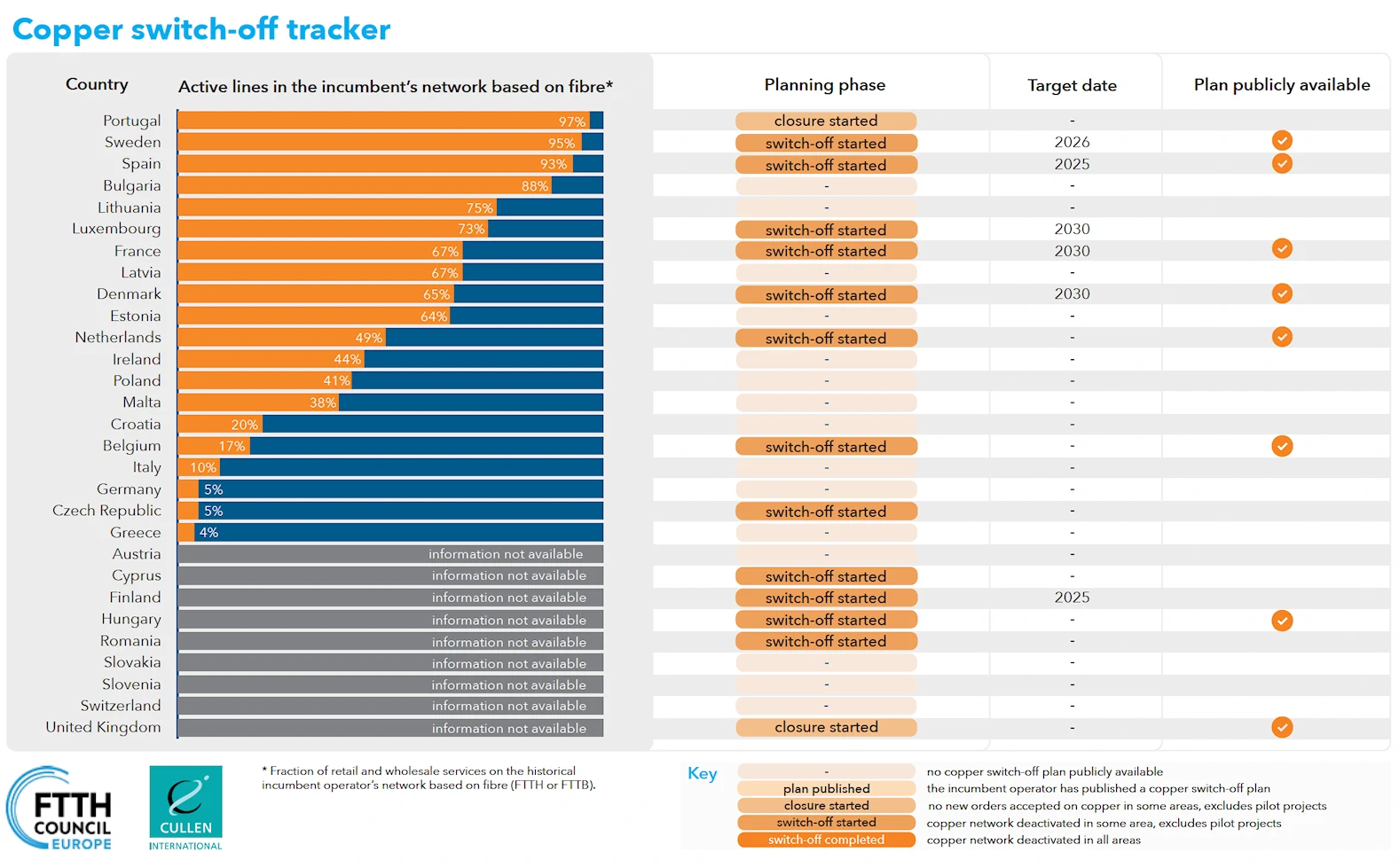
Mobile and broadband operator Sure has today started the process of switching off their old copper line telecoms (phone and broadband) network on the English Channel Island of Guernsey, which comes as the network operator’s roll-out of a new gigabit-capable full fibre (FTTP) network on the island nears imminent completion.

Just to recap. Sure is working alongside the States of Guernsey on a joint £37.5m project (£12.5m of public investment) to build a new Fibre-to-the-Premises (FTTP) network across the whole of Guernsey (30,000+ premises) by the end of 2026 (i.e. end of 2025 for build completion and 2026 for copper retirement).

NOTE: Guernsey is a small island and British Crown dependency in the English Channel, just off the northern coast of France.

The latest update reveals that 93% of homes on the island are now covered by the new full fibre network and 67.7% of properties have already connected to this network (over 20,000 homes), which is up from coverage of 75% and take-up by 15,000 homes at the end of 2024.

As a result, Sure has this week begun the next phase, which involves switching off their old copper line phone and broadband network in stages (this will continue throughout 2026).

Cyrille Joffre, Leader of the Fibre Rollout, said:

“Customers can now enjoy the power of fibre broadband – from working efficiently at home to supporting children’s online learning and streaming their favourite entertainment. Fibre delivers consistently fast, reliable speeds up to 2Gbps, so there are options to suit every home and lifestyle.

The team has worked tremendously hard to deliver a world-class fibre network to the island on time and on budget, and we’re now on the home straight – which is fantastic for Guernsey’s connectivity and customers’ increasingly digital lives.

Switching to fibre is quick and seamless. The old copper network is being retired, so it’s vital that everyone – even landline-only customers – switches to fibre to stay connected.”

Anyone who has not yet switched and is in an area where the copper network is due to be switched-off will receive up to three visits with contact information left if no one is at home. This is closely followed by three letters communicating the imminent copper service cease, the third and final letter being hand-delivered.

Openreach Expand Project Gigabit Broadband Build in Staffordshire and Lancashire UK | ISPreview UK

Original article ISPreview UK:Read More

Network operator Openreach (BT) has issued a progress update on their ongoing roll-out of a new Fibre-to-the-Premises (FTTP) based broadband ISP network in rural parts of Staffordshire and Lancashire (England), which forms part of their Project Gigabit contracts with the government (these entered the construction phase earlier this year).

We’ll start with the usual recap. Over the past 1-2 years Openreach has been selected to deliver all of Project Gigabit’s Cross-Regional (Type C) procurements (here, here and here) via a Single Supplier Framework agreement (here) – currently reflecting £745m in total public subsidy to help upgrade 297,000 premises to full fibre technology in some of the hardest to reach parts of rural England, Scotland and Wales (i.e. premises with no prior access to gigabit connectivity).

NOTE: Project Gigabit aims to help extend gigabit broadband (1000Mbps+) ISP networks to “nationwide” coverage (c.99% of UK premises) by 2032, focusing mostly on the final 10-20% in hard-to-reach areas. Some 88% of premises can already access such a network (here), with Ofcom forecasting a range of 97-98% for May 2027 (here).

The areas covered by these Type C contracts typically reflect locations where no or no appropriate market interest had previously been expressed before to the Government’s umbrella Building Digital UK (BDUK) agency, or areas that have been de-scoped or terminated from a prior plan. Areas like the ones above are often skipped due to being too expensive (difficult) for smaller suppliers. All the other Project Gigabit contracts have gone to smaller alternative networks (altnets).

Openreach actually entered the build phase for their related contracts in Wales, Lancashire, Devon, Wiltshire, Hertfordshire and Staffordshire a few months ago (here). But the operator has today issued a couple of progress updates, which revealed the next batches of locations to be targeted by their ongoing deployment in Staffordshire and Lancashire.

Openreach’s Project Gigabit Progress (Next Locations)

Staffordshire

Openreach engineers are expected to reach more properties in and around Wolseley Bridge, Acton Trussell, Acton Gate, Bednall, Bednall Head, Brocton, Dunston, Dunston Heath, Penkridge, Rodbaston, Stretton, Hatherton, Cannock, Rugeley and Calf Heath.

Lancashire

Openreach engineers are expected to reach more properties in and around Newchurch-in-Pendle, Roughlee, Fence, Barnoldswick, Oswaldtwistle, Great Harwood, Pendleton, West Bradford, Waddington, Twiston, Rimington, Gisburn, Whalley, Trawden, Foulridge, Barrowford, Bracewell, Blackrod, Simonswood, Bickerstaffe, Scarisbrick, Cockerham, Barton, Scorton, Eagland Hill, Woodplumpton, Greenhalgh, Longton, Little Hoole, Hoghton, Bamber Bridge, Chorley, Heath Charnock, Anglezarke, Appley Bridge, Wrightington, Dalton, Skelmersdale and Lathom.

In total, Openreach’s Full Fibre network now reaches more than 340,000 properties across Staffordshire and more than 570,000 properties across Lancashire, although these totals also include their existing commercial deployments and coverage.

Telecoms Minister, Liz Lloyd, said:

“Whether it’s families streaming together, farmers being able to use new technology, or businesses reaching more customers online, this upgrade creates real opportunities for communities across Staffordshire.

By delivering infrastructure that will serve these communities for decades to come, we’re making sure everyone can benefit from the digital world, no matter where they live.”

Kasam Hussain, Openreach Partnership Director, said:

“We’re bringing faster, more reliable broadband to some of the most rural properties in the region and letting local people know what to expect. This is a major infrastructure upgrade, so there will be more engineering teams, equipment and vans around town, and we’re working hard to keep disruption to a minimum.

Wherever possible, we’ll use our existing network of ducts and poles to avoid roadworks, new street furniture and disturbance. But there may be places where we need to install new poles, underground ducts and fibre cables because it’s the only way to make sure households get included in the upgrade.

Openreach is committed to building the best full fibre network, and doing it sustainably is crucial for our business, the communities we serve, and the environment we all share. As part of our ‘Let’s Reach Zero’ strategy, we aim to lower our carbon emissions, use less and waste less material, and protect nature wherever we operate.”

The new service, once live, can be ordered via various ISPs, such as BT, Sky Broadband, TalkTalk, Vodafone and more (Openreach FTTP ISP Choices) – it is not currently an automatic upgrade, although some providers have started to do free automatic upgrades as older copper-based services and lines are slowly withdrawn.

Huawei takes aim at distributed data centre challenges with Xinghe AI Fabric 2.0 | Total Telecom

Original article Total Telecom:Read More

worm's eye-view photography of ceiling

Partner Article 

The solution provides data centre operators a more holistic approach to their entire portfolio, providing unified security and network optimisation

The global data centre (DC) industry is experiencing a surge in investment and expansion, driven by escalating demand for cloud services, AI workloads, and edge computing. Once dominated by vast, centralised hyperscale facilities, the market is now shifting toward a more distributed model that places smaller, strategically located DCs closer to the end user. This strategic shift provides numerous benefits to the customer, providing enabling lower latency, improved resilience, and greater flexibility, but it is not without its challenges.

Running numerous DCs across different regions, each built using equipment from different vendors, is operationally complex. From network optimisation across sites to cybersecurity, managing distributed DCs is costly, and difficult to deploy and maintain.

At the Ultra-Broadband Forum (UBBF), jointly organised by Huawei and the United Nations Broadband Commission, Huawei showcased its answer to these challenges: Xinghe AI Fabric 2.0.

Building for the AI era

Huawei launched its first iteration of AI Fabric back in 2018 – a time when few could have imagined the speed with which the ‘AI era’ was to arrive. Nonetheless, this first release anticipated much of the pressure that AI’s widespread development and deployment would place on the DC industry, focussing on delivering zero packet loss, lower latency, and higher throughput. This provided a strong foundation for AI training, distributed storage, and high-performance computing (HPC).

In 2025, however, simply improving the traditional network is no longer enough. Date centre operators today are looking to AI to help alleviate their biggest pain points: slow deployment, manual operations, and network unreliability.

Solving these problems has been the primary focus of Huawei’s Xinghe AI Fabric 2.0, which combines a variety of AI-powered solutions to improve network security, reliability, and operations and maintenance (O&M).

From fault detection to network optimisation

First among these solutions is Huawei’s StarryWing Digital Map, which is coupled with AI to automate the notoriously complex process of cross-DC network and security provisioning. By integrating security data, this platform dynamically generates a security access matrix, which then automatically recommends policy solutions with 100% accuracy within two minutes. This replaces a previously manual scripting process that would take a typical team two days to complete.

The second element is the introduction of its AI agent, NetMaster. This platform combines four systems – unified detection, network automation, O&M management platform, and traffic visualisation – using over 45 APIs. This allows for natural language orchestration, enabling the automated resolution of 80% of fault tickets and reducing average resolution time by over 90%. This is supported by the AI Eagle Eye Engine, which uses Huawei’s proprietary IFIT (In-situ Flow Information Telemetry) technology to detect and localise faults in seconds, compared to the hours that has long been the norm.

Finally, the Xinghe AI Fabric 2.0 is aiming to dramatically reduce the impact of network outages for DC network operators. It’s Data Plane Crossing Faults (DPCF) technology uses intelligent identification and automatic switching to reduce network fault recovery time from hours to minutes, while its Dynamic Path Fast Recovery (DPFR) technology resolves local failures in just 1ms. Finally, its M-LAG technology focuses on the link itself, using optical module channel protection to improve its reliability ten-fold. Combined, this three-layer approach to outages adds significant resilience, ensuring maximum uptime across deployments.

An automation philosophy: Using AI to support AI

By incorporating AI throughout the platform’s design, DC operators’ networks are increasingly optimised, but also flexible, able to respond quickly and accurately to network faults or cybersecurity incidents without manual oversight. With service demands from enterprise customers, latency-sensitive applications, and AI workloads increasing in prominence, the ability for networks to self-deploy, self-heal, and self-optimise will soon become a necessity.

Ultimately, Xinghe AI Fabric 2.0 is the natural evolution of DC network architecture, representing the latest example of Huawei’s prevailing design philosophy of leveraging AI to support AI, here called ‘AI for Fabric and Fabric for AI’. Huawei is rapidly embracing AI throughout its portfolio, building systems that can self-evolve to meet the changing needs of a rapidly changing AI world.

Also in the news
Connected Britain Award winners 2025 announced!
Netomnia announces ‘powerful and ambitious’ rebrand ahead of Connected Britain
VodafoneThree drops Samsung, relies on Nokia and Ericsson for £2bn network upgrade

The Partnership Paradox: How collaborative infrastructure can accelerate Germany’s fibre future | Total Telecom

Original article Total Telecom:Read More

A patchwork Germany

Viewpoint

Germany stands at a decisive inflection point in its digital infrastructure journey. Fibre rollout is now officially deemed of overriding public interest until 2030 — yet the country’s deployment remains uneven, delayed by fragmented execution, overlapping jurisdictions, and competing incentives.

While billions have been committed and technology keeps improving, progress is constrained by a deeper paradox: the fibre challenge is no longer technical — it’s relational.

This whitepaper argues that Germany’s digital acceleration depends on a new generation of radically interoperable partnerships — where Telco’s, utilities, municipalities, and innovators move beyond competition to build shared value ecosystems.

Drawing from cross-sector case studies, economic modelling, and policy analysis, this paper proposes a “Partnership Compact for Germany 2030”, outlining how collaborative infrastructure can deliver faster rollout, smarter investment, and stronger digital sovereignty. The path forward demands a mind-set shift: from trenching faster to partnering smarter.

The State of Fibre in Germany
Germany’s Fibre Landscape 2025: Progress and Patchwork
Germany’s digital ambitions are clear. The federal government has declared fibre-optic network
expansion to be of overriding public interest until 2030, signalling an unprecedented policy
commitment to closing the connectivity gap. Yet despite this clarity of intent, the reality on the
ground tells a more complicated story.

As of early 2025, only approximately 40% of German households have access to fibre-to-the
home (FTTH) connections. This figure masks significant disparities: while major urban centres
see competitive offerings from multiple providers, rural and semi-rural regions continue to struggle with inadequate coverage. The digital divide is not merely a matter of geography — it reflects deeper structural challenges in how infrastructure is planned, financed, and deployed.

Germany’s telecommunications landscape is uniquely fragmented. Dozens of operators, represented by associations including BREKO (Federal Association of Broadband and Telecommunications), BUGLAS (Federal Association of Carriers and Services), and VATM (Association of Telecommunications and Value-Added Service Providers), are simultaneously building networks across overlapping territories. While this competitive energy has driven innovation and investment, it has also led to inefficiencies: parallel trenching in profitable areas, underinvestment in challenging terrain, and coordination failures that delay projects and inflate costs.

The Partnership Paradox
Here lies the central tension: everyone agrees that cooperation is essential, yet meaningful collaboration remains scarce. Industry roundtables produce consensus statements. Policy forums emphasize coordination. Yet on the ground, competitive instincts, regulatory complexity, and misaligned incentives keep stakeholders working in parallel rather than in partnership.

The irony is stark. Germany has no shortage of capital — public funding schemes, private investment vehicles, and European recovery funds have mobilized billions for digital infrastructure. The technology is mature and proven. The regulatory framework has been clarified. What remains missing is the connective tissue between actors: the trust mechanisms, governance structures, and economic incentives that would enable true collaborative infrastructure at scale.
The real constraint is coordination — not capital or technology.

Research Question
This whitepaper addresses a fundamental challenge: How can Germany unlock collaborative infrastructure models that balance competition, efficiency, and public good? The answer requires moving beyond traditional dichotomies of public versus private, or competition versus monopoly. It demands exploring a third way: structured co-opetition, where operators compete on services while cooperating on infrastructure; where municipalities act as neutral conveners rather than competitors; where data and governance become shared assets that accelerate deployment without compromising commercial differentiation.

The following sections examine the economic rationale for collaboration, draw lessons from adjacent sectors that have navigated similar transitions, propose governance frameworks for shared digital infrastructure, and outline a concrete policy pathway toward a Partnership Compact for Germany 2030.

Download the whitepaper: The Partnership Paradox_Final draft

Join the discussion about Germany’s fibre future in Munich on the 18 – 19 November 2025. Get your ticket here: Connected Germany 2025 | München

Altnet Broadband ISP Lightning Fibre Launches UK Black Friday SALE | ISPreview UK

Original article ISPreview UK:Read More

Eastbourne-based broadband ISP Lightning Fibre, which is building a new multi-gigabit speed full fibre (FTTP) broadband network across parts of Sussex and Kent in England (they also hold a partnership to harness CityFibre’s network around the South Coast – here), has today launched a range of early Black Friday sales on their packages.

Customers covered by the service can now take their entry-level 150Mbps (symmetric speed) package for just £22 per month (reduced from £26) on a 24-month term, while 300Mbps has been reduced to £24 (£28), 500Mbps is now just £26 (£32), 900Mbps is £29 (£36) and their top 2000Mbps package has been slashed to just £35 (£44). All of these include free setup, unlimited data and a wireless router (you get a higher end device on their 900Mbps+ plans).

NOTE: Lightning Fibre was acquired by existing backer Foresight Group in early 2024 and put under a new company called LF Holdco2 Ltd. The same group also backs other altnets, such as Connect Fibre and F&W Networks.

The company also offers an accessible Social Tariff for households in receipt of means tested benefits and pension credits, providing 50Mbps upload and download, guaranteed at the modem, for £15 per month on a rolling 30-day agreement with no credit checks.

The provider’s Chief Commercial Officer (CCO), Rob Reaks, said: “Our Winter Sale is the perfect time for new customers to switch and for existing ones to upgrade at a fantastic price. It runs from 1st November until 31st December.”

The same announcement notes that their sale “coincides with a significant network expansion” via their wholesale agreement with CityFibre, although for some reason they don’t mention precisely what this network expansion covers. The original partnership merely announced expanded coverage across additional premises in Polegate, Eastbourne and Hastings.

Virgin Media O2 Appoint Kate Dohaney as CEO of UK Mobile Provider giffgaff | ISPreview UK

Original article ISPreview UK:Read More

The parent(s) of mobile network operator giffgaff, which is controlled by Virgin Media and O2, have today announced that outgoing Chief Executive Officer (CEO), Ash Schofield, who announced he was stepping down back in July 2025 (here), is to be replaced by Kate Dohaney.

Giffgaff has come a long way since Ash first took it on in 2018 and recently expanded beyond their O2 based virtual operator (mvno) offerings to include a full fibre broadband service (here), which is currently based off nexfibre’s growing FTTP network; but this will eventually be expanded to harness Virgin Media’s existing network too.

Meanwhile, in her early career, Kate held senior leadership roles at News Corp and Dow Jones, before becoming CEO of Orb Group in March 2024, where throughout her tenure she led the modernisation of a global technology platform, securing multi-million-dollar investment and driving triple-digit growth in shareholder value. But the telecoms game is a different kettle of fish, and it will be interesting to see what direction she takes with it.

Kate Dohaney said:

“Being appointed to lead such a dynamic and bold organisation within the UK telecoms sector is a real privilege. giffgaff is known for doing things differently – something I passionately believe in – and I’m excited to get started, driving the next chapter of growth for the business.”

Broadband ISP Gigaclear Kicks Off UK Black Friday Discounts | ISPreview UK

Original article ISPreview UK:Read More

Abingdon-based rural broadband ISP Gigaclear, which covers 612,000 premises (c.160,000 customers) across parts of England via their Fibre-to-the-Premises (FTTP) network, has launched a range of new Black Friday discounts that look set to be available for new customers to order until 2nd December 2025.

The discounted prices now start at £17 per month on an 18-month term for symmetric speeds of 200Mbps, which rises to £19 per month for 469Mbps and £29 for 900Mbps. All packages include a wireless router and free installation, although only their top 469Mbps and 900Mbps tiers also bundle a Smart WiFi Mesh device.

However, new customers should be aware that Gigaclear’s out-of-contract prices will eventually return to £43.50 for 200Mbps, £57 for 500Mbps and £85 for 900Mbps, although discounts can often be agreed for those who may seek to re-contract with the provider at the end of their term.