

Original article ISPreview UK:Read More
A new report from the National Preparedness Commission (NPC), which is said to be an independent and non-political body focused on preparing the country for a major crisis, threats and incidents, has warned that the UK’s proposed plan to switch-off terrestrial TV signals in favour of broadband internet-based streaming “risks … over-concentrating communications on internet-based networks“.
Just to recap. Back in June 2026 the Government proposed a plan (here) to switch-off Digital Terrestrial TV (DTT) signals in either 2034 or 2044 as part of a wider change to reflect the move to internet-based streaming. But the proposals primarily only considered the question of broadcasting policy and didn’t factor in the potential relevance of national resilience.
Funnily enough the Government has previously recognised the broader risk issues attached with an over-dependence upon modern digital infrastructure. For example, the government’s Chronic Risk Analysis assessment states: “Modern infrastructure, ranging from power grids to traffic systems, are deeply reliant on and integrated with digital platforms. Disruptions can lead to catastrophic failures, endangering safety and the economy”.
In short, if the internet goes down, how do you keep a society – one that in the future will have become dependent upon IP-based digital infrastructure – up-to-date without an effective national backup. Obviously, this is very much a worst-case scenario and the internet itself is designed to withstand all sorts of attacks, but it’s a fair point to debate.
Five Key Points of the NPC Report
1. The risk environment has changed.
Recent UK and European incidents, for example the April 2025 Iberian Peninsula blackout that left more than half of Spanish mobile users without service within hoursvii, the March 2025 North Hyde substation fire that closed Heathrow Airport for almost a dayviii, and Storm Éowyn in January 2025 which left around a million homes without power and some communities offline for six days, demonstrate that disruption is no longer exceptional. Worse, interconnectedness of systems means that a single failure frequently cascades across sectors, especially where systems share dependencies on power, the internet, satellites and global software supply chains.2. The UK’s tall tower broadcasting network is a unique, sovereign communications capability that other networks cannot replicate.
The network of more than 1,450 sites – including 16 of the UK’s 20 tallest structures – reaches 98.5% of UK households through a one-to-many architecture that is terrestrial, physically distributed, high-elevation, secure, and self-contained from the internet. Alongside DTT and radio, the tall tower network hosts services used by the emergency services, energy and water companies, and government departments. And the BBC’s FM Rebroadcast Standby Network underpins the Government’s “Go In, Stay In, Tune In” household emergency protocol. Removing DTT would not modernise the UK communications capability, it would narrow it.3. DTT is the anchor use case that sustains the network’s scale, reach and economics – and the policy question is now clear.
The network operates as a shared infrastructure with a fixed cost base that is recovered across all users of the network (Chapter 3 provides more detail on the economics). DTT is by far the largest single user in cost terms, therefore maintaining DTT through 2044 is vital for the economics of other users of the network. Without it the knock-on increase in transmission charges for the radio sector would be around 35%, sufficient to put the range of services available to listeners at risk. 2044 also ensures the economic viability of the network for the many other users, the potential future use cases for the network, and the vital role it plays in providing public information in emergencies. Replicating these services in the absence of the existing network is a multi-billion-pound endeavour, compared to the £80-90 million annual cost to the public service broadcasters (PSBs) of DTT post 2034.4. Resilience policy increasingly prioritises sovereign capability and maintenance of multiple routes for delivering critical services.
Communications policy should do the same. Across government, resilience planning seeks to avoid single points of failure: the electricity grid is designed with redundancy, cash is protected as a fallback when digital payments fail, and the UK is investing in sovereign Positioning, Navigation and Timing capabilities (PNT). Broadcasting and communications policy should reflect the same logic. If households are advised to keep a battery-powered or wind-up radio for use during emergencies, the infrastructure that broadcasts those services should also be protected.5. The growth of internet-based services has brought major benefits, but it has also created new shared dependencies and risks.
Many services now rely on the same underlying infrastructure: electricity networks, broadband and mobile connectivity, data centres, cloud providers and subsea cables. When one part of that system fails, the effects can cascade across multiple services. The National Risk Register 2025 identifies reliance on digital platforms and services as a source of chronic risk. A resilient communications strategy should therefore maintain a terrestrial broadcast layer that remains available when internet-dependent systems are disrupted.
The report concludes by making a series of recommendations, such as calling for the adoption of the 2044 switch-off timeline instead of 2034; including the tall tower network’s resilience value into future government thinking (inc. in future impact assessments); and seeking an independent report to analyse the role the tall tower network “can and should play in hosting and delivering emerging sovereign capabilities“.
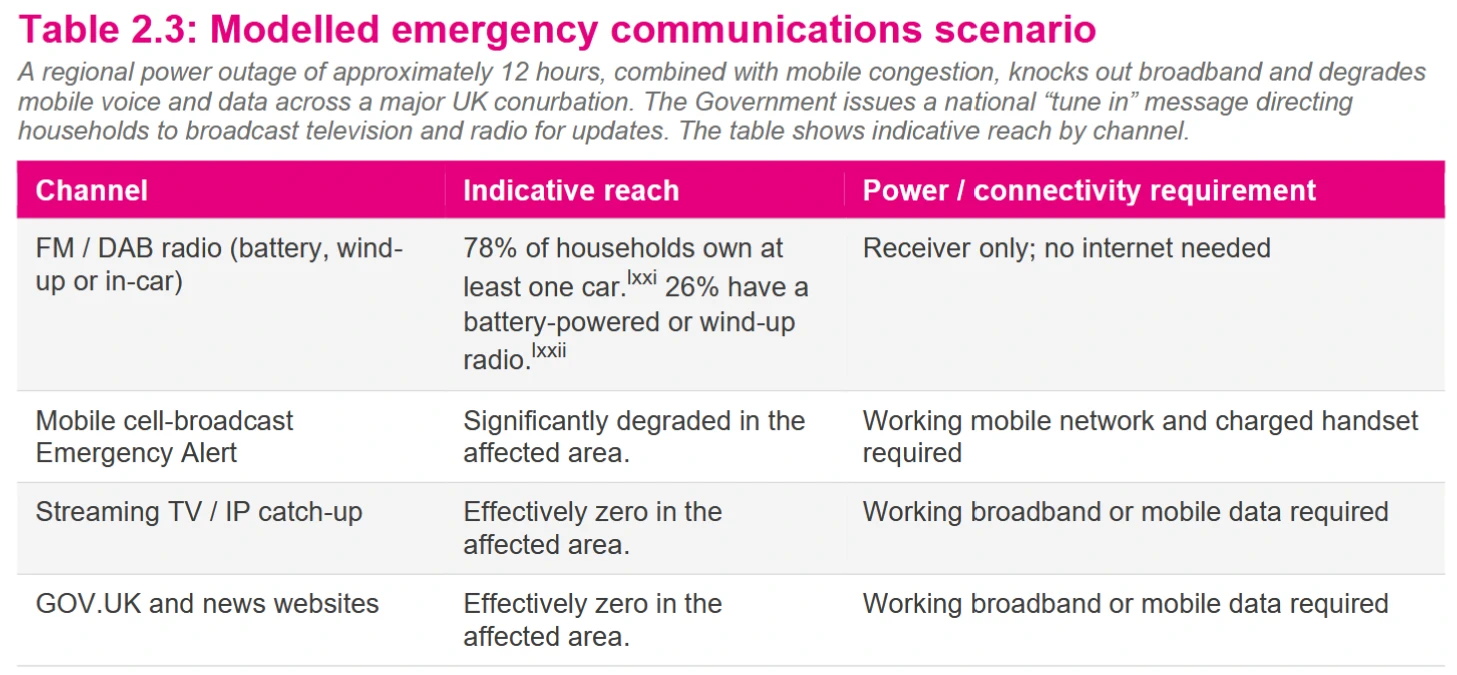
In fairness the UK would still have the cell-broadcast Emergency Alerts service, even in a future dominated by the internet. But the report makes the point that this “is not, by itself, a complete public-warning system” and during tests not all devices were found to be compatible (80% were compatible, although 7% of those didn’t receive the alerts due to other reasons, such as being in aeroplane mode etc.).
“Broadcast radio and television provide the second, structurally distinct route. Both are present in the household whether or not the household has a smartphone, a charged battery, mobile signal or working broadband. Both are capable of reaching the population at the same instant, without congestion or queuing. And both are integrated into existing public-warning “Go In, Stay In, Tune In” guidance. In the moments when an alert is most consequential, having multiple means of communication is not redundancy, it is deliberate strategic capacity,” explained the report.
Finally, there would be the question of cost and who pays for maintaining the old network infrastructure. The report argues that this may be less of an issue than the cost of replicating the value of the existing tall towers network, which would be a multi-billion pound endeavour and “is one that must be compared against the £80-90 million annual cost to the PSBs of retaining DTT post 2034“, said the report.
The resilience case for retaining terrestrial TV and the UK’s tall tower network
https://nationalpreparednesscommission.uk/../NPC_Broadcast2040_When-the-internet-stops.pdf