

Original article ISPreview UK:Read More
A new study from network benchmarking giant Ookla, which collects data from consumers via their popular broadband and mobile Speedtest.net service, has done a deep dive to expose the often hidden ways in which travel eSIMs work and the negative performance impacts (particularly on mobile broadband speeds and latency) this can sometimes have.
In recent years there has been an explosion in travel eSIMs, which despite sometimes being a bit tricky to manage can often be a more cost-effective way of maintaining a mobile phone service while roaming in another country than using the roaming options of your domestic UK provider. But experiences do vary and much also depends on your intended location.
The new report from Ookla goes beyond the surface layer of consumer choice and instead examines how the network routing itself works, as well as some of the caveats this can introduce. According to the research, just a “handful of wholesale networks” underpin most of the market (via over 50 retail brands), with some of the biggest being Hutchison’s networks in Austria and Hong Kong, China Mobile Hong Kong, KPN, Orange, Singtel, Telna, Webbing, Transatel, Proximus, BICS, Plus in Poland, and even Sky in the UK.
However, the route your eSIM traffic must travel to reach the internet isn’t as dependent upon your physical roaming location as you might think, with the data packets often being sent back through a provider’s core network first and that can be based in another country – sometimes even halfway around the world. But it can get even more complicated.
Some brands use a single hub, such as Madrid, London, or Singapore, while others spread traffic across several regional hubs. True local breakout, where traffic exits in the country being visited, is said to remain “uncommon” (unless you buy a local eSIM of course).
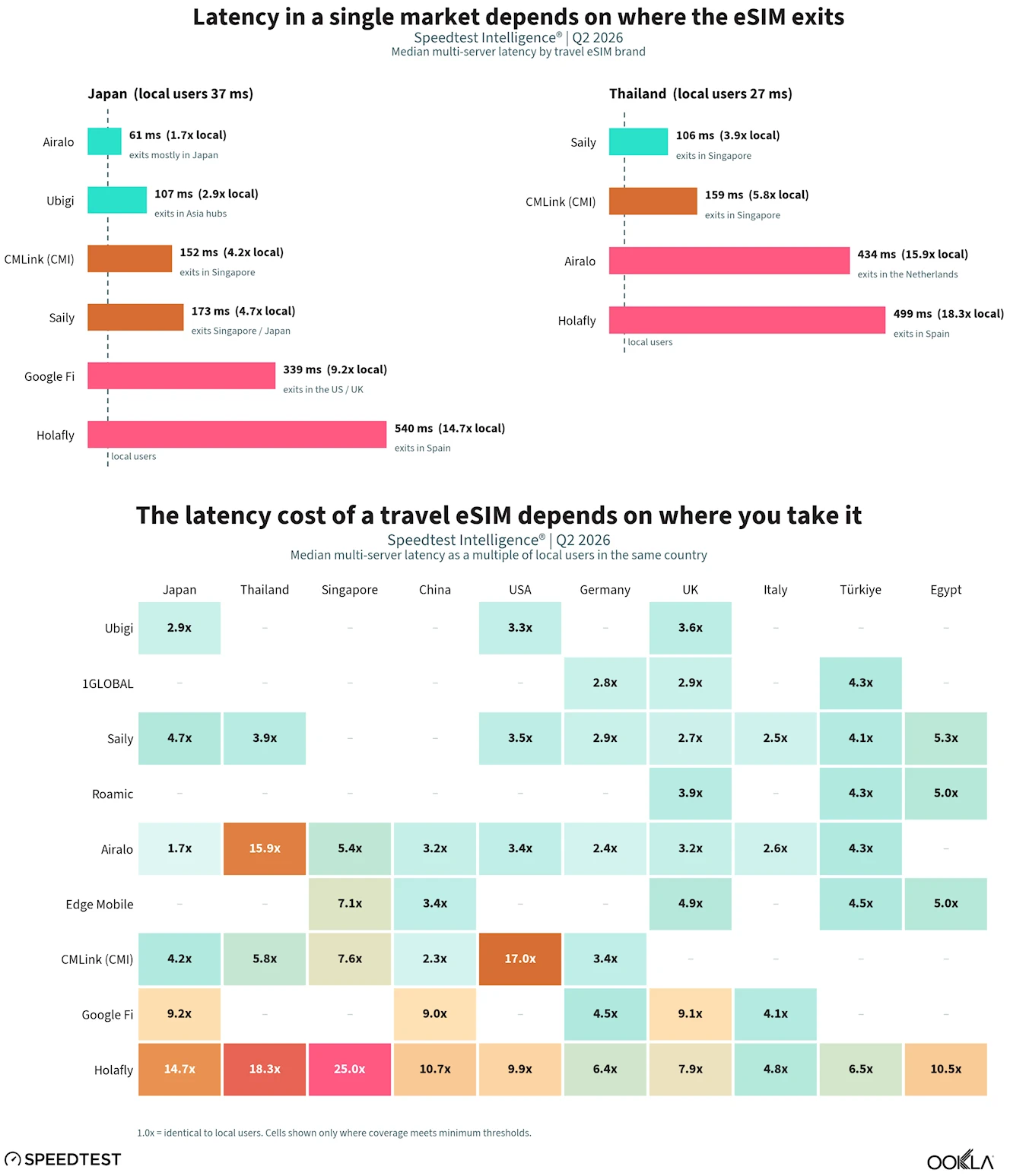
Naturally this kind of complex traffic routing is going to impact network response times like latency (sadly Ookla didn’t look at other factors, such as packet loss). For example, on the same Japanese network, median latency ranged from 54ms (milliseconds) with local routing to 543ms (over half a second!) when traffic was sent through Madrid, despite identical radio conditions. But as above, there’s a lot of variation between eSIM providers, as can be seen below in the examples for Japan and Thailand.
Naturally mobile broadband speeds can also vary between countries due to the different capabilities of various network operators. But in the past, when mobile roaming mostly only happened directly through agreements between domestic operators and the primary network operators in other countries, raw data speeds often weren’t as radically different between local and roaming connections (example).
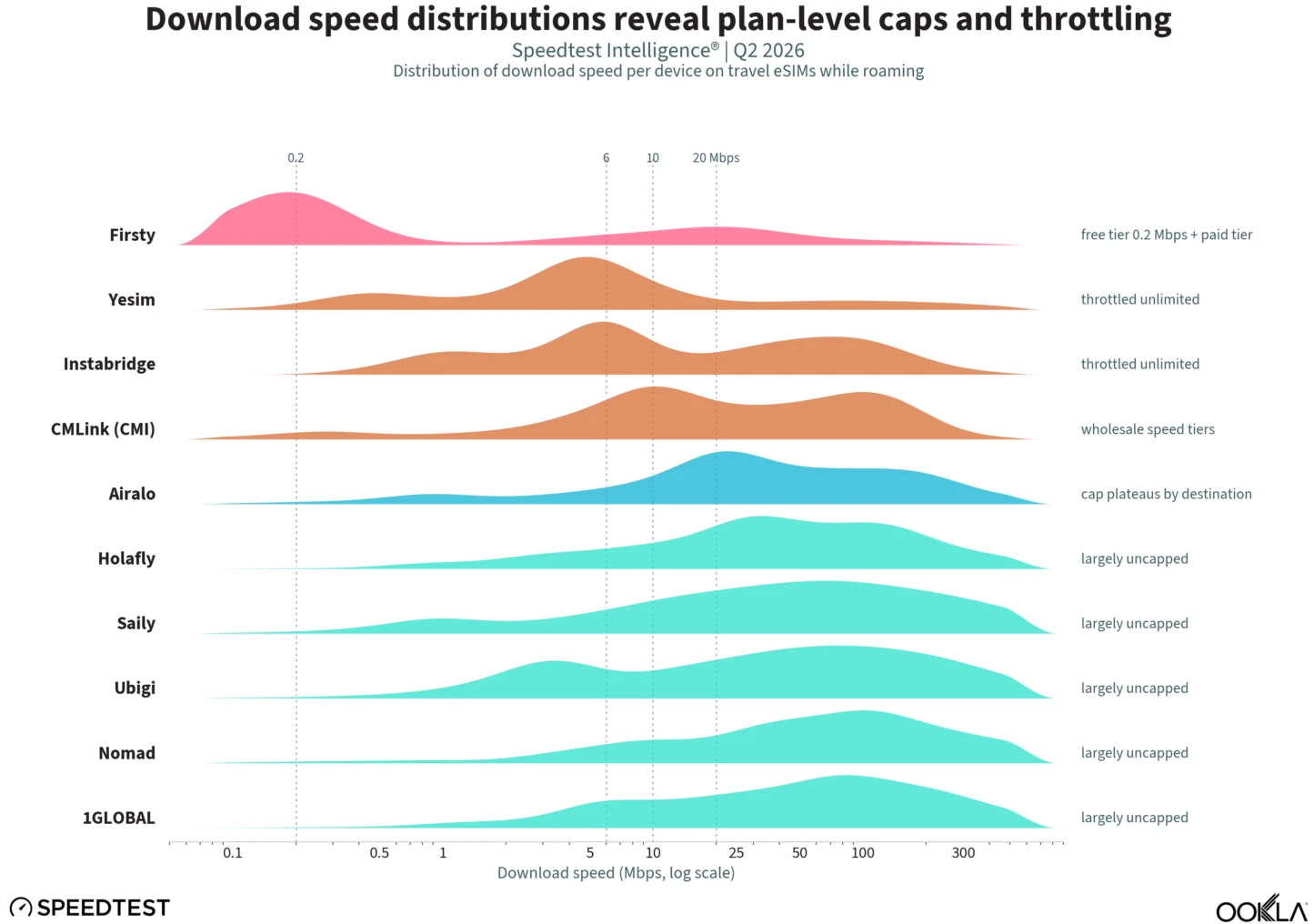
However, the complex network routing of travel eSIMs turns the above expectation on its head, instead showing a much greater performance difference. The download speed distributions on travel eSIMs reveal caps and throttled plans, with one major brand clustering near 6Mbps and a free tier near 0.2Mbps.
For example, Yesim’s global median download speed of 6.03Mbps and Instabridge’s 10.23Mbps point to throttled unlimited plans. Firsty’s free tier was intentionally limited to 0.21Mbps. Airalo reached a global median of 30.11Mbps, but repeated plateaus near 20Mbps across several Asian markets suggest profile-level speed caps in its wholesale agreements or tariff design.
On the flip side, 1GLOBAL (80.21Mbps), Nomad (80.26Mbps), and Ubigi (75.89Mbps) delivered download speed medians that did approach local norms, and Holafly’s 56.87Mbps shows that a hub architecture can still move bulk data quickly even while adding a third of a second to every round trip in terms of latency.
Elsewhere, Ookla found that 5G access appears to be shaped more by commercial agreements than technical limits. Most major brands now connect to 5G in at least half of their samples in Ookla’s data during Q2, led by Ubigi at 62%. Others remain largely 4G-based, with 5G shares of just 20% to 36%, suggesting that wholesale 5G access has not been secured in every market, especially for smaller players.
One crucial thing to remember in all this is that what we see today will vary tomorrow, not least because Ookla found that the wholesale market underpinning travel eSIM brands is “constantly shifting“, which can impact performance (latency and mobile broadband speed) as network relationships and hub sites change.
For example, Saily, which entered the market on rented wholesale anchors, stood up its own registered network in late 2025 and now runs 95% of its measured samples through its own distributed core, a move that coincided with the strongest latency profile among the large brands in Ookla’s data.
The full report is worth a read and Ookla concludes that the “best travel eSIM for a given trip is the one whose exit door is closest to the destination“. The only problem with this is that regular consumers have almost no prior visibility of this changeable chain, until you’re actually connected to the service. Instead, if you want the best performance, then we’d say it’s often better to buy a local eSIM for your country of destination (assuming they’re available).